- 176 pages
- English
- ePUB (mobile friendly)
- Available on iOS & Android
eBook - ePub
About this book
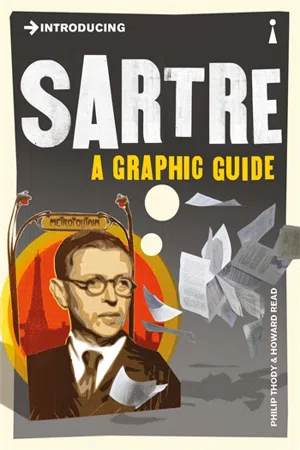
INTRODUCING guide to the father of existentialism and one of 20th century philosophy's most famous characters. Jean-Paul Sartre was once described as being, next to Charles de Gaulle, the most famous Frenchman of the 20th century. Between the ending of the Second World War in 1945 and his death in 1980, Sartre was certainly the most famous French writer, as well as one of the best-known living philosophers. Introducing Sartre explains the basic ideas inspiring his world view, and pays particular attention to his idea of freedom. It also places his thinking on literature in the context of the 20th century debate on its nature and function. It examines his ideas on Marxism, his enthusiasm for the student rebellion of 1968, and his support for movements of national liberation in the Third World. The book also provides a succinct account of his life, and especially of the impact which his unusual childhood had on his attitude towards French society.
Information
Topic
PhilosophySubtopic
Philosopher BiographiesExistentialism
“Europe now philosophizes with hammer blows”, Friedrich Nietzsche (1844–1900) prophetically wrote. One of those who hit hardest in the 20th century was Jean-Paul Sartre. His own philosophy of Existentialism has its starting-point in a statement from his best-known novel, Nausea (1938).
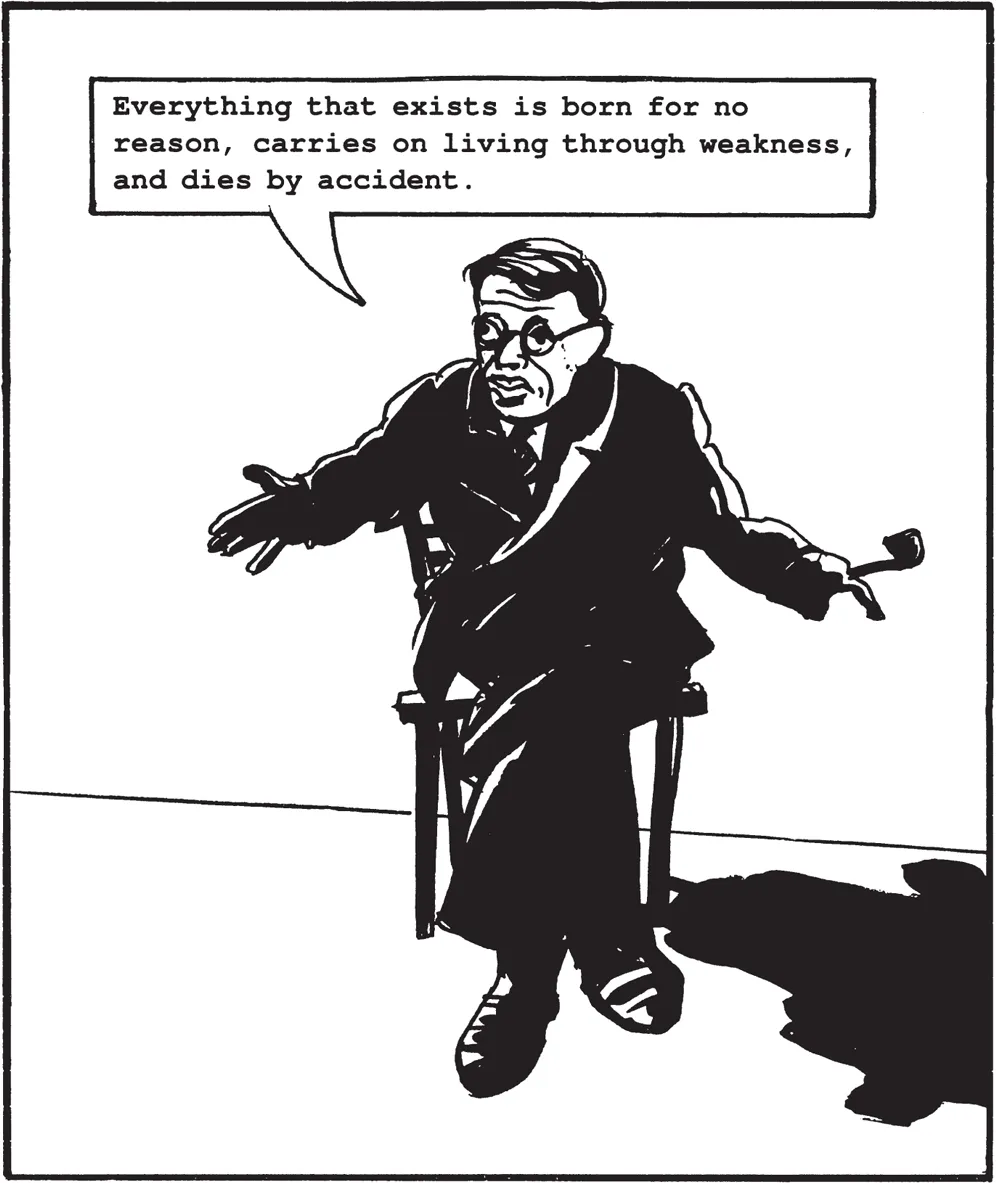
Everything that exists is born for no reason, carries on living through weakness, and dies by accident.
Existentialism, a way of looking at experience which Sartre made famous, was the attempt to draw all possible conclusions from the fact that there is no God. “Man”, he wrote in 1943, “is a useless passion”. But he is also “condemned to be free”.
The Early Years
Jean-Paul Sartre, the French philosopher, playwright, novelist, essayist and political activist, was born in Paris on 21 June 1905. His mother, née Anne-Marie Schweitzer, was 23 years old, and his father, Jean-Baptiste, the son of a country doctor, 31.
On 17 September 1906, Jean-Baptiste Sartre, a naval officer, died of a fever contracted in Cochinchina.
His widow, without means of earning her own living, had to go back to live with her family.

From 1913, I practised as a missionary doctor in the hospital I founded at the jungle village of Lambaréné in Gabon, Africa.
Sartre’s origins, like those of Roland Barthes (1915–80), are Protestant, and this might explain his sense of being an outsider in a largely Catholic France. His maternal grandfather Charles Schweitzer was uncle to the famous Bach scholar, musician, theologian and Christian missionary Albert Schweitzer (1875–1965).
In 1963, Sartre published a biographical essay, Les Mots (Words). It tells the story of what he presented as a lonely and unhappy childhood, isolated from other children.

I was kept at home because of the selfish and possessive attitude of my grandfather, Charles Schweitzer.
In 1917, his mother remarried, choosing as her second husband an old admirer, Joseph Mancy.
We know little of this second husband, with whom Sartre did not get on, except that he had earlier not seen himself as capable of offering Anne-Marie the kind of lifestyle which he thought she deserved.

Now that I began to make a career for myself as an engineer, I proposed marriage and took Anne-Marie and her son to live with me in La Rochelle.
For the first time in his life, in La Rochelle, Sartre began to go regularly to school. Once at school, perhaps understandably, Sartre did not get on well with his fellow pupils.
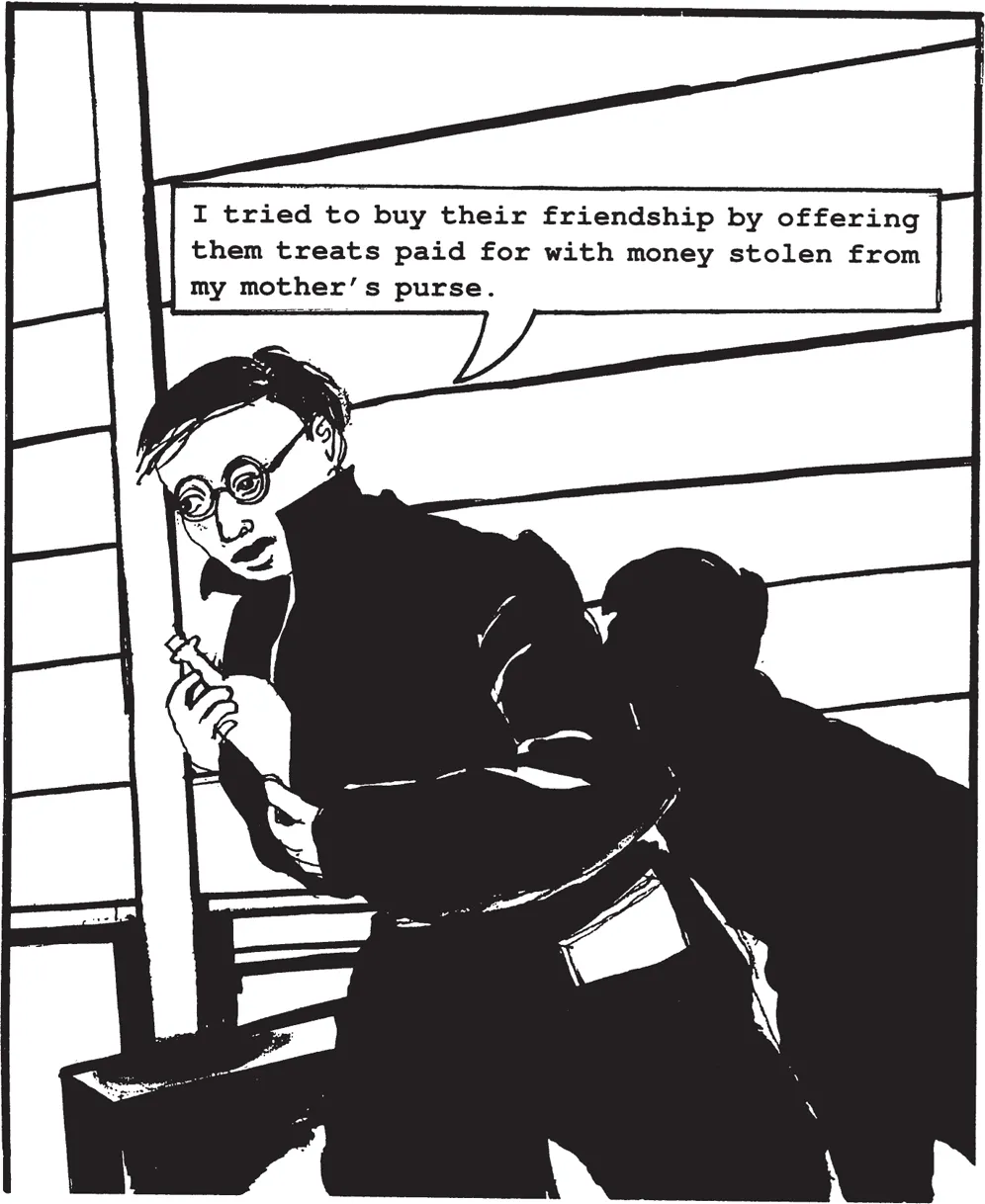
I tried to buy their friendship by offering them treats paid for with money stolen from my mother’s purse.
Academically, however, he had few problems, apart from a reluctance to concentrate on the mathematics which his stepfather saw as essential to the career as an engineer which he wished to see him follow. Joseph Mancy did not himself enjoy a particularly successful career and actually went bankrupt.
In 1920, Sartre returned to Paris to study first at the prestigious lycée Henri IV, then the lycée Louis le Grand, a school with a high success rate in preparing students for the competitive examinations required for entry into one of the grandes écoles. In 1924, he competed successfully to enter the École Normale Supérieure, the most famous of all French institutes of higher education for the study of literature and philosophy, and he stayed till 1928.

I became very critical of French society and the highly élitist system in which I was being educated.
The principal function of the École Normale Supérieure was to prepare students for the competitive examination known as the Agrégation, the essential step in any successful teaching career in France. Candidates successful in this examination enjoy higher pay and shorter hours of work than their less well-qualified colleagues. Then, as now, all pupils in the higher forms of the lycées were required to study philosophy.

It is my aim to become a philosophy teacher.
After having, to everyone’s surprise, failed at his first attempt at the Agrégation de philosophie in 1928, Sartre was more successful in 1929. He came first, followed in the competition, in second place, by Simone de Beauvoir.
The Beaver
Simone de Beauvoir (1908–86) later wrote of her feelings for Sartre at this time in the first volume of her autobiography, Memoirs of a Dutiful Daughter (1958).

I met “the Beaver” earlier in 1929 at the Sorbonne.
I knew when I left him to go home at the end of that academic year that he would never be out of my life.
I knew when I left him to go home at the end of that academic year that he would never be out of my life.
Although Sartre and “the Beaver” (his nickname for her) never married, they would indeed become lifelong partners.
Military Service
Before Sartre could take up the teaching post to which he was now entitled, he had to do his military service. It is an indication of what the French call la dénatalité française (an undesirably low birth-rate) that although Sartre was virtually blind in his left eye, he was not exempted on medical grounds and was called up again at the outbreak of the Second World War in 1939. Like a million-and-a-half other French soldiers, he was taken prisoner in the summer of 1940.
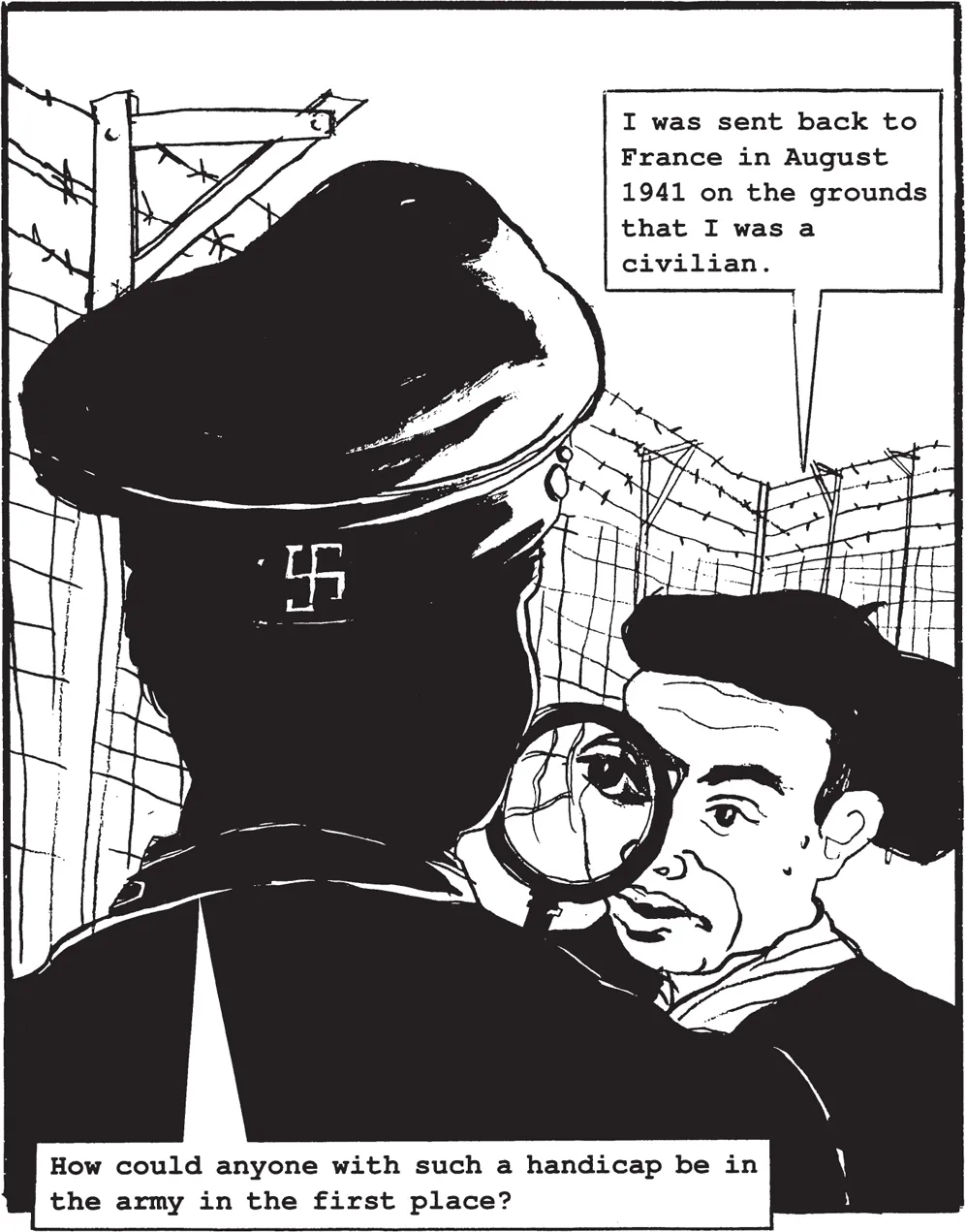
I was sent back to France in August 1941 on the grounds that I was a civilian.
How could anyone with such a handicap be in the army in the first place?
How could anyone with such a handicap be in the army in the first place?
Sartre was not, however, either in 1929 or in 1939, expected to be a fighting soldier, and was put into the meteorological section. By an odd coincidence, his instructor was another French philosopher whom he already knew, Raymond Aron (1905–83).

We had been students together at the École Normale Supérieure.
But our careers and intellectual development would radically diverge.
But our careers and intellectual development would radically diverge.
In a way later resumed by the remark current in intellectual circles in Paris in the 1980s, it was better to be “wrong with Sartre rather than right with Aron”.
Diverging Paths to Freedom
It is interesting at this early stage to remark on the “forks” in the road t...
Table of contents
- Cover
- Title Page
- Copyright
- Contents
- Existentialism
- Notes and Further Reading
- Index
- Acknowledgements
- The Authors
Trusted by 375,005 students
Access to over 1.5 million titles for a fair monthly price.
Study more efficiently using our study tools.
Frequently asked questions
Yes, you can cancel anytime from the Subscription tab in your account settings on the Perlego website. Your subscription will stay active until the end of your current billing period. Learn how to cancel your subscription
No, books cannot be downloaded as external files, such as PDFs, for use outside of Perlego. However, you can download books within the Perlego app for offline reading on mobile or tablet. Learn how to download books offline
Perlego offers two plans: Essential and Complete
- Essential is ideal for learners and professionals who enjoy exploring a wide range of subjects. Access the Essential Library with 800,000+ trusted titles and best-sellers across business, personal growth, and the humanities. Includes unlimited reading time and Standard Read Aloud voice.
- Complete: Perfect for advanced learners and researchers needing full, unrestricted access. Unlock 1.5M+ books across hundreds of subjects, including academic and specialized titles. The Complete Plan also includes advanced features like Premium Read Aloud and Research Assistant.
We are an online textbook subscription service, where you can get access to an entire online library for less than the price of a single book per month. With over 1.5 million books across 990+ topics, we’ve got you covered! Learn about our mission
Look out for the read-aloud symbol on your next book to see if you can listen to it. The read-aloud tool reads text aloud for you, highlighting the text as it is being read. You can pause it, speed it up and slow it down. Learn more about Read Aloud
Yes! You can use the Perlego app on both iOS and Android devices to read anytime, anywhere — even offline. Perfect for commutes or when you’re on the go.
Please note we cannot support devices running on iOS 13 and Android 7 or earlier. Learn more about using the app
Please note we cannot support devices running on iOS 13 and Android 7 or earlier. Learn more about using the app
Yes, you can access Introducing Sartre Introducing Sartre by Philip Thody,Howard Read in PDF and/or ePUB format, as well as other popular books in Philosophy & Philosopher Biographies. We have over 1.5 million books available in our catalogue for you to explore.