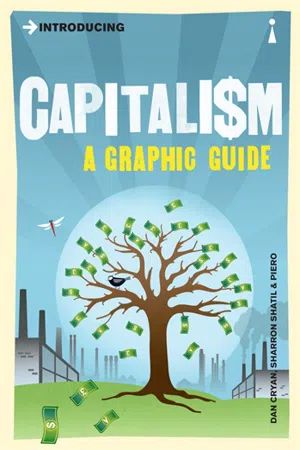
Capitalism now dominates the globe, both in economics and ideology, shapes every aspect of our world and influences everything from laws, wars and government to interpersonal relationships.Introducing Capitalism tells the story of its remarkable and often ruthless rise, evolving through strife and struggle as much as innovation and enterprise.
Dan Cryan and Sharron Shatil, with Piero's brilliant graphics, cover the major economic, social and political developments that shaped the world we live in, such as the rise of banking, the founding of America and the Opium Wars.The book explores the leading views for and against, including thinkers like Adam Smith, Karl Marx, Theodor Adorno and Milton Friedman, the connections between them and their historical context.
Few ideas have had as much impact on our everyday lives as capitalism.
Introducing Capitalism is the essential companion.
eBook - ePub
Introducing Capitalism Introducing Capitalism
A Graphic Guide
- 176 pages
- English
- ePUB (mobile friendly)
- Available on iOS & Android
eBook - ePub
Introducing Capitalism Introducing Capitalism
A Graphic Guide
About this book
Information
Topic
CommerceSubtopic
Commerce GénéralIndex
Adorno, Theodor ref 1, ref 2
anarchism ref 1
antithesis ref 1
Bakunin, Mikhail ref 1, ref 2
banking history ref 1, ref 2
Bentham, James ref 1, ref 2
British East India Company ref 1
capital ref 1
Catholic ethics ref 1, ref 2
Chartists ref 1
Chiang Kai-shek ref 1
China ref 1, ref 2, ref 3
Chydenius, Anders ref 1
circulation of money ref 1
civil government ref 1
class struggle ref 1
communism ref 1, ref 2
consumer culture ref 1, ref 2
consumption ref 1, ref 2
Crusades ref 1
cultural effects ref 1
cycles of capitalism ref 1
Debord, Guy ref 1, ref 2
democracy ref 1, ref 2
depressions ref 1, ref 2
Dickens, Charles ref 1, ref 2
difference principle ref 1, ref 2
directional history ref 1
Dutch East India Company ref 1
Engels, Friedrich ref 1
expansionism ref 1, ref 2
fascism ref 1
feudalism ref 1, ref 2
Ford, Henry ref 1, ref 2
Frankfurt School ref 1, ref 2
free trade ref 1, ref 2, ref 3
freedom, pleasures of ref 1
Friedman, Milton ref 1, ref 2
Fukuyama, Francis ref 1, ref 2
Germany rise ref 1, ref 2
Great Depression ref 1, ref 2
Great Famine ref 1
Hegel, G.W.F. ref 1, ref 2, ref 3
Heidegger, Martin ref 1, ref 2
historical materialism ref 1
history, ...
Table of contents
- Cover
- Title Page
- Copyright
- Contents
- Capital and Capitalism
- Capitalism vs. Feudalism
- The Crusades
- The Knights Templar
- Dissolution of the Templars
- Opening up the Trade Routes
- Expansionism
- The Birthplace of Capitalism
- The Dutch East India Company
- English Pirates
- The Power of Private Investment
- Hobbes, the First Capitalist Thinker
- The Power of the Individual
- The State of Nature
- Leviathan, and the Social Contract
- Natural Reason and Private Property
- Labour = Ownership?
- Locke and Civil Government
- Locke and Colonialism
- The Wealth of Nations
- Self-interest
- The Invisible Hand
- Specialization of Skills
- Free Trade
- The Scottish Enlightenment
- The Slave Trade
- The Rothschilds
- Industrialization
- The Opium Wars
- The Rise of Social Sciences
- David Ricardo
- The Cost of Labour
- The Workers’ Straitjacket
- John Stuart Mill
- Utilitarianism
- The Pleasures of Freedom
- Rules of Nature and Society
- Distribution of Wealth
- Supply and Demand
- Humane Capitalism?
- Life in the Slums
- The Great Famine
- Movements for Reform
- The Chartists
- The Birth of Socialism
- Control of the Means of Production
- Bakunin and Anarchism
- Marx, the anti-Utopian
- Marx and Hegel
- Resolving the Contradictions
- Thesis–Antithesis–Synthesis
- The End of History?
- Historical Materialism
- The History of Class Struggles
- Das Kapital
- Value = Human Labour
- Surplus Value
- Marx’s Prediction
- Capitalism Without Imperialism
- The Rise of the US and Germany
- The Production Line
- The “Empires of Trade”
- The Roaring Twenties
- The Crash and the Great Depression
- The New Deal
- Keynes and Liberal Economics
- A Healthy Circulation
- The Cycles of Capitalism
- Beating Inflation
- Fighting Depression
- State Capitalism
- “Economic Miracles”
- The Marshall Plan
- Monetarism vs. Keynesianism
- How to Ensure Rising Consumption?
- Cultural Effects of Capitalism
- Max Weber and the Protestant Spirit
- Catholic and Protestant Ethics
- The Rise of Rationality
- Making Organizations Work for People
- Neo-Marxism and the Frankfurt School
- The Adoration of the New
- Unmasking Consumer Culture
- Adorno and the Media
- The Construction of Consciousness
- Seeing Beyond the System
- The Situationists
- Debord and the Spectacle
- Every Choice a Pseudo-choice
- Right-wing Critiques of Capitalism
- Knowing Your Place
- Liberty and Difference
- Nozick and Right-wing Libertarianism
- Taxation as Forced Labour?
- Fukuyama and the End of History
- Directional History
- The Struggle for Recognition
- Challenging the Free Market
- The Developing World: Free Trade …?
- … or State Capitalism?
- Islam and Capitalism
- Sharia Banking
- Bursting the Bubble
- Further Reading
- Acknowledgements
- About the Author
- Index
Trusted by 375,005 students
Access to over 1.5 million titles for a fair monthly price.
Study more efficiently using our study tools.
Frequently asked questions
Yes, you can cancel anytime from the Subscription tab in your account settings on the Perlego website. Your subscription will stay active until the end of your current billing period. Learn how to cancel your subscription
No, books cannot be downloaded as external files, such as PDFs, for use outside of Perlego. However, you can download books within the Perlego app for offline reading on mobile or tablet. Learn how to download books offline
Perlego offers two plans: Essential and Complete
- Essential is ideal for learners and professionals who enjoy exploring a wide range of subjects. Access the Essential Library with 800,000+ trusted titles and best-sellers across business, personal growth, and the humanities. Includes unlimited reading time and Standard Read Aloud voice.
- Complete: Perfect for advanced learners and researchers needing full, unrestricted access. Unlock 1.5M+ books across hundreds of subjects, including academic and specialized titles. The Complete Plan also includes advanced features like Premium Read Aloud and Research Assistant.
We are an online textbook subscription service, where you can get access to an entire online library for less than the price of a single book per month. With over 1.5 million books across 990+ topics, we’ve got you covered! Learn about our mission
Look out for the read-aloud symbol on your next book to see if you can listen to it. The read-aloud tool reads text aloud for you, highlighting the text as it is being read. You can pause it, speed it up and slow it down. Learn more about Read Aloud
Yes! You can use the Perlego app on both iOS and Android devices to read anytime, anywhere — even offline. Perfect for commutes or when you’re on the go.
Please note we cannot support devices running on iOS 13 and Android 7 or earlier. Learn more about using the app
Please note we cannot support devices running on iOS 13 and Android 7 or earlier. Learn more about using the app
Yes, you can access Introducing Capitalism Introducing Capitalism by Dan Cryan,Sharron Shatil,Piero,Piero Pierini in PDF and/or ePUB format, as well as other popular books in Commerce & Commerce Général. We have over 1.5 million books available in our catalogue for you to explore.