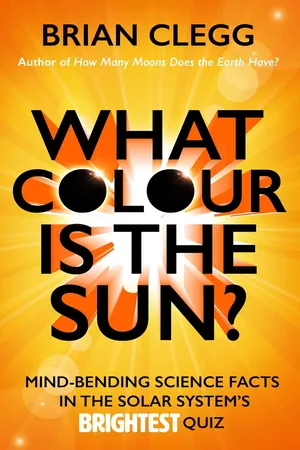
Why do your fingers go wrinkly in the bath? What kind of animal can have 21 limbs? Who would really win a fight between a T.Rex and Godzilla?
Test your knowledge of all things scientific with the biggest, brightest and most mind-bending quiz book this side of the Big Bang. Featuring 100 brain-melting Q&As, with enlightening explanations provided throughout, this is the ultimate examination of what you know about space, chemistry, quantum physics, science fiction and much more.
The ideal bathwater temperature is generally agreed to be around 38°C (100°F) – just over body temperature.
The skin on hands and feet reacts quite differently in a bath than does skin elsewhere on the body.
Skin is waterproof, yet surprisingly it wasn’t until 2012 that it was discovered how the waterproofing worked. It’s down to a layer of fat molecules called lipids with two water-repelling tails. Usually these molecules have the tails pointing in the same direction, but in the skin they point in opposite directions and are stacked together in a way that maximises waterproofing.
To give a better grip in the wet
We’ve all seen how the skin on our hands and feet goes wrinkly in the bath, and it’s common to assume that this is because the skin takes in water – but the hands and feet are just as waterproof as the rest of the body. Instead this is a nervous system reflex that scientists speculate is to give a better grip in wet conditions.
It has been known for 80 years that the wrinkling is not about taking on water. One key indicator is that it doesn’t take place if there is nerve damage in the locations where the skin wrinkling takes place, indicating that it is an action of the central nervous system. But it was only in 2011 that it was suggested that this reflexive action has a use – that it may have evolved because it proved valuable.
This was because wrinkly fingers and toes do have a practical benefit. They act like the indentations in a car tyre. Tyres have the best grip in the dry if they are slick, without any tread. But in the wet, the contoured surface of a road tyre provides channels for water to be taken away from the interface between the tyre and the tarmac, improving grip. Similarly, the wrinkles in our hands and feet work effectively to carry away water that would otherwise reduce our grip in the wet.
This hypothesis was tested by getting participants to pick up objects like marbles in both dry and wet conditions. When the hands were wet and had gained their wrinkling, they were better at picking up wet marbles than dry, wrinkle-free hands, but there was no difference when picking up dry marbles. The wrinkles, it seems, are human tyre treads for hand grip and to make it less likely we will fall over on wet surfaces.
Further reading: Nature Wrinkly
QUESTION 2
Asparagus pee
Some people don’t find their urine smelly after eating asparagus. Is this because they don’t produce the relevant chemical, or because they can’t smell it?
Answer overleaf
While you’re thinking …
We smell something when chemical molecules lock into olfactory receptors – cells at the back of the nose that have special proteins on their tips to accommodate specific molecular forms.
A human has around 450 olfactory receptors, about half the number that a dog has in its nose.
Women are generally better in smell-based tests than men. It has been suggested that this might be due to their having more cells (typically over 40 per cent more) in a region of the brain called the olfactory bulb, which is involved in processing the sense of smell.
It seems to be both (probably)
It has long been known that eating asparagus makes wee smell strange – but not why some people can’t detect the odour. There is still dispute over the detail, with some scientists claiming that everyone produces the distinctively scented urine after eating and that the variation comes entirely from whether or not our noses can detect it. But it seems likely that some of us don’t produce the chemical cocktail responsible for the smell and that others can’t detect it, even when it is definitely present. It doesn’t help that we aren’t totally sure which chemicals are behind the odour, though a compound called methanethiol is a prime suspect.
One of the reasons there is a dispute is that there have been significant variations in the results studies have produced, with the percentage who produce the strange-smelling urine found to be around 50 per cent in some studies and as much as 90 per cent in others. (It has been suggested that the variation may reflect a regional genetic variation.) Similarly, tests looking for the ability to detect the distinctive smell have produced results varying from 10 per cent to practically the entire population.
It’s not unusual for different studies to produce different results. Whenever a scientific test depends on humans describing a response, there is inevitably inaccuracy – and there may be genetic variations in populations around the world. But it is unusual to find such a distinctive split on whether or not something is happening at all. Asparagus is yet to fully give up its secrets.
Further reading: BBC Future – Asparagus
QUESTION 3
Does this bug you?
Is a bug a beetle?
Answer overleaf
While you’re thinking …
New beetles are being found all the time. In 2016, 24 new species of weevil were discovered in a single Australian collection alone.
The original Volkswagen Beetle car (properly the ‘Volkswagen Typ 1’) was often known as the Volkswagen Bug in the USA.
The ladybird, known as a ladybug in the USA, is a beetle.
No, a bug is not a beetle
Although the term ‘bug’ is used very loosely for practically any creepy-crawly (even as a term for a bacterial or viral infection), it actually has a very specific meaning. Both bugs and beetles are insects, but bugs are of the order Hemiptera and beetles are Coleoptera.
Practically speaking, there are two big differences between the two – in the mouth and the wings. A bug has a beak-like sucker of a mouth, ideal to suck the juices out of a plant – aphids, for instance, are bugs – or to suck dry a prey insect (or, in something like a bed bug, which is a true bug, to extract the blood from a human). By contrast, a beetle has a more conventional ‘chewing’ mouth for dealing with solid foods.
As for the...
Table of contents
Copyright Page
Dedication
Contents
About the author
Acknowledgements
Introduction
Quiz 1, Round 1: Biology
Quiz 1, Round 2: History of Science
Quiz 1, Round 3: Technology
Quiz 1, Round 4: Mathematics
Quiz 1, Round 5: Physics
Quiz 1, Round 6: Pot Luck
Quiz 1, First Special Round: An Elementary Message
Quiz 1, Second Special Round: Telescopic Knowledge
Quiz 2, Round 1: All in the Mind
Quiz 2, Round 2: Science Fiction
Quiz 2, Round 3: Miscellany
Quiz 2, Round 4: Space
Quiz 2, Round 5: Quantum Stuff
Quiz 2, Round 6: Chemistry
Quiz 2, First Special Round: Daisy Chain
Quiz 2, Second Special Round: Unreal Scientists
Further reading
Back Cover
Trusted by 375,005 students
Access to over 1.5 million titles for a fair monthly price.
Study more efficiently using our study tools.
Frequently asked questions
Yes, you can cancel anytime from the Subscription tab in your account settings on the Perlego website. Your subscription will stay active until the end of your current billing period. Learn how to cancel your subscription
No, books cannot be downloaded as external files, such as PDFs, for use outside of Perlego. However, you can download books within the Perlego app for offline reading on mobile or tablet. Learn how to download books offline
Perlego offers two plans: Essential and Complete
Essential is ideal for learners and professionals who enjoy exploring a wide range of subjects. Access the Essential Library with 800,000+ trusted titles and best-sellers across business, personal growth, and the humanities. Includes unlimited reading time and Standard Read Aloud voice.
Complete: Perfect for advanced learners and researchers needing full, unrestricted access. Unlock 1.5M+ books across hundreds of subjects, including academic and specialized titles. The Complete Plan also includes advanced features like Premium Read Aloud and Research Assistant.
Both plans are available with monthly, semester, or annual billing cycles.
We are an online textbook subscription service, where you can get access to an entire online library for less than the price of a single book per month. With over 1.5 million books across 990+ topics, we’ve got you covered! Learn about our mission
Look out for the read-aloud symbol on your next book to see if you can listen to it. The read-aloud tool reads text aloud for you, highlighting the text as it is being read. You can pause it, speed it up and slow it down. Learn more about Read Aloud
Yes! You can use the Perlego app on both iOS and Android devices to read anytime, anywhere — even offline. Perfect for commutes or when you’re on the go. Please note we cannot support devices running on iOS 13 and Android 7 or earlier. Learn more about using the app
Yes, you can access What Colour is the Sun? by Brian Clegg in PDF and/or ePUB format, as well as other popular books in Biological Sciences & Science General. We have over 1.5 million books available in our catalogue for you to explore.