'A kind of epic poem, one that moves in circular fashion from passionate denunciation to intense autobiographical reflection ... should be required reading for every MP, peer, councillor, civil servant and commentator. The fury and sense of powerlessness that so many people feel at government policy beam out of every page.'
The Guardian
'It is not enough to read Harry's record of the struggles and hopes of a generation – we have to re-assert his principles of common ownership and the welfare state. If Harry can do it, we should too!' Ken Loach, Director of
I, Daniel Blake
'As one of the last remaining survivors of the Great Depression and the Second World War, I will not go gently into that good night. I want to tell you what the world looks like through my eyes, so that you can help change it…'
In November 2013, 91-year-old Yorkshireman, RAF veteran and ex-carpet salesman Harry Leslie Smith's Guardian article – 'This year, I will wear a poppy for the last time' – was shared over 80,000 times on Facebook and started a huge debate about the state of society.
Now he brings his unique perspective to bear on NHS cutbacks, benefits policy, political corruption, food poverty, the cost of education – and much more.
From the deprivation of 1930s Barnsley and the terror of war to the creation of our welfare state, Harry has experienced how a great civilisation can rise from the rubble. But at the end of his life, he fears how easily it is being eroded.
Harry's Last Stand is a lyrical, searing modern invective that shows what the past can teach us, and how the future is ours for the taking.
'Smith's unwavering will to turn things around makes for inspirational reading.'
Big Issue North
'[With] sheer emotional power ... Harry Leslie Smith reminds us what society without good public services actually looks and feels like.'
New Statesman
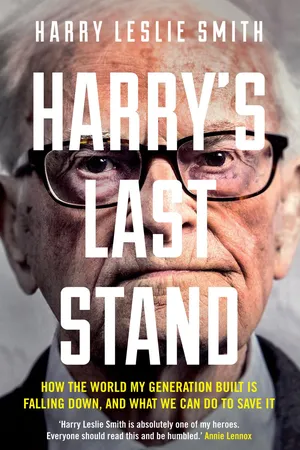
eBook - ePub
Harry's Last Stand
How the world my generation built is falling down, and what we can do to save it
- 192 pages
- English
- ePUB (mobile friendly)
- Available on iOS & Android
eBook - ePub
Harry's Last Stand
How the world my generation built is falling down, and what we can do to save it
About this book
Information
Everything Old is New Again
I. Education
Déjà vu, translated as ‘already seen’, is the phenomenon of having the strong sensation that an event or sensation currently being experienced has happened in the past. In these troubled times, it is what I live every day. I know what it like to lose loved ones early, to grow up with a father out of work, to see debt collectors come to your parents’ door, to feel like you will never get an education, or hold a real job, or have a chance to find love and raise a family in stable economic times. I’ve been there, but I hope that future generations won’t have to be.
When I think of my fortunes in life, I believe that what really turned things around was the opportunity I got after the war to further my education. In the 1940s, 50s and 60s, governments cooperated with business to enhance the prosperity of the nation. However, unlike today, it was under the premise that everyone must share in our country’s success. That is why those governments from history invested so much public money in schools of higher learning, and doubled the number of institutes to 43 in the 1960s. They wanted to emancipate the working class from want and ignorance through education and ensure that the children of the middle classes had the necessary skills to navigate a modern industrial economy.
These investments had a phenomenal payout for our nation. Graduates from British universities increased from 10,000 per annum in the late 1940s to over 50,000 a year in 1973. State-sponsored institutes of higher learning have added to the wealth of this country, through producing expert professionals in science, medicine, technology, the arts and even business.
Friede and I didn’t go to university, but in the 1950s we went to night school. Through adult education programmes I was able to improve my writing and comprehension skills, and further developed the love for writing that has stayed with me throughout my life. As for Friede, being able to take English language courses helped her feel more comfortable both at work and within British society.
Several generations ago, when urban renewal was the watchword for progress in Britain, the city council ordered the warren of rotting Bradford streets I once called home to be bulldozed to the ground. The bricks of poverty and the mortar of class division were turned to rubble by the wrecking ball of modern social development. A university campus was erected on top of unhappy dead-end lanes where my family once lived terrorised by unemployment, famine and disease. My boyhood neighbourhood was transformed from a ghetto to a scholastic paradise built on the premise that education was a human right for all of this nation’s citizens. I saw the creation of Bradford University as a steel and glass testament to progress.
The university was constructed during an era of great social change and optimism for the future. In the 1960s regional and national governments weren’t afraid to invest in both infrastructure and their citizens’ well-being. Schools, council estates, hospitals, bridges and motorways were constructed at the same pace that the private sector currently erects condominiums in London’s overheated housing market.
By the time students first began to enrol and attend classes in Bradford’s university, I was long gone from that city. By the 1960s I, like so many other people from Britain, had emigrated with Friede to Canada to make a new start in a new land. I had left it behind me, but my sister Alberta was never able to break its gravitational pull. Work and her husband kept her near to our family’s early tragedies. After the Great Depression my sister’s life was fixed in an orbit that forever crossed paths with the struggles of our youth.
‘You men have all the luck,’ she said to me, after the war. ‘If you’re not going off to fight Hitler, you’re moving on to greener pastures.’
I moved away from Yorkshire because I wanted to put the past behind me. I didn’t want people to know me as Harry Smith, son of a pauper, resident of doss houses and survivor of Bleak Times. I wanted to make my destiny without the baggage of my family’s suffering to dog my career and poison my home life. However, I was never able to free myself from my early history, my parents, my sister and my half-brothers. They were in my blood, and a change in postcode wasn’t ever able to erase what was bred in my bones, through tradition, fealty and suffering. Wherever I lived, for good or ill, I was still in my soul a boy from Barnsley who had grown up on the mean and desperate streets of Bradford and Halifax. Besides, my work with a UK carpet manufacturer required me to spend long periods of time back in Britain.
Nonetheless, during the 1960s I lived in a leafy suburb of Toronto called, funnily enough, Scarborough. I owned a back-split house that I shared with my wife and our three young sons, Michael, Peter and John. I marvelled that by the age of 40, I had travelled from the cruel warrens of Barnsley and Bradford to comfort of middle-class life. Yet it wasn’t luck that brought me to this state of economic successes, it was government policy, because as in Britain, Canada had created a social safety net that protected its citizens from life’s misfortunes.
In our back yard we had a mature pear tree that my boys climbed in summer and built snow forts underneath in winter. It was a safe place, and I was proud that my wife and I were able to create a loving and supportive environment for them to grow from boys to men. Sure, while they were growing up their knees got scraped, their hearts got broken and some of their dreams were dashed. But they were free of want, disease or ignorance. Their boyhoods were not stunted like mine by a daily struggle to survive during an economically depressed era.
The schools they attended in Canada were new, their teachers enthusiastic and decently paid. My salary ensured us a comfortable but not lavish lifestyle. I owned a second-hand Morris and we went to a country cottage for our annual summer vacations. It was an era that in both Britain and North America saw the urban landscape renewed by governments mandated to improve the health, education and living conditions of their constituents. While I may never have been able to free myself from the privations of my past, in those days it seemed that the next generation would be luckier.
Students today face many different challenges than what I underwent as a boy. Some of them I just can’t understand, but others – the ones caused by the government’s austerity measures that have diminished individual opportunity – I can appreciate. At home and abroad, many young people today are being blown off course from their middle-class destinations by the return of a monetised education system. Obtaining a university degree is no longer about having the right stuff to become a scholar; it’s now all about the money.
The expense of education has got parents across this country understandably concerned for their children’s future. Over the last decade tuition costs have crept beyond affordability for most families. Except for the top 1 per cent of society, to make it to graduation day undergraduates must rely upon excessive student loans or their parents’ willingness and ability to mortgage their retirement plans.
In the coming years, proposed government cutbacks in education subsidies will overwhelm the household budgets of many ordinary families. By 2015, when the education maintenance grant is set to expire and the National Scholarship programme is to be curtailed, uni will be an indulgence only for the wealthy.
Even today, the cost of higher education is punitive to a student from an average wage-earning family. In 2014, if you want to attend a British university, it will set you back £9,000 a year, or £27,000 for a three-year degree. By anyone’s reckoning that’s a lot of brass, and a big wager to make during a time of economic transition. Moreover, in the last five years, only half of those who graduated from a post-secondary institution found employment related to their field of study. Because of this nation’s inability to generate sustainable job growth, many are in professions where their degrees make them overqualified and under-paid for their work tasks.
A university degree has become like a lucky dip on the national lottery: for every potential winner, there are countless losers. Yet there are few alternatives for the young. Seeing that unemployment for those aged 25 and under is at nearly a million people and underemployment affects millions more, it is not surprising that the young are so willing to put a flutter on their futures with a large student debt.
What is distressing is that no one in government or business wants to discuss or seek remedies to ensure that this generation is not sacrificed in the pursuit of a balanced exchequer. My greatest concern is that if students don’t start to soon see demonstrable material and social results from the time and money they have invested in their education, our streets will be filled with civil unrest. If action is not taken soon to address youth unemployment and underemployment we may see riots comparable to the 1968 demonstrations that erupted on campuses around the world.
It is essential that we understand that this deficit between the cost of an education and its ultimate payout was not caused by young people having expectations that exceeded their grasp, as many media outlets like to report it. Instead, the problem lies squarely with our newly globalised economy that only generates profits for stock- and bond-holders and gives nothing back to ordinary folk. Young people are entering an employment market where both small and large companies won’t pay a living wage to their employees. A national economy cannot be sustained when the cost of housing, energy, transportation, education and food strip most of its inhabitants of savings and require them to live on extended credit to meet even their basic household budget.
There is something patently cruel about this modern work world that demands a post-secondary degree for every entry-level position, but pays a salary that seems more commensurate with a school leaving certificate. Our university education system creates innumerable graduates who discover that the job market is not impressed by their expensive degrees. Only a minority of privileged graduates, because of their rarity and skills, get positions that pay £29,000 a year or more. As for the rest, they are condemned to an Ixion’s wheel of student loan repayment in professions where wages have been hollowed out by this outsourced economy. It is a vicious cycle.
The young today are facing grave expenses caused by the need to have a post-secondary education to even get a step on the ladder of life. It will only get worse because the government plans to sell off student loans to private enterprise. In the not-so-distant future, graduates will face a daunting employment ladder while negotiating repayment of their excessive student loans to profit-driven companies that are as predatory as payday lenders.
For today’s students, the hyper-inflated price tag of an average post-secondary degree education is a major impediment in their economic ascent to self-sufficiency. It saddles working- and middle-class students with enormous debts which impair their future prospects to build stable lives. Ultimately debt, an uncertain job market and the gargantuan financial burden of either renting or owning your domicile will cause unrelenting emotional stress that will affect the health and well-being of Britain in the future.
The angst of living in the constrained economy of today has created untold worries for students. According to a NUS study 80 per cent of those polled felt stressed from their studies. Seventy per cent were anxious over the precarious state of their finances because of their student debt, while one in ten had suicidal thoughts. This is not the future of ‘education for all’ that my generation dreamed of.
II. Crash
But then, vision in this modern world isn’t about governments investing our tax money into the building of great societies; it’s about tearing them down. In the name of efficiency, governments have delegated the shape and scope of 21st-century society to corporations, through privatisation schemes in schooling, medicine and the delivery of social services. Where once governments spent enormous amounts of money on maintaining our communities, our schools, our hospitals and urban and rural landscapes, they now advance it to companies in the form of subsidies, tax forgiveness or just good old-fashioned bailouts. Economists call it synergy, but I think it’s just welfare for the big lads of commerce.
Last year, while the American people struggled through a desert of fiscal austerity that saw essential services disembowelled through budget cuts and its frontline providers decimated by employment attrition, their government gave more free money to corporations than it spent on the food stamp programme or on building affordable housing. In 2013 the Cato Institute estimates that the US government gave $100 billion, or 5 per cent of its federal annual budget pie, to US businesses in the form of subsidies. When it comes to feeding taxpayers’ money to Wall Street and corporate America’s fat cats the Democrats and Republicans are equal opportunity enablers, because under George W. Bush’s administration subsidies paid to wealthy industries were $92 billion in 2006. In that same year, the American government paid only $56 million to fund food stamps and welfare payments for America’s least affluent citizens.
These subsidies to rich corporations have humbled the United States’ unwritten mission statement that opportunity to succeed should be available to anyone who displays the gumption to work hard and play by the rules. An egalitarian spirit cannot be kept alive in a country that subsidises the patrician class through tax revenue while everyone else is required to tighten their belts.
It is estimated that in the last ten years, $3 trillion has gone uncollected by the US treasury because wealthy Americans and corporations have shirked their civic responsibility to the republic by not paying their fair share of federal and state tax. This has contributed to the country’s $642 billion fiscal deficit. Subsidies to corporations and their reluctance to accept a fair tax burden has prevented the US federal government from properly funding their nation’s schools and colleges. It has stopped the government from keeping their roads and bridges in working order.
Collaboration between business and government that permits enormous amounts of public wealth to be transferred into the hands of private enterprise doesn’t advance the public good. It is just crony capitalism that injures the free market and erodes society’s fabric quicker than street crime denudes a neighbourhood of its real estate value.
Sadly, this ‘I’ll scratch your back if you scratch mine’ relationship is not unique to Washington. It exists in Ottawa, Paris, Sydney and London. In fact, at the moment it seems that anywhere there is power, money fuels an all-encompassing moral indolence that leads to ethical corruption on an Olympic scale. Tax avoidance and subsidies to corporations is a massive septic tank leak that no one wants to fix. If governments and societies don’t address its toxicity to the public good, it will seep out from the corridors of power and contaminate everything in its path.
It has already had a pernicious influence on our economy. During the course of the banking crisis and the recession that followed in its wake, the British government doled out roughly £500 billion to banks to keep them afloat. Just like in the Great Depression, both the Brown and coalition governments rescued the banks and the well-to-do and made the rest of us fend for ourselves.
The burden for the financial crisis, like the economic catastrophe of my youth, was shouldered by the poor and the middle classes. It caused extreme hardship to the average taxpayer through job losses and a reduction in social services. Yet the wilful recklessness of the banks was never punished, nor did heads roll. No government sought to indict or persecute those responsible for a calamity that destroyed our economy and jeopardised our social safety net through feckless greed.
I was in the Algarve when the crash came. I didn’t hear about it right away, because the neighbourhood in the small city where I resided was populated with expats who had come to Portugal to forget their troubles. Instead, it was by chance that I discovered that Wall Street and the City were on the verge of financial collapse.
I had gone to a café for my morning coffee and noticed a Guardian newspaper resting forlornly on the outdoor table opposite me. I scooped it up but I was hesitant to read it. I wasn’t sure if I wanted to disturb my retirement with news from the outside world. Near me some local Portuguese men smoked and argued over the merits of a Benfica striker. It was a typical morning in the Algarve. The café’s table umbrellas were unfurled to shield customers from the warm sun. The street was deserted, except for the odd tourist looking for cheap cigarettes. Everything was peaceful, normal, indolent and carefree. Even the bright blue ocean looked calm and steady, far off in the distance.
I glanced at the headlines that told me of the Lehmann Brothers’ collapse. At first I didn’t know what to make of this financial news. I thought that surely there must be regulations, fail-safes, measures to rectify this? This wasn’t 1929, after all. Surely our banks had matured in the seven decades that had followed that crash? I put away the newspaper and decided I was too old to worry about it. I thought it was best to go take a walk into the old town. I’d be damned if some banks were going to spoil my exile in the sun. You see, I had just moved to Albufeira. I had come, so to speak, to test the waters. I wanted to know if I could tolerate a cheap retirement in the sun.
I was 85 and a widower. My wife Friede had died ten years earlier from cancer, but during that time I had not been alone because my middle son Peter, who suffered from schizophrenia, lived with me. He was an artist of some repute but his mental illness required him to reside where it was safe, calm and familiar, and that was with me. Fortunately, after many years of therapy, his medication improved his standard of life and he was able to marry his long-term girlfriend. He moved away and I was overjoyed at his small step towards independence.
My son had suffered greatly from his affliction. So it was a great relief to me when he was able to pick up the strands of his life. I was glad that he was able to have a go at being an ordinary husband and homeowner. With him gone, I sold my home because I didn’t want to end up cleaning my gutters every day to keep the dementia of boredom at bay. Portugal seemed the best answer to calm my wanderlust because it was a cheap and cheerful place for an expat to avoid winter’s wrath. In summer, I came home to England and spent my days in Yorkshire.
At first, life for me in Portugal went on as usual. I read my books, I watched the ocean. Most mornings, I spoke to either my children or my grandchildren via Skype. In the afternoons, I drank wine in cafés near the ocean, made new friends, read books or wrote in my journal. I thought that if this was how my life was to end, it wasn’t a bad note to go out on. But as the year progressed the financial news grew worse. In Portugal the government ...
Table of contents
- Copyright Page
- Dedication Page
- Contents
- Prologue
- A Day in the Life
- Live to Work
- Everything Old is New Again
- The Green and Pleasant Land
- Eventide
- Acknowledgements
Trusted by 375,005 students
Access to over 1.5 million titles for a fair monthly price.
Study more efficiently using our study tools.
Frequently asked questions
Yes, you can cancel anytime from the Subscription tab in your account settings on the Perlego website. Your subscription will stay active until the end of your current billing period. Learn how to cancel your subscription
No, books cannot be downloaded as external files, such as PDFs, for use outside of Perlego. However, you can download books within the Perlego app for offline reading on mobile or tablet. Learn how to download books offline
Perlego offers two plans: Essential and Complete
- Essential is ideal for learners and professionals who enjoy exploring a wide range of subjects. Access the Essential Library with 800,000+ trusted titles and best-sellers across business, personal growth, and the humanities. Includes unlimited reading time and Standard Read Aloud voice.
- Complete: Perfect for advanced learners and researchers needing full, unrestricted access. Unlock 1.5M+ books across hundreds of subjects, including academic and specialized titles. The Complete Plan also includes advanced features like Premium Read Aloud and Research Assistant.
We are an online textbook subscription service, where you can get access to an entire online library for less than the price of a single book per month. With over 1.5 million books across 990+ topics, we’ve got you covered! Learn about our mission
Look out for the read-aloud symbol on your next book to see if you can listen to it. The read-aloud tool reads text aloud for you, highlighting the text as it is being read. You can pause it, speed it up and slow it down. Learn more about Read Aloud
Yes! You can use the Perlego app on both iOS and Android devices to read anytime, anywhere — even offline. Perfect for commutes or when you’re on the go.
Please note we cannot support devices running on iOS 13 and Android 7 or earlier. Learn more about using the app
Please note we cannot support devices running on iOS 13 and Android 7 or earlier. Learn more about using the app
Yes, you can access Harry's Last Stand by Harry Leslie Smith in PDF and/or ePUB format, as well as other popular books in Política y relaciones internacionales & Biografías de ciencias sociales. We have over 1.5 million books available in our catalogue for you to explore.