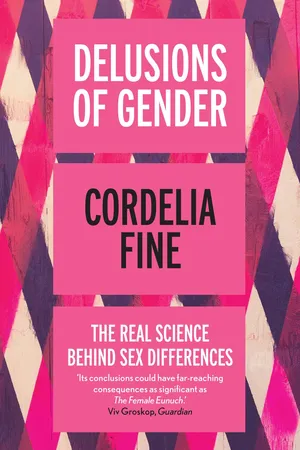
THE BRILLIANT AND HUGELY INFLUENTIAL BOOK BY THE WINNER OF THE 2017 ROYAL SOCIETY INSIGHT INVESTMENT SCIENCE BOOKS PRIZE
'Fun, droll yet deeply serious.'
New Scientist
'A brilliant feminist critic of the
neurosciences … Read her, enjoy and learn.'
Hilary Rose,
THES
'A witty and meticulously researched
exposé of the sloppy studies that pass for scientific
evidence in so many of today's bestselling books
on sex differences.'
Carol Tavris,
TLS
Gender inequalities are increasingly defended by citing hard-wired differences between the male and
female brain. That's why, we're told, there are so few
women in science, so few men in the laundry room –
different brains are just suited to different things.
With sparkling wit and humour, Cordelia Fine attacks
this 'neurosexism', revealing the mind's remarkable
plasticity, the substantial influence of culture on identity,
and the malleability of what we consider to be
'hardwired' difference.
This modern classic shows
the surprising extent to which boys and girls, men and
women are made – not born.
- 300 pages
- English
- ePUB (mobile friendly)
- Available on iOS & Android
eBook - ePub
About this book
Information
Subtopic
Gender StudiesIndex
Biological Sciences

The more I was treated as a woman, the more woman I became. I adapted willy-nilly. If I was assumed to be incompetent at reversing cars, or opening bottles, oddly incompetent I found myself becoming. If a case was thought too heavy for me, inexplicably I found it so myself.
—Jan Morris, a male-to-female transsexual describing her post-transition experiences in her autobiography, Conundrum (1987)1
Suppose a researcher were to tap you on the shoulder and ask you to write down what, according to cultural lore, males and females are like. Would you stare at the researcher blankly and exclaim, ‘But what can you mean? Every person is a unique, multifaceted, sometimes even contradictory individual, and with such an astonishing range of personality traits within each sex, and across contexts, social class, age, experience, educational level, sexuality and ethnicity, it would be pointless and meaningless to attempt to pigeonhole such rich complexity and variability into two crude stereotypes’? No. You’d pick up your pencil and start writing.2 Take a look at the two lists from such a survey, and you will find yourself reading adjectives that would not look out of place in an eighteenth-century treatise on the different duties of the two sexes. One list would probably feature communal personality traits such as compassionate, loves children, dependent, interpersonally sensitive, nurturing. These, you will note, are ideal qualifications for someone who wishes to live to serve the needs of others. On the other character inventory we would see agentic descriptions like leader, aggressive, ambitious, analytical, competitive, dominant, independent and individualistic. These are the perfect traits for bending the world to your command, and earning a wage for it.3 I don’t have to tell you which is the female list and which is the male one: you already know. (These lists, as sociologists Cecilia Ridgeway and Shelley Correll have pointed out, also most closely match stereotypes of ‘white, middle-class, heterosexual men and women, if anyone.’)4
Even if you, personally, don’t subscribe to these stereotypes, there is a part of your mind that isn’t so prissy. Social psychologists are finding that what we can consciously report about ourselves does not tell the whole story.5 Stereotypes, as well as attitudes, goals, and identity also appear to exist at an implicit level, and operate ‘without the encumbrances of awareness, intention, and control’, as social psychologists Brian Nosek and Jeffrey Hansen have put it.6 The implicit associations of the mind can be thought of as a tangled but highly organised network of connections. They connect representations of objects, people, concepts, feelings, your own self, goals, motives and behaviours with one another. The strength of each of these connections depends on your past experiences (and also, interestingly, the current context): how often those two objects, say, or that person and that feeling, or that object and a certain behaviour have gone together in the past.7
So what does the implicit mind automatically associate with women and men? The various tests that social psychologists use to assess implicit associations work from the assumption that if you present your participant with a particular stimulus, then this will rapidly, automatically and unintentionally activate strongly associated concepts, actions, goals and so on, more than weakly associated ones. These primed representations become more readily accessible to influence perception and guide behaviour.8 In one of the most widely used tests, the computer-based Implicit Association Test or IAT (developed by social psychologists Anthony Greenwald, Mahzarin Banaji and Brian Nosek), participants must pair categories of words or pictures.9 For example, first they might have to pair female names with communal words (like connected and supportive), and male names with agentic words (like individualistic and competitive). Participants usually find this easier than the opposite pairing (female names with agentic words, and male names with communal words). The small but significant difference in reaction time this creates is taken as a measure of the stronger automatic and unintended associations between women and communality, and men and agency.10
You probably have similar associations, regardless of whether you consciously endorse them. The reason for this is that the learning of these associations is also a process that takes place without the need for awareness, intention and control. The principle behind learning in associative memory is simple: as its name suggests, what is picked up are associations in the environment. Place a woman behind almost every vacuum cleaner being pushed around a carpet and, by Jove, associative memory will pick up the pattern. This certainly has its benefits – it’s an effortless and efficient way to learn about the world around you – but it also has its drawbacks. Unlike explicitly held knowledge, where you can be reflective and picky about what you believe, associative memory seems to be fairly indiscriminate in what it takes on board. Most likely, it picks up and responds to cultural patterns in society, media and advertising, which may well be reinforcing implicit associations you don’t consciously endorse. What this means is that if you are a liberal, politically correct sort of person, then chances are you won’t very much like your implicit mind’s attitudes. Between it and your conscious, reflective self there will be many points of disagreement. Researchers have shown that our implicit representations of social groups are often remarkably reactionary, even when our consciously reported beliefs are modern and progressive.11 As for gender, the automatic associations of the categories male and female are not a few flimsy strands linked to penis and vagina. Measures of implicit associations reveal that men, more than women, are implicitly associated with science, maths, career, hierarchy and high authority. In contrast, women, more than men, are implicitly associated with the liberal arts, family and domesticity, egalitarianism and low authority.12
The results of a series of experiments by Nilanjana Dasgupta and Shaki Asgari at the University of Massachusetts give us an indication of how the media, and life itself, can give rise to these associations, quite independently of our consciously endorsed beliefs. These researchers looked at the effects of counterstereotypic information. In the first study, they gave one group of women a series of short biographies of famous women leaders to read (like Meg Whitman, then CEO of e-Bay, and Ruth Bader Ginsburg, US Supreme Court Justice). Afterwards, these women found it easier to pair female names with leadership words on the IAT, compared with controls who had not just read about women leaders. However, reading about these exceptional women had not an ounce of effect on the women’s explicit beliefs about women’s leadership qualities. Dasgupta and Asgari then went on to look at the effects of the real world on the implicit mind. They recruited women from two liberal arts colleges in the United States, one a women’s college and the other coed. The researchers measured the women’s implicit and conscious attitudes towards women and leadership during the first few months of freshman year and then again a year later. The type of college experience – coed or single sex – had no effect on the students’ self-reported beliefs about women’s capacity for leadership. However, it did have an effect on their implicit attitudes. At the beginning of freshman year, both groups of women were slow to pair female and leadership words on the IAT. But by sophomore year, the women at the single-sex college had lost this implicit disinclination to associate women with leadership, while coed students had become even slower at pairing such words. This divergence appeared to be due to students in women’s colleges tending to have more exposure to female faculty, and coed students – particularly those who took maths and science classes – having less experience with women in leadership positions. The patterns of their environment, in other words, altered the gender stereotypes represented in the implicit mind.13
When gender is salient in the environment, or we categorise someone as male or female, gender stereotypes are automatically primed. For several years, social psychologists have been investigating how this activation of stereotypes affects our perception of others.14 But more recently, social psychologists have also become interested in the possibility that sometimes we might also perceive our own selves through the lens of an activated stereotype. For, as it turns out, the self-concept is surprisingly malleable.
Perhaps, on presenting your psyche to a psychiatrist for analysis, you would fail to see a brightening of the eye, a gleam that anticipates an hour that is more pleasure than work. But even if your personality offers little to hold the interest of a shrink, there is nonetheless plenty in there to fascinate the social psychologist. This is because your self has multiple strings to its bow, it’s a rich, complex web, it has a nuance for every occasion. As Walt Whitman neatly put it, ‘I am large: I contain multitudes.’15 But while a self that runs to the multitudes is certainly a fine thing to own, you can immediately see that it is not ideal to have the entire multitude in charge at the same time. What works better is if, at any one time, just a few self-concept items are plucked out from the giant Wardrobe of Self.
Some psychologists refer to whatever self is in current use – the particular self-concept chosen from the multitudes – as the active self.16 As the name implies, this is no passive, sloblike entity that idles unchanging day after day, week after week. Rather, the active self is a dynamic chameleon, changing from moment to moment in response to its social environment. Of course, the mind can only make use of what is available – and for each of us certain portions of the self-concept come more easily to hand than do others. But in all of us, a rather large portion of the Wardrobe of Self is taken up with the stereotypical costumes of the many social identities each person has (New Yorker, father, Hispanic American, vet, squash player, man). Who you are at a particular moment – which part of your self-concept is active – turns out to be very sensitive to context. While sometimes your active self will be personal and idiosyncratic, at other times the context will bring one of your social identities hurtling towards the active self for use. With a particular social identity in place, it would not be surprising if self-perception became more stereotypic as a result. In line with this idea, priming gender seems to have exactly this effect.17
In one study, for example, a group of French high school students was asked to rate the truth of stereotypes about gender difference in talent in maths and the arts before rating their own abilities in these domains. So, for these students, gender stereotypes were very salient as they rated their own ability. Next, they were asked to report their scores in maths and the arts on a very important national standardised test taken about two years earlier. Unlike students in a control condition, those in the stereotype-salient group altered the memory of their own objective achievements to fit the well-known stereotype. The girls remembered doing better than they really had in the arts, while the boys inflated their marks in maths. They gave themselves, on average, almost an extra 3 percent on their real score while the girls subtracted the same amount from their actual maths score. This might not seem like a large effect, but it’s not impossible to imagine two young people considering different occupational paths when, with gender in mind, a boy sees himself as an A student while an equally successful girl thinks she’s only a B.18
If this method of priming gender doesn’t seem very subtle, it’s because it isn’t. Of course that’s not to say that it might not provide a useful proxy for the real world. Gender stereotypes are ubiquitous, sometimes even in settings where they shouldn’t be. When the Scottish Qualifications Authority recently announced a drive to increase the dismally low numbers of senior school girls in subjects like physics, woodworking, and computing, some teachers freely expressed doubt that it was worth the effort. ‘I think it is much better to realise that there are differences between boys and girls, and ways in which they learn’, said a headmaster at a well-known Edinburgh private school. ‘Overall, boys choose subjects to suit their learning style, which is more logic based’.19 He was gracious enough to leave his audience to make the inference that girls’ preferred learning style is an illogical one, rather than making the point explicitly. But importantly, gender identity can also be primed without the help of openly expressed stereotypes. Have you, for example, ever filled in a question on a form that looks something like this?
□ Male
□ Female
Even an innocently neutral question of this kind can prime gender. Researchers asked American university students to rate their mathematical and verbal abilities, but beforehand, some students were asked to note down their gender in a short demographics section, and others to mark their ethnicity.20 The simple process of ticking a box had surprising effects. European American women, for example, felt more confident about their verbal skills when gender was salient (consistent with the prevailing belief that females have the edge when it comes to language skills) and rated their maths ability lower, compared with when they identified themselves as European American. In contrast, European American men rated their maths ability higher when they were thinking of themselves as men (rather than as European Americans), but their verbal ability better when their ethnicity had been made salient.
Even stimuli that are so subtle as to be imperceptible can bring about a change in self-perception. Psychologists Jennifer Steele and Nalini Ambady gave female students a vigilance task, in which they had to indicate with a key press, as quickly as possible, on which side of the computer screen a series of flashes appeared.21 These flashes, were, in fact, subliminal primes: words replaced so quickly by a string of Xs that the word itself couldn’t be identified. For one group, the words primed ‘female’ (aunt, doll, earring, flower, girl and so on). The other group saw words like uncle, hammer, suit, cigar and boy. Then, the volunteers were asked to rate how much pleasure they found in both feminine activities (like writing an essay or taking a literature exam) and masculine tasks (like solving an equation, taking a calculus exam or computing compound interest). The male-primed group of women rated both types of activity as equally enjoyable. But the female-primed group reported a preference for arts-related activities over maths-based ones. The prime ‘changed women’s lens of self-perception’, the authors suggest.22
We are not just influenced by the imperceptible, but also the intangible. The Australian writer Helen Garner noted that one can either ‘think of people as discrete bubbles floating past each other and sometimes colliding, or … see them overlap, seep into each other’s lives, penetrate the fabric of each other’.23 Research supports the latter view. The boundary of the self-concept is permeable to other people’s conceptions of you (or, somewhat more accurately, your perception of their perception of you). As William James put it, ‘a man has as many social selves as there ar...
Table of contents
- Cover
- Praise for A Mind of Its Own
- Title Page
- Copyright
- Dedication
- About the Author
- Contents
- Introduction
- Part 1: ‘Half-Changed World’, Half-Changed Minds
- Part 2: Neurosexism
- Part 3: Recycling Gender
- Epilogue: And S-t-r-e-t-c-h!
- Acknowledgements
- Author’s Note
- Notes
- Bibliography
- Index
Trusted by 375,005 students
Access to over 1.5 million titles for a fair monthly price.
Study more efficiently using our study tools.
Frequently asked questions
Yes, you can cancel anytime from the Subscription tab in your account settings on the Perlego website. Your subscription will stay active until the end of your current billing period. Learn how to cancel your subscription
No, books cannot be downloaded as external files, such as PDFs, for use outside of Perlego. However, you can download books within the Perlego app for offline reading on mobile or tablet. Learn how to download books offline
Perlego offers two plans: Essential and Complete
- Essential is ideal for learners and professionals who enjoy exploring a wide range of subjects. Access the Essential Library with 800,000+ trusted titles and best-sellers across business, personal growth, and the humanities. Includes unlimited reading time and Standard Read Aloud voice.
- Complete: Perfect for advanced learners and researchers needing full, unrestricted access. Unlock 1.5M+ books across hundreds of subjects, including academic and specialized titles. The Complete Plan also includes advanced features like Premium Read Aloud and Research Assistant.
We are an online textbook subscription service, where you can get access to an entire online library for less than the price of a single book per month. With over 1.5 million books across 990+ topics, we’ve got you covered! Learn about our mission
Look out for the read-aloud symbol on your next book to see if you can listen to it. The read-aloud tool reads text aloud for you, highlighting the text as it is being read. You can pause it, speed it up and slow it down. Learn more about Read Aloud
Yes! You can use the Perlego app on both iOS and Android devices to read anytime, anywhere — even offline. Perfect for commutes or when you’re on the go.
Please note we cannot support devices running on iOS 13 and Android 7 or earlier. Learn more about using the app
Please note we cannot support devices running on iOS 13 and Android 7 or earlier. Learn more about using the app
Yes, you can access Delusions of Gender by Cordelia Fine in PDF and/or ePUB format, as well as other popular books in Biological Sciences & Gender Studies. We have over 1.5 million books available in our catalogue for you to explore.