Mobile phones are a ubiquitous technology with a fascinating history. There are now as many mobile phones in the world as there are people. We carry them around with us wherever we go. And while we used to just speak into them, now mobiles are used to do all kinds of tasks, from talking to twittering, from playing a game to paying a bill.
Jon Agar takes the mobile to pieces, tracing what makes it work, and puts it together again, showing how it was shaped in different national contexts in the United States, Europe, the Far East and Africa. He tells the story from the early associations with cars and the privileged, through its immense popular success, to the rise of the smartphone.
Few scientific revolutions affect us in such a day-to-day way as the development of the mobile phone. Jon Agar's deft history explains exactly how this revolution has come about - and where it may lead in the future.
- 288 pages
- English
- ePUB (mobile friendly)
- Available on iOS & Android
eBook - ePub
About this book
Information
Part one
World in bits
Chapter 1
What’s in a phone?
You can tell what a culture values by what it has in its bags and pockets. Keys, combs and money tell us that property, personal appearance or trade matter. But when the object is expensive, a more significant investment has been made. In our day the mobile or cellphone is just such an object. But what of the past? In the 17th century, the pocket watch was a rarity, so much so that only the best horological collections of today can boast an example from that time. But if in the following century you had entered a bustling London coffee shop or Parisian salon, then you might well have spied a pocket watch amongst the breeches and frock-coats. The personal watch was baroque high technology, a compact, complex device that only the most skilful artisans could design and build. Their proud owners did not merely buy the ability to tell the time, but also bought into particular values: telling the time mattered to the entrepreneurs and factory owners who were busy. As commercial and industrial economies began to roar, busy-ness conveyed business – and its symbol was the pocket watch.
At first sight it might seem as if owning a pocket watch brought freedom from the town clock and the church bell, making the individual independent of political and religious authorities. Certainly, possession granted the owner powers over the watchless: power to say when the working day might begin and finish, for example. However, despite the fact that the pocket watch gave the owner personal access to the exact time, this very accuracy depended on being part of a system. If he was unwilling personally to make regular astronomical observations, his pocket watch would still have to be reset every now and then from the town clock. With the establishment of time zones, the system within which a pocket watch displayed the ‘right’ time spread over the entire globe. 7.00am in New York was exactly 12.00pm in London, which was exactly 8.00pm in Shanghai. What is more, the owner of a pocket watch could travel all day – could be mobile – and still always know what time it was. Such certainty was only possible because an immense amount of effort had put an infrastructure in place, and agreements had been hammered out about how the system should work. Only in societies where time meant money would this effort have been worth it.
Pocket watches provide the closest historical parallel to the remarkable rise of the mobile cellular phone in our own times. Pocket watches, for example, started as expensive status symbols, but by the 20th century most people in the West possessed one. When cellular phones were first marketed they cost the equivalent of a small car – and you needed the car to transport them, since they were so bulky. But in 2002, global subscriptions to cellular phone services passed 1 billion. By 2010 the number was 5 billion, and in 2012 it was predicted that mobile devices of all kinds would soon outnumber human beings. In many countries most people have a mobile phone. Like the pocket watch, the phone had made the leap from being a technology of the home or street to being a much rarer creature indeed: something carried everywhere, on the person, by anybody. So, if pocket watches resonated to the rhythm of industrial capitalism, what values do the ringtones of the mobile phone signify? What is it about humanity in the 21st-century world that has created a desire to be in constant touch? To answer this question, I began with a rather drastic step.
In this world of weightless information, there is nothing quite so satisfying as taking a hammer to a piece of technology. My old mobile phone, a Siemens S8, was a solid enough device, and it took some effort to take it apart. But in the interests of research I wanted to know what was inside. Now the various parts lie in front of me.
The battery came away first. It is about the size of a large postage stamp, and as heavy as a paperback book. But I can at least lift it, and this would not have been true of the early years. Let’s take an example of mobile radio communication from far back. The entrepreneurial expat Italian inventor Guglielmo Marconi had hawked his new technology of wireless telegraphy – radio communication by Morse code – around London in 1900, but he focused his efforts on one main customer: the mighty Royal Navy. His pitch was simple. The Admiralty had invested many thousands of pounds in battleships which became incommunicative and blind as soon as fog descended. Wireless telegraphy provided new mechanical senses: to warn of maritime dangers and to organise the fleet. The Sea Lords were convinced and Marconi sealed the deal. The Navy installed 32 wireless sets aboard ships. Sixteen years later, during the Battle of Jutland, the purchase would prove a wise one: listening stations detected the German fleet by picking up unusually heavy radio traffic, and the same radio technology enabled the British Grand Fleet to steam across the foggy North Sea to the Danish coast to engage its enemy in the Skagerrak.
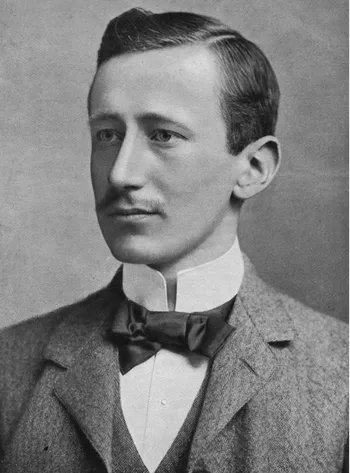
Guglielmo Marconi.
Marconi wanted to sell wireless to the Admiralty because it took a vehicle the size and power of a battleship to carry it. Radio transmission in the 1900s had been achieved by creating bursts of sparks generated by immense electrical voltages. (The same principle is behind the crackling interference caused by lightning.) Giant voltages meant heavy batteries. The first mobile radio was restricted to behemoths. But a feature of the history of electrical technology has been continuous miniaturisation of components. Even before the First World War, the Swedish electrical engineer Lars Magnus Ericsson had demonstrated new possibilities for mobile communication.
The young Ericsson had trained as a smith and as a mining and railway engineer before becoming an apprentice under the telegraph-maker A.H. Öller in the early 1870s. He then studied abroad in Switzerland and Germany before setting up his own company in Stockholm in 1876, first to manufacture and repair telegraph apparatus, and later, following Alexander Graham Bell’s invention, telephones. Ericsson’s business boomed. However, he seems to have wearied of the commercial life early in the new century, and retired, backed by a healthy bank balance, to a comfortable life as a farmer. But in 1910 Ericsson, in the spirit of tinkering, built a telephone into his wife Hilda’s car: the vehicle connected by wires and poles to the overhead telephone lines that had sprung up even in rural Sweden. Enough power for a telephone could be generated by cranking a handle, and, while Ericsson’s mobile telephone was in a sense a mere toy, it did work.
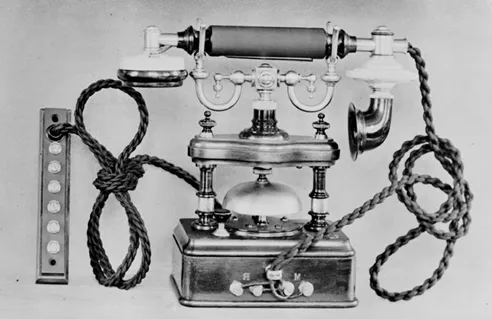
An Ericsson table telephone, c. 1900. (BT Archives)
At one level the story of the retired Swedish engineer-turned-farmer is trivial: no great industry of car-carried mobile telephones was founded on the experiment. But in many other ways it was significant. Ericsson’s company, after many twists and turns, would supply much of the infrastructure for the cellular phone systems built in the late 20th century. More of that later. Secondly, the experiment happened in Sweden, and the Nordic countries have a remarkable prominence in the history of the mobile phone. Finally, Ericsson’s vehicle showed that the technologies of communication could be fitted in an automobile, the first instance in a long and profound association between two technologies of mobility that have shaped our modern world.
Marconi’s weighty wireless had to be carried by battleship. Early practical mobile phones were carried by cars, since there was room in the boot for the bulky equipment, as well as a car battery to power them. One of the most important factors permitting phones that can be carried in pockets and bags has been a series of remarkable advances in battery technology. As batteries have become more powerful, so they have provided more energy. Partly because improvements in battery design have been incremental, their role in technological change is often underestimated. The great Prussian physicist Walther Hermann Nernst, who later articulated the Third Law of Thermodynamics, had experimented in Göttingen in 1899 with nickel as a means of converting chemical energy into electrical energy. Built a century later, my disintegrated phone has a Ni-MH – Nickel Metal Hydride – battery; it is in one sense recognisably similar to Nernst’s, but in another it is transformed: it is many, many times lighter and more efficient. Step-by-step, nickel batteries have got better. Continuous experimentation with other metals has revealed slight but significant improvements, so that, for example, the early-21st-century choice for mass-produced energy packs is between nickel- and lithium-based techniques. Gradual change can eventually trigger a profound revolution. Once batteries became powerful and portable, a Rubicon was crossed. Uncelebrated improvements in batteries, put into laptops, camcorders and cellphones, triggered our mobile world.
A similar story can be told of the other bits and pieces in front of me. The LCD or liquid crystal display, the grey panel on which I read my incoming call numbers or SMS messages on my old phone, is now commonplace in consumer electronics. The contradictory properties of liquid crystals – fluids that can paradoxically retain structure – had been noted in the 19th century by the Austrian botanist Friedrich Reinitzer. He had noticed that the organic solid cholesteryl benzoate seemed to have two melting points, and that between the lower and higher temperatures the liquid compound behaved oddly. But it was not until the 1960s that industrial laboratories, such as RCA’s in America, began to find applications exploiting this behaviour. Again, incremental development followed. Liquid crystal displays don’t produce light, they reflect light, which potentially saves energy, so changes in one component (displays) interacted with another (batteries). Much effort was needed to turn this advantage into a practical one. However, by the 1970s LCDs appeared in calculators and digital watches, replacing the red glow of light-emitting diodes.
LCDs were not essential ingredients of a cellphone (indeed my new smartphone has ditched this old display technology). We could keep in constant touch with a simple assemblage of the other bits and pieces found in the wreckage of my phone: aerials, microphones, loudspeakers and electronic circuitry. But improved screens are part of what makes a mobile phone more than a mere instrument of communication. We don’t just talk. Without the screen, the extra aspects of the mobile phone – the games, YouTube, the address books, the text messaging – all the features which contribute to a rich mobile culture, involving manipulation of data as well as transmission of the voice, would not be possible.
If I had superhuman strength I could hammer my phone into constituent atoms. A new global politics can be found among the dust. Mobile phones depend on quite rare materials: for example, within every phone there are ten to twenty components called capacitors, which store electrical charges, and since the Second World War the best capacitors have been made using thin films of a metal called tantalum. On the commodities market in the early 1990s, capacitor-grade tantalum could usually be bought for $30 a pound, sourced from locations such as the Sons of Gwalia mines at Greenbushes and Wodgina in Western Australia, the world’s best source of the element. But in the last years of the 20th century, as more and more people bought mobile phones, the demand for tantalum shot up. The price per pound rose to nearly $300 in 2000.
Tantalum, in the form of columbite-tantalite (‘coltan’ for short), can also be found in the anarchic north-east regions of the Democratic Republic of Congo, where over 10,000 civilians have died and 200,000 have been displaced since June 1999 in a civil war, fought partly over strategic mineral rights, between supporters of the deceased despot Laurent Kabila and Ugandan and Rwandan rebels. As the price of tantalum increased, the civil war intensified, funded by the profits of coltan export. The mobile phone manufacturers are distanced, however, from the conflict. Firms such as Nokia, Ericsson, Samsung and Motorola buy capacitors from separate manufacturers, who in turn buy raw material from intermediaries. On each exchange, the source of tantalum becomes more deniable. ‘All you can do is ask, and if they say no, we believe it,’ Outi Mikkonen, communications manager for environmental affairs at Nokia, recently said of her firm’s suppliers. On the other hand, export of tantalum from Uganda and Rwanda has multiplied twentyfold in the period of civil war, and the element is going somewhere.
To build a single cellphone requires material resources from across the globe. The tantalum in the capacitors might come from Australia or the Congo. The nickel in my battery probably originated from a mine in Chile. The microprocessor chips and circuitry may be from North America. The plastic casing and the liquid in the liquid crystal display were manufactured from petroleum products, from the Gulf, Texas, Russia or the North Sea, and moulded into shape in Taiwan. The collected components would have been assembled in factories dotted around the world. While the work might be coordinated from a corporate headquarters – Ericsson’s base is in Sweden, Nokia’s in Finland, Siemens’ in Germany, Alcatel’s in France, Samsung’s in Korea, Apple’s and Motorola’s in the United States, and Sony’s, Toshiba’s and Matsushita’s in Japan – the finished phone could have come from secondary manufacturers in many other countries.
The phone might be an international conglomerate, but it was put together in different ways in different countries, and shortly we will see how the cellular phone was imagined in different ways according to national context. I will return later to consider what the mobile tells us about our culture that has adopted it so readily. I will ask how the mobile cellphone fits with changing social structures, why it has become the focus of new types of crime, and what it can signify when it appears in cultural products such as television programmes and movies. For material components alone do not add up to a working cellphone. Indeed, it was the scarcity of a non-material resource that prompted the idea of the cellular phone in the first place.
Chapter 2
Save the ether
When Lars Magnus Ericsson was driving through the Swedish countryside, he still had to stop his car and wire his car-bound telephone to the overhead lines. If he had pressed his foot on the accelerator, the wire would have whipped out, wrecking the apparatus. It was not a mobile phone in our current sense of the word. Until the last decades of the 20th century, most telephones were like this: to use them, you had to stand still, because you were physically connected by inelastic copper wire to the national system. A few privileged people – members of the armed forces, engineers, ship captains – could command the use of a true wireless phone, connecting to the land-locked national system through radio. The reason it was a privilege was because the radio telephone had to fight for a share of a scarce resource: a place on the radio spectrum.
The first radio transmissions were profligate beasts. Take Marconi’s again. Such radio waves generated by a spark would crackle across many frequencies on the spectrum, interfering with and swamping other attempts at communication. This problem meant that early radio users had a choice: either find some way of regulating use so that interference was limited, or take a chance with a chaotic Babel of cross-talk. The route to regulation was taken. (Although not in all parts of...
Table of contents
- Title page
- Copyright information
- Dedication
- Contents
- About the author
- Acknowledgements
- Preface
- Part one: World in bits
- Part two: Different countries, different paths to mobility
- Part three: Mobile cultures
- Part four: Smartphones
- Bibliography
- Index
Trusted by 375,005 students
Access to over 1.5 million titles for a fair monthly price.
Study more efficiently using our study tools.
Frequently asked questions
Yes, you can cancel anytime from the Subscription tab in your account settings on the Perlego website. Your subscription will stay active until the end of your current billing period. Learn how to cancel your subscription
No, books cannot be downloaded as external files, such as PDFs, for use outside of Perlego. However, you can download books within the Perlego app for offline reading on mobile or tablet. Learn how to download books offline
Perlego offers two plans: Essential and Complete
- Essential is ideal for learners and professionals who enjoy exploring a wide range of subjects. Access the Essential Library with 800,000+ trusted titles and best-sellers across business, personal growth, and the humanities. Includes unlimited reading time and Standard Read Aloud voice.
- Complete: Perfect for advanced learners and researchers needing full, unrestricted access. Unlock 1.5M+ books across hundreds of subjects, including academic and specialized titles. The Complete Plan also includes advanced features like Premium Read Aloud and Research Assistant.
We are an online textbook subscription service, where you can get access to an entire online library for less than the price of a single book per month. With over 1.5 million books across 990+ topics, we’ve got you covered! Learn about our mission
Look out for the read-aloud symbol on your next book to see if you can listen to it. The read-aloud tool reads text aloud for you, highlighting the text as it is being read. You can pause it, speed it up and slow it down. Learn more about Read Aloud
Yes! You can use the Perlego app on both iOS and Android devices to read anytime, anywhere — even offline. Perfect for commutes or when you’re on the go.
Please note we cannot support devices running on iOS 13 and Android 7 or earlier. Learn more about using the app
Please note we cannot support devices running on iOS 13 and Android 7 or earlier. Learn more about using the app
Yes, you can access Constant Touch by Jon Agar in PDF and/or ePUB format, as well as other popular books in Technology & Engineering & Technology & Engineering Research & Skills. We have over 1.5 million books available in our catalogue for you to explore.