When was radium discovered? Who are Dmitri Mendeleev and Glenn T. Seaborg? Who discovered uranium's radioactivity? Which element is useful for dating the age of Earth? And why doesn't gold have a scientific name?
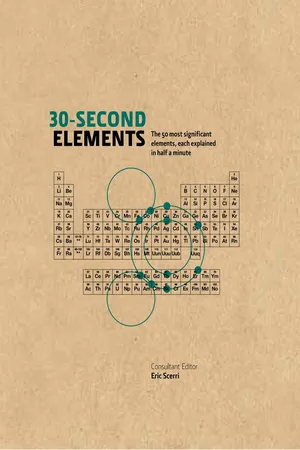
30-Second Elements presents you with the very foundations of chemical knowledge, explaining concisely the 50 most significant chemical elements.
This book uses helpful glossaries and tables to fast track your knowledge of the other 68 elements and the relationships between all of them.
eBook - ePub
30-Second Elements
The 50 most significant elements, each explained in half a minute
- 160 pages
- English
- ePUB (mobile friendly)
- Available on iOS & Android
eBook - ePub
About this book
Information

TRANSITION METALS
TRANSITION METALS
GLOSSARY & ELEMENTS
alloy A material that has metallic properties and is composed of two or more chemical elements of which at least one is a metal. Alloys are usually harder than pure metal and more resistant to corrosion. Brass is an alloy made from 70 per cent copper and 30 per cent zinc; bronze is an alloy of 90 per cent copper and 10 per cent tin.
amalgam An alloy of mercury with another metal. Iron does not form an amalgam with mercury but most other metals do. Dental amalgam, combining mercury with silver, tin and other metals, was popular from around 1800 onwards, but is less used today because of health concerns over the use of mercury.
ductile Capable of being pulled out into a wire.
heavy metal One of a group of elements among transition metals, metalloids, lanthanides and actinides that have metallic properties. The term generally refers to those that are heavier than iron and zinc. Examples include mercury, lead and cadmium. They are toxic to humans if ingested.
insulator Material that prevents an electrical charge flowing through it.
isomers Compounds with an identical molecular formula but different structural formulae. While a molecular formula describes the combination of elements in a molecular compound, the structural formula describes how the atoms are fitted together in the molecule. For example, isomers of hydrocarbons have the same number of hydrogen and carbon atoms, but they are connected in different ways.
metastable state A relatively stable state of an atom or molecule, more stable than its most excited states, but less stable than its most stable state.
nuclear isomer A metastable state of an atomic nucleus, in which one or more of its protons or neutrons is excited (has an elevated level of energy).
ore Rock containing a valuable element (typically a metal), for which it is mined.
photon A quantum (bundle) of electromagnetic energy.
quadruple bond Bond between two atoms that involves eight bonding electrons. A single bond involves two electrons, a double bond four and a triple bond six. Quadruple bonds are most commonly made among transition metals such as rhenium and chromium.
salts Ionic compounds formed when an acid undergoes a neutralization reaction with a base.
superheavy element Another name for transuranic elements (see here), elements with an atomic number greater than 92 (the atomic number of uranium). In some contexts, however, superheavy element refers to elements with an atomic number greater than 100.
TRANSITION METALS
The transition metals are in groups 3–12 of the periodic table. They are mostly dense and hard, and are good conductors of electricity and heat. Their valence electrons (with which they combine with other elements) are in more than one electron shell.
Transition metals
Symbol | Atomic Number | |
Scandium | Sc | 21 |
Titanium | Ti | 22 |
Vanadium | V | 23 |
Chromium | Cr | 24 |
Manganese | Mn | 25 |
Iron | Fe | 26 |
Cobalt | Co | 27 |
Nickel | Ni | 28 |
Copper | Cu | 29 |
Zinc | Zn | 30 |
Yttrium | Y | 39 |
Zirconium | Zr | 40 |
Niobium | Nb | 41 |
Molybdenum | Mo | 42 |
Technetium | Tc | 43 |
Ruthenium | Ru | 44 |
Rhodium | Rh | 45 |
Palladium | Pd | 46 |
Silver | Ag | 47 |
Cadmium | Cd | 48 |
Lutetium | Lu | 71 |
Hafnium | Hf | 72 |
Tantalum | Ta | 73 |
Tungsten | W | 74 |
Rhenium | Re | 75 |
Osmium | Os | 76 |
Iridium | Ir | 77 |
Platinum | Pt | 78 |
Gold | Au | 79 |
Mercury | Hg | 80 |
Lawrencium | Lr | 103 |
Rutherfordium | Rf | 104 |
Dubnium | Db | 105 |
Seaborgium | Sg | 106 |
Bohrium | Bh | 107 |
Hassium | Hs | 108 |
Meitnerium | Mt | 109 |
Darmstadtium | Ds | 110 |
Roentgenium | Rg | 111 |
Copernicium | Cn | 112 |
CHROMIUM
the 30-second element
Chromium is one of the so-called transition metals (like iron, cobalt, nickel and copper). Its compounds form the basis of many traditional artists’ pigments and paints; chrome yellow, for example, is pure lead chromate. The colour of rubies and emeralds is due to contamination of otherwise transparent crystalline material with small amounts of chromium oxide. Chromium was discovered in 1798 by French chemist Louis-Nicolas Vauquelin, who ground up precious stones in an effort to explain thei...
Table of contents
- Cover
- Title
- Copyright
- Contents
- Introduction
- Alkali & Alkaline Earths
- 30 Rare Earths
- Halogens & Noble Gases
- Transition Metals
- Metalloids
- Other Metals
- Non-metals
- APPENDICES
Trusted by 375,005 students
Access to over 1.5 million titles for a fair monthly price.
Study more efficiently using our study tools.
Frequently asked questions
Yes, you can cancel anytime from the Subscription tab in your account settings on the Perlego website. Your subscription will stay active until the end of your current billing period. Learn how to cancel your subscription
No, books cannot be downloaded as external files, such as PDFs, for use outside of Perlego. However, you can download books within the Perlego app for offline reading on mobile or tablet. Learn how to download books offline
Perlego offers two plans: Essential and Complete
- Essential is ideal for learners and professionals who enjoy exploring a wide range of subjects. Access the Essential Library with 800,000+ trusted titles and best-sellers across business, personal growth, and the humanities. Includes unlimited reading time and Standard Read Aloud voice.
- Complete: Perfect for advanced learners and researchers needing full, unrestricted access. Unlock 1.5M+ books across hundreds of subjects, including academic and specialized titles. The Complete Plan also includes advanced features like Premium Read Aloud and Research Assistant.
We are an online textbook subscription service, where you can get access to an entire online library for less than the price of a single book per month. With over 1.5 million books across 990+ topics, we’ve got you covered! Learn about our mission
Look out for the read-aloud symbol on your next book to see if you can listen to it. The read-aloud tool reads text aloud for you, highlighting the text as it is being read. You can pause it, speed it up and slow it down. Learn more about Read Aloud
Yes! You can use the Perlego app on both iOS and Android devices to read anytime, anywhere — even offline. Perfect for commutes or when you’re on the go.
Please note we cannot support devices running on iOS 13 and Android 7 or earlier. Learn more about using the app
Please note we cannot support devices running on iOS 13 and Android 7 or earlier. Learn more about using the app
Yes, you can access 30-Second Elements by Eric Scerri in PDF and/or ePUB format, as well as other popular books in Physical Sciences & Chemistry. We have over 1.5 million books available in our catalogue for you to explore.