Riddled with jealousy, rivalry, missed opportunities and moments of genius, the history of the atom's discovery is as bizarre, as capricious, and as weird as the atom itself.
John Dalton gave us the first picture of the atom in the early 1800s. Almost 100 years later the young misfit New Zealander, Ernest Rutherford, showed the atom consisted mostly of space, and in doing so overturned centuries of classical science. It was a brilliant Dane, Neils Bohr, who made the next great leap - into the incredible world of quantum theory. Yet, he and a handful of other revolutionary young scientists weren't prepared for the shocks Nature had up her sleeve.
This 'insightful, compelling' book (
New Scientist) reveals the mind-bending discoveries that were destined to upset everything we thought we knew about reality and unleash a dangerous new force upon the world. Even today, as we peer deeper and deeper into the atom, it throws back as many questions at us as answers.
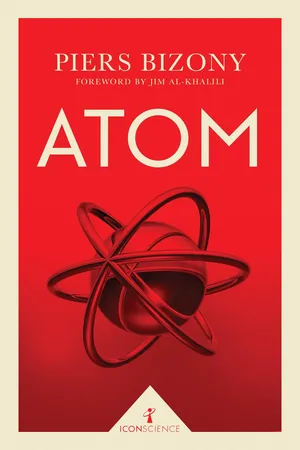
- 224 pages
- English
- ePUB (mobile friendly)
- Available on iOS & Android
eBook - ePub
Atom (Icon Science)
About this book
Information
Subtopic
Science HistoryIndex
HistoryPART ONE
Energy in Pieces
In the year 1900 a deeply conservative physicist called Max Planck concluded, somewhat reluctantly, that energy is not smooth and continuous. It is divided into discrete amounts, mysterious packets, which he called ‘quanta’. It was a discovery that would revolutionise all of science.
The word ‘atom’ is derived from a Greek idea formulated 2,400 years ago. The philosopher Democritus argued that matter is made from indivisible, imperishable and unchanging particles, which he called atomos. It was a brilliant insight, based on logical argument, but Democritus did not choose to test any of his concepts experimentally. Like most of his contemporaries, he thought that logic alone should be able to resolve the mysteries of nature. During the next 22 centuries the atom made almost no impact on the human imagination, until a precocious young teacher at the dawn of the Industrial Revolution discerned the hard-edged practical value of talking about atoms. John Dalton was born in 1766 into a modest Quaker family in Cumberland, and earned his living for most of his life as a teacher, first at his local village school (where he began giving classes at the age of twelve) and then in the factory-dominated city of Manchester. Here he reanimated the atomic theory in a strict mathematical framework rather than just as a vague philosophical idea. He concluded that all atoms of a given element must be identical to each other, and argued that chemical compounds are formed by a combination of two or more different kinds of atoms. Carefully weighing his chemicals before and after they reacted with each other, he worked out the ratios of different elements that went into certain well-known compounds. The atom emerged from his work as a spectacularly reliable chemical counting unit. As a statistical way of looking at gas and steam pressures, the atom was also invaluable. Yet it remained, for now, just that: a workable counting tool with no proper physical explanation behind it.
By the end of the 19th century, a self-confident set of rules had been assembled to describe just about everything that could be looked at, listened to, weighed or measured: the precise movements of the stars and planets across the sky, the temperatures and pressures of gases under given conditions, the rate of transfer of heat from one substance into another, the equations for shaping glass lenses so that they would bring rays of light to a focus, and so on. It was a mechanistic and results-driven way of looking at the world, and it ushered in the age of the electric lightbulb, the radio telegraph, the telephone, the motion picture, the motor car and the aeroplane. Science also seemed capable of unveiling secrets of nature at the profoundest levels. In the 1820s, a number of astronomers insisted that the gravity of an unknown planet must be responsible for observed irregularities in the orbit of an already familiar planet, Uranus. For three decades the pure and logical rule of Newtonian mathematics was their only guide. And then in 1846 they steered their telescopes to the point in the sky where the mathematics said that the planet should be. And there it was. Neptune existed because the classical laws of nature said it had to exist.
Scientists were satisfied of two things. First, almost everything that could be understood was understood; and second, the remaining mysteries were the province of religion and metaphysics, not science. Many properties of the commonly available chemical elements – hydrogen, oxygen, carbon, nitrogen, copper, iron, and so on – were predictable. Thanks to Dalton and his successors, chemists knew the precise ratios of elements in thousands of industrially useful compounds. There was an elaborate counting system based on the atom, which was widely held to be the most fundamental unit of all matter. The atom was a useful idea, but it was too small to be seen in any microscope, so its existence could not be verified.
We knew everything. And yet we knew nothing. Scientists were thoroughly accustomed to putting different kinds of knowledge into separate compartments. Botany was popular in the late Victorian age as a respectable hobby for the leisured classes, as was mathematics and the study of optics. The smellier and more hands-on business of chemistry and mechanical engineering were best left to the newly powerful industrialists. Few people would have imagined that all these disciplines might share common ground. No one suspected that the shapes of molecules, the specific arrangements of atoms in chemical compounds, might give strength to a tree, while another arrangement lent flexibility to its rubbery sap, and yet another controlled the shape of its leaves. There were many individual natural philosophers and amateur scientists intrigued by such questions, but the burgeoning numbers of university specialists, military research arsenals and commercial laboratories had no common framework with which to tackle deep, abstract problems in science. There were no grants available to study questions that did not already appear on the list of approved and potentially profitable questions: how could catalytic converters be made more efficient? How could the casings of steam engines be machined in stronger but more lightweight configurations? What mix of explosives could most effectively hurl a 15-pound shell the greatest distance?
The ‘what happens when …’ questions of science were incredibly well understood by 1900. The ‘why’ questions were barely addressed. No one had the tools to understand the strange invisible energies emanating from Henri Becquerel’s experiments with uranium salts. It was a puzzle, also, that his compounds emitted their energies week after week, month after month, without apparently depleting like any normal energy source. Similarly, and on a grander scale, it was a mystery how the sun could keep shining and not burn itself out. There was no unifying concept that could link all these disparate wonders together and explain them. We didn’t even now why red things look red.
A seemingly unremarkable young clerk in the Patent Office at Berne, Switzerland, pondered that the science of his day was like a vast library of unrelated books in myriad subjects. Yet he had faith in ‘a definite plan in the arrangement of the books, a mysterious order, which we do not comprehend, but dimly suspect’. The clerk believed that if only we could study how that order worked, instead of concentrating just on the individual books, then the entire library might one day resolve itself into a single, compact and breathtakingly tidy volume. The clerk was not an experimenter and had no laboratory. He drew his conclusions purely from the logic of scientific papers already available to his generation. In 1905, aged just 25, he published three papers which, in principle, should have revolutionised all scientific thinking. A few scientists adopted his ideas enthusiastically, and the clerk quickly gained acceptance in academia, but the world as a whole remained unmoved, and he graduated from youthful revolutionary to middle-aged professor without attracting much attention outside his close-knit scientific coterie. Albert Einstein was 40 years old by the time he even began to become famous.
It often happens in science that an observation in one field of research eventually throws a startling new light on another area. An observation in botany unexpectedly laid the foundations for one of the most important discoveries in all of modern science: the discovery of the atom. And it was Einstein who spotted the clues. His 1905 theory on Special Relativity, for which he is now best known, was only one of several intellectual breakthroughs he published in that extraordinary year. Another paper was all about little grains of pollen.
From botany to the atom
In 1827 the Scottish botanist Robert Brown was examining pollen grains under a simple microscope. He put some grains in a droplet of water, and noticed that they moved about, tracing random zigzag paths across his microscope’s field of view. At first, he concluded that the movement of each grain ‘arose neither from currents in the fluid, nor from its gradual evaporation, but belonged to the particle itself’. Other botanists enthusiastically decided that Brown had witnessed a fundamental ‘life force’ animating these tiny pieces of biological matter (typically the pollen grains measured no more than 1/100th of a millimetre across). This was a perfect example of something that tends to happen in science. There can be an unseemly rush to try to confirm theories which have already gained currency among researchers. Observational facts are sometimes interpreted to fit a favourite theory, and this is one of the biggest mistakes that any scientist can make. It’s much better to adjust the theory to fit the facts, even – or perhaps especially – when it involves abandoning cherished ideas about how nature works.
Wisely as it turns out, Brown was more cautious. Even as he prepared to publish his results, he revised his text to warn that he had seen a similar motion among pollen grains he had preserved in alcohol many months before, so that surely they must have been lifeless by the time he put them under the microscope. Of course there was a slim chance that pollen was harder to kill than he had assumed, so one more experiment was needed to remove any ambiguity. He ground down some inorganic mineral samples into powders and suspended them in water. Again, he saw random movements through his microscope. If there was some kind of a force at work here, it almost certainly wasn’t coming from the grains. And yet they moved. The only logical conclusion was that something in the water was pushing them around.
Throughout the Victorian era, the jiggling of the grains remained an intriguing enigma whose significance was not truly understood. Then, at the dawn of the 20th century, a Swiss-Italian electrical engineer named Michelangelo Besso introduced his very good friend Albert Einstein to what he called ‘Brownian motion’. In 1905 Einstein was inspired to write a paper on this theme, in which he described how the motion could be understood as the buffeting of billions of water molecules against the grains. Previous theorists had been confused by the idea that something so infinitesimally small and lightweight as a molecule could push against the comparatively massive grains. Einstein certainly wasn’t suggesting that the individual zigs and zags of the grains were caused by each one being hit by individual molecules. They were the cumulative outcomes of many millions of random impacts. He even calculated the probability of the motions in a way that could be tested by subsequent experimenters. Ignoring all the zigs and zags, and focusing only on the straight-line distances covered between the start of a grain’s journey and where it ended up after a given amount of time, Einstein accurately predicted how far a grain would travel. In other words he ‘smoothed out’ the irrelevant details of every last zig and zag, and treated the whole problem statistically.
Yet he drew back from claiming that the apparent action of the molecules on the grains specifically proved the existence of molecules. Instead he suggested that the statistical effects he described would produce the visible large-scale motions observed in Brownian motion if it turned out to be the case that molecules existed. As for the molecules themselves, he warned that ‘the data available to me are so imprecise that I could not form a judgement on the question.’ It was an important and conscientious distinction. For now, these invisible entities remained a useful theoretical model for predicting the thermal and kinetic forces in liquids and gases, and for predicting the outcomes of chemical reactions. But still, no one had yet ‘seen’ a molecule, let alone an atom.
Smaller than the smallest thing
Strangely enough, someone had by now demonstrated the existence of something even smaller than an atom. In 1897 the English physicist Joseph J. Thomson was experimenting with a sealed glass tube from which most of the air had been drawn out. Inside were two metal plates, mounted at opposite ends, and wired up to a battery. The plate attached to the positive terminal was called the anode, and the negative plate was known as a cathode. When the current was switched on, a mysterious glow could be observed at the anode end of the tube. Certain types of glass exhibited a very faint glow unaided, but when a coat of phosphor was applied to the inside of the glass tube at the positive end, the glow was unmistakable. Some kind of invisible beam was crossing the gulf between the cathode and the anode, striking the end walls of the tube and producing the glow.
These ‘cathode ray’ tubes, tremendously popular among experimenters in the late 1800s, were the ancestors of television. Thomson’s special contribution was to prove that electric currents or magnets just outside the vacuum tube could deflect and even steer the rays, altering the positions of the luminous spots on the phosphor screens. A wide variety of different anode and cathode metals produced similar results, so he concluded that the rays were a fundamental constituent of nature, and not just some oddity connected with a particular material. He showed that the rays were narrow beams of negatively charged particles, which he called ‘corpuscles’. By measuring the influences of external magnets and electrical currents on these particles, he proved they were 2,000 times less massive than an atom of even the lightest element, hydrogen. We know these particles, today, as electrons.
It was an odd state of affairs, that an entity even smaller than the atom had been identified while the atom itself remained just a theoretical notion. In April 1897 Thomson admitted to a meeting of the Royal Society in London that ‘the assumption of a state of matter more finely divided than the atom is a somewhat startling one’. In 1904 he took the bold step of asserting that ‘the atom consists of a number of corpuscles [electrons] moving about in a sphere of uniform positive electrification’. This came to be known as the ‘plum pudding’ model. For now, that’s all it was: a mind’s eye visualisation, a vague speculation. Yet Thomson’s confidence was bolstered by news from Paris, where a brave and romantic couple were at last finding substance in the atom’s elusive shadow.
Scientific romance
A hundred years ago, even at the tail end of the Victorian era, a male scientist could get away with having an adulterous affair as long as his work was good enough. A woman had to tread more carefully in her private life, even if her work was in the Nobel Prize-winning class. One who always refused to toe the line was Madame Curie.
Maria Skłodowska was born in 1867 in Warsaw, the fifth and youngest child of Bronisława Boguska, a pianist, singer and teacher, who died of tuberculosis while Maria was still a child, and Władysław Skłodowski, a professor of mathematics and physics. At sixteen Maria won a gold medal for outstanding achievement at her secondary school education. She dreamed now of travelling to Paris and entering the Sorbonne, one of the few major European universities where a young woman might be allowed to study. Unfortunately her father lost all the family savings in a failed investment scheme. Maria was forced to find work as a teacher, and then became a governess, essentially a nanny-cum-tutor role familiar to well-brought-up young women in the Victorian age whose families had fallen on hard times. Meanwhile, she found time to read Polish books to poor women who would not otherwise have had access to education, except at the hands of Poland’s Russian overlords. Maria was a member of a clandestine and politically radical ‘flying university’ which convened wherever it could, and just as quickly dispersed whenever threatened. The Russian authorities did not approve of Maria’s nationalist ideals.
Her next risky adventure was to fall in love with one of the sons of the family she was living with as a governess. The affair was passionate, and the love completely mutual, but the young man’s parents refused to let him marry a penniless governess, and Maria was forced to leave the household. Now her only hope was her sister Bronia, who had struck a deal with her some years earlier. Funded by Maria’s earnings as a governess, Bronia had made it to Paris, where she was studying for a medical degree. On her return to Poland, the sisters were supposed to swap roles. These two strong-minded women kept to their plan, and in November 1891 Maria at last set out on the thousand-mile train journey to Paris and the Sorbonne. She attended physics and mathematics lectures by day, then at night returned to her very humble student’s lodgings in the city’s Latin Quarter. She ate little more than bread and butter, and seldom drank anything more costly than tea. Her studies went well, and after three years of dedicated student life, she passed examinations in physics and mathematics with outstanding grades. Marie’s goal (she changed her name while in Paris) was to obtain a teacher’s diploma and then return to Poland. Her instincts told her that her widowed father must surely expect her to come home and play her part in supporting the family.
And then she chanced to meet her soulmate. ‘I was struck by the open expression on his face’, she recalled. ‘His simplicity, his smile, at once grave and youthful, inspired confidence.’ Thirty-five-year-old Pierre Curie was the head of a laboratory at the School of Industrial Physics and Chemistry. He had already made something of a name for himself by discovering, with help from his brother Jacques, that when an electric current was applied to a quartz crystal, it changed shape by a tiny amount. Conversely, when the crystal was squeezed or pulled, it delivered a jolt of electricity in response. This might sound obscure, yet it was the key to a new range of super-sensitive scientific instruments. Pierre was a skilled designer of measuring equipment, and he was well respected in Paris at that time, although he was not so good at insinuating his way into the professional élite of French science. He despised political games-playing and had little appetite for medals and awards, or any of the other back-slapping perks of his trade.
Marie’s good fortune was that this decent and unegotistical man proved very happy to collaborate with her in work as well as in love. She knew she was supposed to return to Poland after completing her studies at the Sorbonne, and she visited her family to give them the news about Pierre, uncertain how they would react. Much to her relief, her father made it quite clear that she should return to Paris straight away and marry him. In July 1895, after an idyllic wedding, one of the most romantic couples in the history of science got down to work, studying the strange invisible rays recently discovered by another French scientist, Henri Becquerel. He had worked with a very unusual element. It was called uranium.
The dollar lode
At the beginning of the 16th century, the rough mountain territory dividing Bohemia from Saxony, the borderland between modern Germany and the Czech Republic, was covered by an impenetrable virgin forest, a refuge for wolves, bears and bandits. The discovery of precious metals triggered the first ‘silver rush’ in history. The previously insignificant little town of Joachimsthal soon become the largest mining centre in Europe. In just a couple of years an eager influx of chancers swelled the population to 20,000. The silver was minted into a coin called a Joachimsthaler, later known more simply as a thaler. Rather like a certain currency in today’s world, the thaler was accepted worldwide. The silver coins are no longer in circulation, but the name has stayed with us, slightly transmuted. It’s now pronounced ‘dollar’.
After just three decades, Joachimsthal’s silver reserves were exhausted. Plagues killed off much of the population, and the Thirty Years War finished the job. Joachimsthal became a ghost town with an unhealthy reputation. Miners had always fallen ill there, even before the plague struck. But just because the silver was gone didn’t mean that the mines had nothing left to offer. Along with the silver, the miners had often come across a shiny black mineral, which didn’t immediately impress them as being of much use. They called it Pechblende, from the German words Pech, which means bad luck, and Blende, meaning mineral. In 1789 an amateur German chemist, Martin Klaproth, decided to see what it was made of. He found that it contained ‘a strange kind of half-metal’, which he named in honour of the planet Uranus, at that time believed to be the last planet in the solar system.
During the next century, ‘pitchblende’ was found in Cornwall, France, Austria and Romania, and by the end of the Victorian era, thousands of scientific papers had been published on geological and mineral occurrences of ‘uranium’. The metal, as dense as gold, was apparently the heaviest element on earth. Its principal value appeared to lie in the vivid colours of its oxides and salts, which were used to create glassware with an attractive fluorescent glow, or gla...
Table of contents
- Cover
- Contents
- Title Page
- Copyright
- List of illustrations
- Foreword by Jim Al-Khalili
- Acknowledgements
- About the author
- Preface
- Part One Energy in Pieces
- Part Two The Empty Atom
- Part Three Not Even Wrong
- Part Four Playing With Marbles
- Part Five Blast Radius
- Part Six Renormalising the Infinities
- Part Seven ‘Three Quarks for Muster Mark!’
- Part Eight Ylem
- Part Nine New Frontiers
- Further Reading
- Index
Trusted by 375,005 students
Access to over 1.5 million titles for a fair monthly price.
Study more efficiently using our study tools.
Frequently asked questions
Yes, you can cancel anytime from the Subscription tab in your account settings on the Perlego website. Your subscription will stay active until the end of your current billing period. Learn how to cancel your subscription
No, books cannot be downloaded as external files, such as PDFs, for use outside of Perlego. However, you can download books within the Perlego app for offline reading on mobile or tablet. Learn how to download books offline
Perlego offers two plans: Essential and Complete
- Essential is ideal for learners and professionals who enjoy exploring a wide range of subjects. Access the Essential Library with 800,000+ trusted titles and best-sellers across business, personal growth, and the humanities. Includes unlimited reading time and Standard Read Aloud voice.
- Complete: Perfect for advanced learners and researchers needing full, unrestricted access. Unlock 1.5M+ books across hundreds of subjects, including academic and specialized titles. The Complete Plan also includes advanced features like Premium Read Aloud and Research Assistant.
We are an online textbook subscription service, where you can get access to an entire online library for less than the price of a single book per month. With over 1.5 million books across 990+ topics, we’ve got you covered! Learn about our mission
Look out for the read-aloud symbol on your next book to see if you can listen to it. The read-aloud tool reads text aloud for you, highlighting the text as it is being read. You can pause it, speed it up and slow it down. Learn more about Read Aloud
Yes! You can use the Perlego app on both iOS and Android devices to read anytime, anywhere — even offline. Perfect for commutes or when you’re on the go.
Please note we cannot support devices running on iOS 13 and Android 7 or earlier. Learn more about using the app
Please note we cannot support devices running on iOS 13 and Android 7 or earlier. Learn more about using the app
Yes, you can access Atom (Icon Science) by Piers Bizony in PDF and/or ePUB format, as well as other popular books in History & Science History. We have over 1.5 million books available in our catalogue for you to explore.