Overcome fears, manage negativity and improve your life.
Using the tools of Cognitive Behavioural Therapy (CBT), understand your behaviour and how to change negative patterns, learn how to think differently about problematic situations, put your worries into perspective and start to feel better, achieving and exceeding your goals.
Clinical psychologists Clair Pollard and Elaine Iljon Foreman offer activities to support you, stories to provide perspective and a clear framework to guide you. This Practical Guide will help you to develop effective coping strategies, so that you can think more constructively, act more calmly, and feel better about yourself.
Part of the Reading Well Books on Prescription scheme.
eBook - ePub
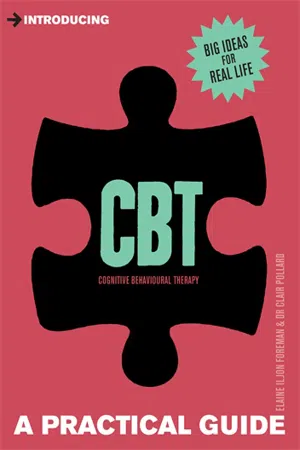
A Practical Guide to CBT
From Stress to Strength
- 224 pages
- English
- ePUB (mobile friendly)
- Available on iOS & Android
eBook - ePub
About this book
Information
Subtopic
Cognitive Psychology & CognitionIndex
Psychology1. Introducing CBT
Men are disturbed not by things but by the views which they take of them … when, therefore, we are hindered, or disturbed, or grieved, let us never blame anyone but ourselves: that is, our own judgments.
Epictetus, Greek Philosopher
Cognitive Behavioural Therapy: where did it come from?
Some readers may be familiar with the name of Pavlov, and his early experiments in the 1900s looking at the way in which dogs can be ‘conditioned’ to salivate at the sound of a bell. What many people don’t know is that Pavlov was actually studying the digestive system of dogs and just happened to observe this ‘conditioned reflex’. However, he opened up a whole new field of study, allowing new insights into understanding the way in which animals learn. From there, it was but a small step to transfer this knowledge from four-legged to two-legged creatures. So the field of behaviour therapy was born. It stemmed from applying the principles of learning theory to shaping the behaviour of first animals and eventually humans, looking at ways in which altering behaviour might help alleviate psychological ‘disorders’.
Dr. Aaron Beck, originally a psychoanalyst, is generally credited with founding cognitive therapy in the 1970s. Working with depressed patients, he noticed they experienced a series of spontaneous negative thoughts, which he called automatic thoughts. He divided them into 3 categories: negative thoughts relating to the self, to the world and to the future. Working to identify and challenge these thoughts enabled patients to re-evaluate them more realistically. The result? The patients felt better and showed positive changes in behaviour. They became able to think in a more balanced, realistic way; to feel better emotionally and to behave in a more functional manner. The key concept of cognitive therapy concentrates on how we process information, organize it, store it, and relate new information to old. In cognitive therapy we focus on understanding the way in which humans think and applying these principles to the treatment of psychological disorders.
In the 1970s and 1980s furious debate raged over whether behaviour therapy or cognitive therapy held the key to understanding and overcoming psychological difficulties. Eventually, although there is no general agreement of exactly when, it became clear that this wasn’t a contest with a winner and a loser. People neither operate on purely behavioural principles, nor live their lives based purely on thinking. It is in this realization that we find the roots of CBT.
There is an apocryphal tale of a paper written in the early 1990s. It was about understanding the nature and treatment of a particular anxiety disorder. The author believed in its importance (which author doesn’t?!) and was convinced that the research had international significance. But there was a conundrum – two world conferences appeared to address the subject matter. One was the World Congress of Behaviour Therapy, the other the World Congress of Cognitive Therapy. The two were apparently miles apart, the conceptual separation reflected geographically, with one taking place in Canada, the other in Australia!
How to make a decision? As a behavioural experiment, the author sent an identical abstract to both. The result? BOTH were delighted to accept the paper as truly representative of research in that field! This is actually no shaggy dog’s tale – the author in question is the first author of this book!
So what happened the following year? A historical first took place – the first World Congress of Behavioural and Cognitive Therapies. This fortunately meant that from then on, Elaine only had to submit her research to one conference, instead of two!
Modern ‘Cognitive Behavioural Therapy’ – the CBT which this book explores – applies principles of both schools of thought to the treatment of psychological distress. It looks at the way in which our thoughts, emotions, behaviours and physical states all interact to cause and maintain difficulties. Since we know all of these factors interact, it follows that altering any one of them will have an effect on the others. CBT focuses on the way we can change patterns of thinking and behaviour in order to feel better.
Now, nearly 20 years later, we are moving into what is called the ‘third wave’ of CBT. Instead of just ‘mind’ and ‘behaviour’, CBT is moving into domains previously addressed primarily by other traditions, in the hopes of improving both understanding and outcomes. Thus third wave therapies include concepts such as mindfulness meditation, acceptance, values and relationships. The emphasis in these newer ways of working is less on changing the content of thoughts; rather it is on changing our awareness of and relationship to thoughts. If you are interested in reading more about this see our list of suggested resources in Chapter 8. So: where are we now?
What is Cognitive Behavioural Therapy?
Cognitive Behavioural Therapy (CBT) techniques have been developed from extensive research. Studies indicate that treatments for psychological disorders based on CBT principles:
- Are as effective as medication in treating many psychological disorders and often more effective in effecting long-lasting change and preventing relapse
- Are particularly effective for common mental health problems such as anxiety, depression, panic disorder, phobias (including agoraphobia and social phobia), stress, eating disorders, obsessive-compulsive disorder, post-traumatic stress disorder and difficulties with anger
- Can help if you have a low opinion of yourself, or physical health problems like pain or fatigue
- Can also be useful in helping to manage more severe mental health problems like bipolar disorder (previously called ‘manic-depression’) and psychosis.
CBT works on the principle that our behaviour and emotions depend to a large degree on our perception of what we understand is happening. What we think and anticipate can greatly affect our reaction to events and people. Having understood what you are thinking and how to deal with your thoughts, it is possible to train yourself to respond in a different way. This new style of thinking and behaving can then lead to a potentially more satisfying way of life, becoming part of your normal lifestyle.
CBT uses practical techniques and exercises to help you make lasting changes in the way in which you think and behave in order to help you feel better.

In this book we concentrate on the practical skills and techniques that have been developed using the principles of CBT. They are presented in a format that is easy to use, so you can develop the life and lifestyle that is right for you. We have focused on the more common areas of mental distress and discomfort experienced by a large number of people.
PLEASE NOTE: If at any point when you are working through this book you find that things are getting worse rather than better, do seek professional help immediately. Likewise if your mood drops and you start to feel overwhelmed, ensure that you see either your GP or one of the mental health professionals described in Chapter 9.
2. The ABC of CBT
The ABC of CBT:
Antecedents – Beliefs – Consequences
A = the Antecedent, trigger event or occurrence which appears to lead to an emotional reaction.
B = our Beliefs, thoughts, interpretation or evaluation of that event and its possible causes or meaning.
C = the Consequences of that way of viewing the event – our emotional or behavioural reaction to it.
Imagine you are in bed at night, alone in the house and you hear a sudden noise downstairs. This is the antecedent, the triggering event – an A.
You might think you’d know immediately how you’d react or feel in this situation. Actually, our feelings and reactions depend entirely on how we interpret the A. Look at the three possibilities below:
- You might think: ‘Oh gosh there have been several burglaries in this area recently, I bet it’s them’. This would be a belief, or thought – a B. It might follow that you’d feel scared or even angry. This would be a consequence, or reaction – a C. Your behavioural reaction (another C) might be to hide under the covers or to call the police.
- You might think: ‘That’s my son coming home late again and crashing around waking me up – third time this week – he’s always so thoughtless!’ – a very different B. In this case your reaction (C) might also be quite different. Now you might feel very angry and frustrated and your behavioural C might be to shout at him or try to impose some kind of sanction.
- But you might think: ‘Ahh! That’s my lovely partner returning earlier than expected to surprise me because I was feeling a bit low today. How very sweet!’ Then your feelings (C) might be loving and positive and your behavioural reactions (more Cs) equally so!
So, in each of these scenarios the A is exactly the same. The Cs are all completely different. What makes the difference? The Bs, our beliefs! The way in which we think about the situation determines the way we feel about it and react to it.
Of course in real life things are more complicated. Our beliefs are influenced by myriad factors including our upbringing, education and past experiences. Behavioural and emotional Cs in one situation feed into the As and Bs of other situations, and so on. However, bearing in mind these simple principles can help us understand and then make changes in many areas of difficulty.
Throughout this book we’ll be illustrating how it’s our Bs (beliefs) that largely cause the stressful Cs (consequences), not necessarily the actual situation itself. So, if someone isn’t stressed about meeting important deadlines, giving a presentation or meeting new people it’s because they believe they’ll cope well and therefore don’t predict any awful consequences. The fact that they’re not stressed in this way can then become a self-fulfilling prophecy, in that it will cause them to behave and react in positive ways which might actually make a successful outcome more likely. When we hold overly negative beliefs the opposite can happen.
A key part in the process of challenging negative beliefs is to question the commands which say you must, ought, should, or even have to achieve a particular outcome.
Where do these commands come from? Do they just pop automatically into your head, or are others telling you these things? If they’re from others, is there a reason you have to agree? Are others necessarily infallible? What would happen if you did fail? Would it really be that unbearably awful? Could you be exaggerating the outcome? And if it did happen, is there a way you could bear it, even if you didn’t like it? After all, there’s no law which says you have to like it! Challenge those previously unquestioned assumptions. Ask yourself how one missed deadline means you are a complete waste of space at work. Isn’t that a bit unfair on yourself? Would you judge others like this?
In becoming more aware of the beliefs that are driving your reactions and behaviours you can then make those beliefs more balanced, realistic and flexible, less demanding and no longer so absolute. When beliefs are modified you usually find that you feel emotionally and physically different. This actually enables you to evict ‘catastrophizing’ and his companion, procrastination, and get on with the task in hand. The consequence? You normally find yourself feeling ever so much better than before.
Have another look at the quotation from Epictetus at the start of the introduction. Amazing how it’s absolutely spot on, encapsulating the latest developments in CBT, despite being said over 2,000 years ago.
But identifying the Antecedents, and the Beliefs, and then actually Challenging them, both in your mind and your behaviour, like so many things, is much easier said than done.
It’s very important to tell yourself that like any new skill, learning your ABC takes a while. It will take time before you know it by rote, and can incorporate it automatically into your daily routine.
Think of this book as your mental workout – af...
Table of contents
- Cover
- Title Page
- Copyright
- About the authors
- Author’s note
- Contents
- 1. Introducing CBT
- 2. The ABC of CBT
- 3. Improving your sleep
- 4. Managing anxiety
- 5. Beating bad habits and building better ones
- 6. Dealing with depression
- 7. Coping with bad times
- 8. Maintaining progress and reducing recurrences
- 9. What now? Further helpful resources
- Acknowledgements
- Dedication
Trusted by 375,005 students
Access to over 1.5 million titles for a fair monthly price.
Study more efficiently using our study tools.
Frequently asked questions
Yes, you can cancel anytime from the Subscription tab in your account settings on the Perlego website. Your subscription will stay active until the end of your current billing period. Learn how to cancel your subscription
No, books cannot be downloaded as external files, such as PDFs, for use outside of Perlego. However, you can download books within the Perlego app for offline reading on mobile or tablet. Learn how to download books offline
Perlego offers two plans: Essential and Complete
- Essential is ideal for learners and professionals who enjoy exploring a wide range of subjects. Access the Essential Library with 800,000+ trusted titles and best-sellers across business, personal growth, and the humanities. Includes unlimited reading time and Standard Read Aloud voice.
- Complete: Perfect for advanced learners and researchers needing full, unrestricted access. Unlock 1.5M+ books across hundreds of subjects, including academic and specialized titles. The Complete Plan also includes advanced features like Premium Read Aloud and Research Assistant.
We are an online textbook subscription service, where you can get access to an entire online library for less than the price of a single book per month. With over 1.5 million books across 990+ topics, we’ve got you covered! Learn about our mission
Look out for the read-aloud symbol on your next book to see if you can listen to it. The read-aloud tool reads text aloud for you, highlighting the text as it is being read. You can pause it, speed it up and slow it down. Learn more about Read Aloud
Yes! You can use the Perlego app on both iOS and Android devices to read anytime, anywhere — even offline. Perfect for commutes or when you’re on the go.
Please note we cannot support devices running on iOS 13 and Android 7 or earlier. Learn more about using the app
Please note we cannot support devices running on iOS 13 and Android 7 or earlier. Learn more about using the app
Yes, you can access A Practical Guide to CBT by Clair Pollard,Elaine Foreman,Elaine Iljon Foreman in PDF and/or ePUB format, as well as other popular books in Psychology & Cognitive Psychology & Cognition. We have over 1.5 million books available in our catalogue for you to explore.