- 176 pages
- English
- ePUB (mobile friendly)
- Available on iOS & Android
eBook - ePub
About this book
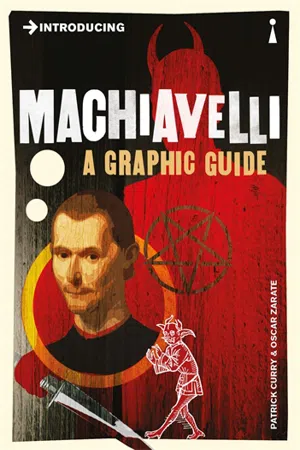
Illustrated guide to the crucial Italian philosopher and author of The Prince. 'Machiavellian' is a popular byword for treachery and opportunism. Machiavelli's classic book on statecraft, The Prince, published over 400 years ago, remains controversial to this day because of its electrifying frankness as a practical guide to power. Is it a how-to manual for dictators, a cynical philosophy of 'the end justifies the means', or a more complex and subtle analysis of successful government? Machiavelli was a loyal servant of the Florentine republic. His opposition to Medici despotism led him to torture on the rack and exile, and yet he chose as his model for the Prince the most notorious tyrant, Cesare Borgia. Introducing Machiavelli traces the colourful life of this paradoxical realist whose clear-sighted patriotism made him the first truly modern political scientist. Machiavelli is seen as central to the postmodern debate on Civil Society. This book brings the creative turbulence of Renaissance Italy to life, and presents a compelling portrait of a key figure of European political history.
Information
Topic
PhilosophySubtopic
Historical Biographies“Old Nick”
For over four hundred years, Niccolò Machiavelli has been a byword for cynicism, immorality and cruelty in politics. In the 16th century, his first name was often shortened to “Old Nick”, the popular nickname for Satan. The Jesuits (themselves accused of Machiavellism by Protestants) called him “the Devil’s partner in crime”. “Murderous Machiavel” became a favourite reference in Elizabethan plays, including those of Shakespeare.
As Lord Macaulay wrote in 1827, “We doubt whether any name in literary history be so generally odious …”

This is how the philosopher Bertrand Russell, in our own century, described Machiavelli’s most famous book, The Prince.

A HANDBOOK FOR GANGSTERS…
WELL… AH…
A HANDBOOK FOR STATESMEN!
WELL… AH…
A HANDBOOK FOR STATESMEN!
Fittingly, one of the people Russell probably had in mind, Benito Mussolini, praised it. He had a strong view about whom the new Prince was meant to be and wrote a foreword to a new edition.
This undoubtedly explains the response of Henry Kissinger, for several years the power behind the presidential throne in American politics, to an interviewer’s suggestion in 1972 that he was a Machiavellian: “No, not at all!” Was he not influenced by Machiavelli’s ideas to at least some extent?
As we shall see, Machiavelli had his fans too, and many of these, like the philosopher Francis Bacon, were not thugs.

WE ARE MUCH BE HOLDEN TO MACHIAVELLI AND OTHERS, THAT WRITE WHAT MEN DO, AND NOT WHAT THEY OUGHT TO DO
NICCOLO MACHIAVELLI WROTE ABOUT THE WORLD WE LIVE IN, MAN, THE WAY IT REALLY IS, WITHOUT ALL THE BULLSHIT.
NICCOLO MACHIAVELLI WROTE ABOUT THE WORLD WE LIVE IN, MAN, THE WAY IT REALLY IS, WITHOUT ALL THE BULLSHIT.
But Machiavelli’s bad press continues today. The Prince, says the Guardian newspaper, is “the ultimate handbook in political expediency”. And the latest edition of Chambers English Dictionary has Machiavellian as an adjective, meaning “politically cunning and unscrupulous, seeking power or advantage at any price; amoral and opportunist”.
So what was Machiavelli: evil genius or brilliant political theorist? And what does he have to tell us today? To answer that you have to know who he was, and what he wrote in relation to his own time and problems.
Renaissance Florence
The golden age of Florence was in the 15th century. Florence’s wealth became legendary. Its coin, the florin, was respected everywhere, and its merchants conducted business far and wide, first in the wool industry and then in silk and trade with the East. One of the richest and most successful families was the Medici. Originally from the Mugello valley, they amassed great wealth as merchant bankers and became bankers to the Papacy. Soon their ambitions extended to politics, the Papacy itself, and the rulership of their native city. But the Medici were also renowned as generous patrons of the arts and humanities. They were no petty tyrants.

Emblem of Florence
This combination of commerce, culture and enlightened despotism made Florence the Renaissance equivalent of Athens in classical antiquity, another turning point in European culture and civilization.
Thanks to the patronage of wealthy merchant families like the Medici, in a time of almost unprecedented creativity and optimism, Florence became the principal centre for Western arts and sciences. Around 1420, Filippo Brunelleschi designed the huge dome of the cathedral of Santa Maria del Fiore, near the Tower by Giotto, and, together with Ghiberti, oversaw its construction. It was completed in 1436, although the lantern was not finished until after Brunelleschi’s death. Along with Alberti, he also developed linear perspective.

Discoveries in anatomy, combined with artistic creativity, distinguished the sculptures of Donatello and the paintings of Piero della Francesca. Botticelli’s Birth of Venus and Primavera exquisitely expressed the new interest in pagan classical subjects.

Leonardo da Vinci was a Florentine and in his life and work perhaps best exemplifies its intellectual curiosity, humane scepticism, and sensitivity. He rubbed shoulders in Florence with Michelangelo, the giant of Western sculpture and painting, as he developed his mastery of the human form.

And, incredibly, the still younger Raphael – from Urbino, but painting in Florence – visited and watched both men’s work in progress.

At the same time, ideas about the frontiers of the known physical world were also being challenged. Christopher Columbus set sail on his first historic trip in 1492. Shortly afterwards, he was followed by a Florentine, Amerigo Vespucci, who gave his name to the Americas.

PATIENCE, COMRADES: LAND IS JUST AROUND THE CORNER!
THE PARTY’S OVER… THE ITALIANS ARE COMING!
HMMM–AMERICA… WHAT A GOOD NAME FOR A NEW WORLD!
THE PARTY’S OVER… THE ITALIANS ARE COMING!
HMMM–AMERICA… WHAT A GOOD NAME FOR A NEW WORLD!
In philosophy, Cosimo de’Medici commissioned Marsilio Ficino to translate the mystical writings of Hermes Trismegistus and Pl...
Table of contents
- Cover
- Title Page
- Copyright
- Contents
- “Old Nick”
- Further Reading
- Index
Trusted by 375,005 students
Access to over 1.5 million titles for a fair monthly price.
Study more efficiently using our study tools.
Frequently asked questions
Yes, you can cancel anytime from the Subscription tab in your account settings on the Perlego website. Your subscription will stay active until the end of your current billing period. Learn how to cancel your subscription
No, books cannot be downloaded as external files, such as PDFs, for use outside of Perlego. However, you can download books within the Perlego app for offline reading on mobile or tablet. Learn how to download books offline
Perlego offers two plans: Essential and Complete
- Essential is ideal for learners and professionals who enjoy exploring a wide range of subjects. Access the Essential Library with 800,000+ trusted titles and best-sellers across business, personal growth, and the humanities. Includes unlimited reading time and Standard Read Aloud voice.
- Complete: Perfect for advanced learners and researchers needing full, unrestricted access. Unlock 1.5M+ books across hundreds of subjects, including academic and specialized titles. The Complete Plan also includes advanced features like Premium Read Aloud and Research Assistant.
We are an online textbook subscription service, where you can get access to an entire online library for less than the price of a single book per month. With over 1.5 million books across 990+ topics, we’ve got you covered! Learn about our mission
Look out for the read-aloud symbol on your next book to see if you can listen to it. The read-aloud tool reads text aloud for you, highlighting the text as it is being read. You can pause it, speed it up and slow it down. Learn more about Read Aloud
Yes! You can use the Perlego app on both iOS and Android devices to read anytime, anywhere — even offline. Perfect for commutes or when you’re on the go.
Please note we cannot support devices running on iOS 13 and Android 7 or earlier. Learn more about using the app
Please note we cannot support devices running on iOS 13 and Android 7 or earlier. Learn more about using the app
Yes, you can access Introducing Machiavelli by Patrick Curry,Oscar Zarate in PDF and/or ePUB format, as well as other popular books in Philosophy & Historical Biographies. We have over 1.5 million books available in our catalogue for you to explore.