Essays examining the relationships between culture, film, and the audience around the turn of the twentieth century.
The current digital revolution has sparked a renewed interest in the origins and trajectory of modern media, particularly in the years around 1900 when the technology was rapidly developing. This collection aims to broaden our understanding of early cinema as a significant innovation in media history. Joining traditional scholarship with fresh insights from a variety of disciplines, this book explains the aesthetic and institutional characteristics in early cinema within the context of the contemporary media landscape. It also addresses transcultural developments such as scientific revolutions, industrialization, urbanization, and globalization, as well as differing attitudes toward modernization.
Film 1900 is an important reassessment of early cinema's position in cultural history.
"The capable Ligensa and Kreimeier invited a coterie of renowned Continental scholars and thinkers to reflect on issues of modernity and cinema by harking back to the fin de siècle. . . . Summing Up: Highly recommended. Graduate students, researchers, faculty." —T. Lindval,
Choice
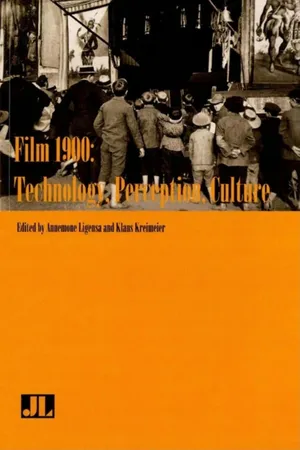
eBook - ePub
Film 1900
Technology, Perception, Culture
- 256 pages
- English
- ePUB (mobile friendly)
- Available on iOS & Android
eBook - ePub
Film 1900
Technology, Perception, Culture
About this book
Information
Subtopic
Film History & CriticismChapter 1
Archaeologies of Interactivity: Early Cinema, Narrative and Spectatorship
Thomas Elsaesser
It is difficult not to discuss contemporary cinema in terms of its multiple – and for some, mortal – crises: loss of indexicality, due to the transition from photographic to digitally generated images; death of the auteur cinema, even in Europe, as a creative force, overtaken once more by Hollywood’s Bat-, Spider- and Iron-Men, with their sequels and prequels; decline of the cinema as an art-form, its medium-specificity diluted by the hybridisation of a film’s textual autonomy in the DVD bonus package; appropriation of the cinema’s history and cannibalisation of its cultural memory through television and the internet serving up teasers, trailers and other pre-cooked forms of compilation and compression. Finally, some of the most persistent anxieties arising from these crises of cinema centre on spectatorship and narrative, figured as a loss of attention and the decay of storytelling. Filmmaking, according to this argument, is threatened by the impatient, hyperactive spectator, and trapped by the contradiction between ‘game logic’ and ‘narrative logic’.
Of course, these symptoms of decline can be turned around and advertised as signs of continuity, transformation and renewal: digital technologies have vastly extended a filmmaker’s creative tools; special effects have been the lifeblood and ‘attractions’ of cinema since its beginning; platforms like the video recorder or the DVD player have created new markets not only for the mainstream; the bonus package encourages reflexivity, provides historical information, technical background and can be put to good pedagogical use, while television and the internet open up distribution, circulation and choice unmatched by site-specific cinemas. As to the active-interactive spectator, his or her heightened involvement in the story or immersion in the spectacle has been the goal of the popular arts for centuries.
In what follows, I shall take a different line of defence, arguing that it is possible to map certain variables around spectatorship and narrative (which include some, though by no means all of the phenomena just listed) and trace their persistence as a constant throughout the history of cinema, thus providing a possible ‘archaeology’ for both the impatient viewer and the interactive user. It means shifting somewhat the ground and focus of our theories, while extending the conceptual framework deployed by the studies of spectatorship in film theory and cultural studies towards anthropology. As so often, such a shift is best implemented by a ‘return’ to early cinema: reviewing – and, if necessary, revising – our interpretations of the cinema’s initial modes of bodily engagement and sensory immersion. If successful, it should permit a fresh approach to the issue whether there is a future for the cinema after narrative, thereby also illuminating another perennial question: why and how did the cinema turn to narrative in the first place?
Modernity and the attention economy
An obvious starting point for such an archaeology would be to re-examine the evidence we have of how spectators construed or experienced cinema around 1900, how they made sense of the different kinds of movement and of the new kinds of surface agitation within the fabric of the everyday. Did the apparitions on the screen take them out of their lives into the ‘kingdom of shadows’, or were they inclined to integrate or embed moving images into the urban experience, as its natural extension and site of heightened sensation? Such studies have been undertaken under the headings of modernity and visuality, of shock and protective shield, conceptually held together by the idea of a ‘cinema of attractions’, typical for an intense and immersive but also intermittent and impatient spectatorial habitus. Fast-forward to 2000: can one locate a similarly contradictory dynamic (or ‘dialectic’) in contemporary modes of spectatorship, and how might one describe their polarities? In other words, what are the dynamics of attention and interaction commensurate with our contemporary media environment, and what kinds of bodily presence and sensory agency do they entail or stage?
A second shift is required: one that opens up the somatic as well as the perceptual field, taking us away from the cinema as a physical site of optical projection, though hopefully only in order to bring us back to the cinema as a space of mental, affective and sensory extension. Firstly, then, let us look at ‘attention’, that is, the selective perception of a particular stimulus (sustained by means of concentration and the exclusion of interfering sense-data).1 In the contemporary knowledge society and information economy, attention has arguably risen to the status of a universal currency, while also becoming this society’s scarcest resource. As such, it paradoxically emerges as both a problem (for child psychologists, cultural critics and advertisers) and a solution (for audiences and spectators), in that the audio-visual media constantly solicit our attention and spare no effort or expense to retain it. Attention is the problem for educators, under the name of attention deficit disorder, and for cultural critics who lament the general amnesia in our culture, blaming television or video games. But attention is the solution when considered as a response to the dilemmas of overload and over-exposure, because as a form of selectivity, as an ability to shift or switch, it allows for a mode of perception – and by extension, spectatorship – that refuses to be absorbed or drawn in, that resists contemplation or analysis in depth, resolutely staying on the surface and remaining alert. It is the reed rather than the rooted tree that weathers the storm, and it is the cork, bobbing on the water, that survives a flood.
What if the attention economy demanded choices being made between being ‘reed’ or ‘cork’, rather than, as used to be, between ‘active’ and ‘passive’ spectatorship, or between ‘identification’, ‘distraction’ and ‘distanciation’? In such a case, the much-maligned figure of the television zapper, along with the equally despised first-person shooter of the video game might yet become the unlikely heroes of these new ‘flexible’ modes of perception: witting or unwitting vanguard figures, parrying the double-binds of interactivity, as bodies engage with images, and images require different motor-skills or hand-eye coordination in order to be ‘grasped’. At once target and survivor, the zapper wields the remote control as much to ward off the ever-increasing army of programmes, as s/he selects favourites or chooses amongst them. But the zapper is also the canny user, the disabused and uncommitted sceptic, who surveys all, brushes or grazes the media world with the lightest of touches, before deciding who or what to engage with, and for how long. Similarly, the first person shooter, armed with joystick, console or mouse, learns to be both defensive and aggressive, to anticipate the ambush and prepare for the next proactive, pre-emptive move, all in order to gain a foothold on the terrain, and then to stay the course.
It may seem that these two figures – the zapper and the gamer – are typical phenomena of the last 30-odd years, products of television and the Internet and thus symptomatic of precisely those crises of the cinema just mentioned, especially the decay of narrative and the corresponding decadence of spectatorship.2 Yet one can also recognize in this configuration a much older cultural trope, that of ephemerality, chance and the fugitive moment, first diagnosed by Charles Baudelaire around the emergence of photography, with its confusing and hyper-stimulating l’émeute du detail (‘riot of detail’), given a heroic-ironic embodiment in the urban rag-picker, the drunk and the dandy, but also – even more emblematic for our purposes – typified in the ‘man of the crowd’, from the story by Edgar Allen Poe. The significance of this tale largely comes to us through Walter Benjamin, interpreting Baudelaire, who translated Poe. The man of the crowd’s modernity is manifest in his anonymity as much as in his ‘state of heightened sensitivity’: As Poe describes him, in ‘one of those happy moods – which are so precisely the converse of ennui-moods – of the keenest appetency, when the film from the mental vision departs … and the intellect, electrified, surpasses greatly its everyday condition’,3 he can stand for a new somaticsensory state of immersive bodily attention.
Yet such clarity of alertness, coupled with introspection, also acts like a shield or mirror: for much of the time, Poe’s protagonist is not immersed in the ebb and flow, but glued to his window as if to a screen, watching the crowd over a whole day and night cycle, both switching focus and varying speed. It is as if Poe’s narrative anticipates or emulates some typically ‘cinematic’ techniques of montage and editing, as well as ‘televisual’ ones, of fast-forward and action-replay, and thus the protagonist becomes not only the well-known flâneur of the metropolis in Benjamin’s interpretation, but already the zapping attention-flâneur of media-immersion and media-saturation.
In other words, the trope of the ‘fugitive moment’, of ‘sensory overload’, of ‘heightened sensitivity’ and selective surface attention inevitably brings us back to Benjamin and Siegfried Kracauer’s theories of the ‘culture of distraction’, which Benjamin contrasts to the reception mode of ‘auratic’ works of art, and Kracauer to the reading mode of the realist novel. If Versenkung (‘sinking into a text’) is the gathered, focused concentration that leads to immersion, distraction is the mode of perception engendered by the technical media, particularly the cinema.
At this point, one needs to be clearer what is meant by ‘cinema’. Benjamin keeps intact the essential tensions just outlined between distraction and focussed immersion, which I argue are typical for the contemporary mode of selective attention and bodily participation. Yet he refers to a cinema that knows about the problematic status of narrative, as in the films of Sergei Eisenstein or Dziga Vertov, neither of whom assumes storytelling to be the necessary destiny of cinema, as it reaches ‘maturity’ as an art form. Likewise Benjamin, for whom the turn to narrative is more like a compromise formation or even a reactive rearguard action, a sign of the cinema mimicking the bourgeois novel. As is well-known, in the debate between ‘realists’ and ‘formalists’, Benjamin favoured the montage cinema of the Soviets, but not exclusively for the political reasons of outlining an aesthetics appropriate to the Socialist revolution.
The mode of ‘distracted viewing’ and the ‘montage of attraction’ advocated in Benjamin’s ‘Artwork’-essay4 signify both more and less than artistic experiment and revolutionary practice. They can be understood as a complex counter-stance to another kind of revolution. For with the emergence and rapid dissemination of mechanically reproduced sounds and images at the turn of the twentieth century, there began a data-flow previously unknown in human history, whose main material supports were the cinema, photography, radio and the gramophone. Time and the moment could now be stored, without the intervention of any kind of symbolic notation, such as a musical score, verbal language or a chronometer. But the recording and transmission of sights and sounds, thanks to the camera and the phonograph, also meant the proliferation of acoustic and optical data in quantities, and with a degree of physiological presence as well as signal precision (‘fidelity’) hitherto unimaginable. The impact can be measured negatively: widely resented as a threat to the established arts and their institutions, the cinema also occasioned medical warning about eye strain and attention-deficit, besides the better-known moral panics about sexuality, drink and other ‘depravities’ or ‘degeneracies’. But mechanical reproduction also gave rise to what has been called ‘haunted media’: extremely popular para- and pataphysical experiments that accompanied the discovery of electricity, electro-acoustics, electromagnetic fields and radio waves. Jeffrey Sconce (who coined the term) has documented some of the rich folklore and fantasy-literature accompanying the introduction into everyday life of the telephone, the telegraph and the wireless.5 Friedrich Kittler has shown how
all data-flows prior to the phono- and cinematograph had to be cut up, symbolized and pass through the ‘gate’ of the signifier: alphabet, grammatology, writing … [so that the technical media] launched a two-pronged attack on … the book [and its monopoly] on the storage of serial data. The gramophone [for instance] empties out worlds by bypassing their imaginary aspect (signifieds) for their real aspects (the physiology of the voice).6
Against this background, Benjamin’s theories and Eisenstein’s practice can be seen as the complex aesthetic-philosophical interventions that they are: both mimetic of the riot of detail unleashed by audio-visual technology and anti-mimetic in that they try to recapture or re-instate the regulatory powers of language and grammar, of form and syntax for these seemingly undifferentiated, unframed, horizon-less magnitudes of data. A materialist media theory (around repetition, seriality and assembly) as well as the idea of film language (around montage and interval) answer to Benjamin’s dual concerns, namely to identify the cinema as the art-form appropriate to technical modernity and to elaborate a theory of spectatorship that combines the mode of distraction with that of immersion. At another, philosophical stage, the cinema exposes the contradictions between Erfahrung and Erlebnis (two kinds of ‘experience’: integrated and continuous vs. shock-like and intermittent), thereby becoming, in Benjamin’s words, modernity’s optical unconscious.7 It is in this context that the question of narrative becomes decisive: its therapeutic function – to contain conflicts by representing actions and motives as Manichean either/or choices – at once disguises and highlights the breach in the fabric of experience that it is meant to heal. In terms of the embodied spectator as modernity’s subject, Benjamin argues against narrative, because its ‘linearised’ focalisation of attention and its causal chains of temporal succession put the body under the tyrannical dominance of the eye, while repressing this body’s other faculties and senses.8 Instead, filmmakers should use the ‘dynamite of the millisecond’ to blast open the artificial continuum of narrative, to inoculate the spectator against the very hierarchy that vision imposes on the sensible world.
Forty years on, the same questions would be debated around ‘interpellation’, ‘voyeurism’ and ‘subject-positioning’ as the ideological effects of narrative in psychoanalytically inspired film theory. In both Benjamin and Screen Theory, the cinema appears as an apparatus of integration and stabilisation, disciplining the spectator via pleasure rather than coercion. Yet only Benjamin – emphasizing the somatic, traumatizing aspects, where bodily motor-skills are the perpetual ‘return of the repressed’ and thus the default mode of cinema’s mode of perception – is fully alert to the monitoring, and, above all, self-monitoring type of reflexivity inherent in the cinema. Anticipating Michel Foucault’s surveillance paradigm, Benjamin, perhaps more than Jacques Lacan, is the theorist to take along when undertaking an archaeology of the zapper and the gamer, who is training, besides the eyes and vision, also fingers, touch and hands, making them fit for new steering, monitoring and self-monitoring tasks. Such an archaeology would inevitably lead us back to early cinema and the origins of narrative in the dilemmas of spectatorship.
One of the singular achievements of New Film History and early c...
Table of contents
- Cover
- Title page
- Copyrights
- Contents
- Introduction Triangulating a Turn: Film 1900 as Technology, Perception and Culture
- Chapter 1 Archaeologies of Interactivity: Early Cinema, Narrative and Spectatorship
- Chapter 2 Viewing Change, Changing Views: The ‘History of Vision’-Debate
- Chapter 3 The Ambimodernity of Early Cinema: Problems and Paradoxes in the Film-and-Modernity Discourse
- Chapter 4 Mind, the Gap: The Discovery of Physiological Time
- Chapter 5 ‘Is Everything Relative?’: Cinema and the Revolution of Knowledge Around 1900
- Chapter 6 The Aesthetic Idealist as Efficiency Engineer: Hugo Münsterberg’s Theories of Perception, Psychotechnics and Cinema
- Chapter 7 Between Observation and Spectatorship: Medicine, Movies and Mass Culture in Imperial Germany
- Chapter 8 The Scene of the Crime: Psychiatric Discourses on the Film Audience in Early Twentieth Century Germany
- Chapter 9 Seen Through the Eyes of Simmel: The Cinema Programme as a ‘Modern’ Experience
- Chapter 10 ‘Under the Sign of the Cinematograph’: Urban Mobility and Cinema Location in Wilhelmine Berlin
- Chapter 11 Perceptual Environments for Films: The Development of Cinema in Germany, 1895–1914
- Chapter 12 ‘Fumbling Towards Some New Form of Art?’: The Changing Composition of Film Programmes in Britain, 1908–1914
- Chapter 13 The Attraction of Motion: Modern Representation and the Image of Movement
- Chapter 14 ‘Dashing Down Upon the Audience’: Notes on the Genesis of Filmic Perception
- Chapter 15 German Tonbilder of the 1900s: Advanced Technology and National Brand
- Chapter 16 Sculpting With Light: Early Film Style, Stereoscopic Vision and the Idea of a ‘Plastic Art In Motion’
- Chapter 17 ‘A Cinematograph of Feminine Thought’: The Dangerous Age, Cinema and Modern Women
- Chapter 18 Cinema as a Mode(l) of Perception: Dorothy Richardson’s Novels and Essays
- Acknowledgements
- Biographies of the Authors
- Back Cover
Trusted by 375,005 students
Access to over 1.5 million titles for a fair monthly price.
Study more efficiently using our study tools.
Frequently asked questions
Yes, you can cancel anytime from the Subscription tab in your account settings on the Perlego website. Your subscription will stay active until the end of your current billing period. Learn how to cancel your subscription
No, books cannot be downloaded as external files, such as PDFs, for use outside of Perlego. However, you can download books within the Perlego app for offline reading on mobile or tablet. Learn how to download books offline
Perlego offers two plans: Essential and Complete
- Essential is ideal for learners and professionals who enjoy exploring a wide range of subjects. Access the Essential Library with 800,000+ trusted titles and best-sellers across business, personal growth, and the humanities. Includes unlimited reading time and Standard Read Aloud voice.
- Complete: Perfect for advanced learners and researchers needing full, unrestricted access. Unlock 1.5M+ books across hundreds of subjects, including academic and specialized titles. The Complete Plan also includes advanced features like Premium Read Aloud and Research Assistant.
We are an online textbook subscription service, where you can get access to an entire online library for less than the price of a single book per month. With over 1.5 million books across 990+ topics, we’ve got you covered! Learn about our mission
Look out for the read-aloud symbol on your next book to see if you can listen to it. The read-aloud tool reads text aloud for you, highlighting the text as it is being read. You can pause it, speed it up and slow it down. Learn more about Read Aloud
Yes! You can use the Perlego app on both iOS and Android devices to read anytime, anywhere — even offline. Perfect for commutes or when you’re on the go.
Please note we cannot support devices running on iOS 13 and Android 7 or earlier. Learn more about using the app
Please note we cannot support devices running on iOS 13 and Android 7 or earlier. Learn more about using the app
Yes, you can access Film 1900 by Annemone Ligensa, Klaus Kreimeier, Annemone Ligensa,Klaus Kreimeier, Klaus Kreimeier, Annemone Ligensa in PDF and/or ePUB format, as well as other popular books in Media & Performing Arts & Film History & Criticism. We have over 1.5 million books available in our catalogue for you to explore.