The representation of aquatic people in contemporary film and television—from their on-screen sexuality to the mockumentaries they've inspired.
Mermaids have been a feature of western cinema since its inception and the number of films, television series, and videos representing them has expanded exponentially since the 1980s.
Making a Splash analyses texts produced within a variety of audiovisual genres. Following an overview of mermaids in western culture that draws on a range of disciplines including media studies, psychoanalysis, and post-structuralism, individual chapters provide case studies of particular engagements with the folkloric figure. From Hans Christian Andersen's "The Little Mermaid" to the creation of Ursula, Ariel's tentacled antagonist in Disney's 1989 film, to aspects of mermaid vocality, physicality, agency, and sexuality in films and even representations of mermen, this work provides a definitive overview of the significance of these ancient mythical figures in 110 years of western audio-visual media.
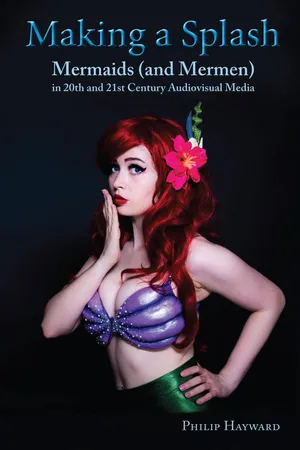
eBook - ePub
Making a Splash
Mermaids (and Mermen) in 20th and 21st Century Audiovisual Media
- 218 pages
- English
- ePUB (mobile friendly)
- Available on iOS & Android
eBook - ePub
About this book
Information
Topic
Scienze socialiSubtopic
Storia e critica del cinemaChapter One
Becoming Ariel, Becoming Ursula
‘Den lille Havfrue’ (‘The Little Mermaid’) is Danish writer Hans Christian Andersen’s best-known short story. Since its initial publication in 1837 it has been translated into a variety of languages and has been the subject of numerous stage, film and television adaptations. The first section of this chapter introduces the folkloric context of the story, its original inflections and various psychoanalytic interpretations of its narrative and symbolism. Focus then shifts to the Disney company’s sustained engagement with the story before moving on to explore subsequent screen interpretations of the scenarios and characters produced by Disney. The word “becoming” in the chapter’s title is used in two senses. The first refers to the duality of the little mermaid’s experiences. Not only does she have to negotiate the process of becoming a young adult mermaid, she then has to cope with the implications of her decision to transform into a young adult woman. Entwined with its exploration of these facets, the chapter also characterises the manner in which the nameless principal protagonist of Andersen’s original work became ‘Ariel’ and the nameless sea witch became ‘Ursula’ within a body of Disney texts and subsequent productions. The chapter thereby moves from folklore through literary adaptation to media-lore, documenting the processes of those transitions.
I. Danish Roots
It is impossible to understand The Little Mermaid as Andersen intended without first understanding the folkloric mermaid. Attempting to do so is the equivalent of reading Beatrix Potter’s Peter Rabbit without ever having heard of any rabbit besides Bugs Bunny. (Grydehøj 2006: 10)
There is a critical consensus that Andersen’s short story ‘Den lille Havfrue’ was his own invention rather than his interpretation of an existing folk tale. While this may be an accurate characterisation it has resulted in limited address to prior representations of aquatic people in the Danish cultural context from which Andersen emerged and their potential linkage to and/or inspiration for aspects of his short story.
The modern nation state of Denmark comprises the Jutland peninsula together with over 400 islands (and many smaller islets), the majority located off the eastern coast of the peninsula. As a result of this geography, and its position at the mouth of the Baltic Sea where it meets the North Atlantic Ocean, the country has had a long association with the sea and with maritime livelihood activities. This orientation has, in turn, been reflected in various aspects of its folklore. Water-dwelling types of men and women, referred to as havmænd and havfruer (the plurals of havmanden and havfrue), have been recurrent and well documented motifs in its folklore. As discussed in the Introduction to this volume, while the Danish terms are now routinely translated as ‘mermaids’ and ‘mermen’ there is nothing in their linguistic basis that specifies piscine lower bodies and the terms refer to a wide range of water-dwelling folk. This stated, a substantial strand of havmanden and havfrue folklore does concern fish-tailed people. In 1833, for instance, Danish folklorist Andreas Faye provided the following account of aspects of havmænd and havfruer:
The males are of a dusky hue, have a long beard, and black hair, and above are like men but below like fishes; the females on the contrary are beautiful, and above are like the fairest women, but shaped like a fish below. Their children are called ‘Marmaeler’, sea talkers, and fishermen sometimes take them home to get from them a knowledge of the future. It is however a rare occurrence to hear the merwomen talk or sing. Seamen are very sorry to see these creatures because they portend a storm. (translated in Prior 1860: 330–331).
A number of representations of fish-tailed havfruer also feature in Danish churches dating from the late medieval period.25 Some are standard period images in which (as discussed in the Introduction and again in Chapter 5), the mermaid can be understood to symbolise the temptations of lust and/or vanity.26 Other images are more ambiguous. In the case of the Fanefjord Church wall painting (Figure 2), the havfrue’s voluptuous upper-bodily appearance would seem to indicate a figure symbolizing carnal desire, yet what is her purpose in the tableau of aquatic abundance? Who is she meant to be tempting? And what does the position of her arms signify? Is she raising them in alarm, or mimicking Jesus’s gestures to the left of the image? Along with these individual examples, one of the most common uses of havfrue and havmanden images in Danish churches is their inclusion in representations of God’s creation of living creatures (Mills-Kronborg Index 2004: online). This is somewhat curious on several counts. The most obvious is that the havfrue and havmanden are entirely absent from Christian creation myths and their presence in such images appears to have a more associative purpose. Yet that purpose is far from clear and scholars have not yet provided any convincing account of a singular allegorical function for the inclusion of the creatures in these scenarios. While acknowledging the latter uncertainly, it is still evident that late medieval Danish churches represented the havfrue and havmænden in a variety of symbolic contexts. Havfruer and havmænd were, thereby, figures ‘in play’ in the period in which they were painted and evidence of that play adorned Danish church walls through to Andersen’s day, when various ballads derived from regional folklore were also in circulation.27

Figure 2 – Detail from a mural at Fanefjord Church (c1480) showing a fish-tailed havfrue as a prominent motif, top right (photo: L. Pigott, Wikimedia Commons). (Note the similarity of the mermaid’s positioning on a rock to Erik Eriksen’s later bronze statue of Andersen’s Little Mermaid erected adjacent to Langelinnie Promenade in Copenhagen in 1913.)
Andersen was born in Odense, on Funen Island, in 1805 and lived there until moving to Copenhagen in 1819. In the early 1800s Denmark had a strong marine orientation. The country relied on a network of small ships to move people and goods between various parts of its archipelago and to exploit its inshore and offshore fisheries. The country was also implicated into a broader pattern of Atlantic marine trade and transport through its colonial possessions, including the Faroe Islands, Iceland and Greenland in the North Atlantic, and the islands of Saint Thomas, Saint John and Saint Croix in the Caribbean. During Andersen’s formative years Odense transformed into a port town, following its linkage to the sea by a canal that was constructed between 1799–1807. While the town was subject to major transformations, Easterlin has identified that folk traditions were still “vitally alive” in the early 1800s, noting that “although Andersen’s father, a poor cobbler, was also a freethinker and man of some education, his mother was superstitious and nearly illiterate, as were her acquaintances” (2001: 262). One significant element of local folklore concerned a nøk. In 19th Century Danish usage, the term nøk referred to water spirits of various kinds, including human- and horse-formed ones.28 One type of nøk reputed to live around Odense was believed to drown a man each year (Craigie 1896: 243–245). While functional explanations for elements of folklore tend to be reductive and conjectural, it is nevertheless possible to view figures such as the nøk as serving a prohibitive function, deterring individuals from the perils of drowning at a time when canal networks and maritime activities were expanding in the area.29
The early 19th Century was a fertile period for research into Danish folklore and a series of contemporary publications presented material gained directly or indirectly from field research (see Tangherlini 1994). A number of writers also drew on folkloric motifs for their creative work. One notable example of the latter was Bernhard Severin Ingemann, a novelist, dramatist and poet with whom Andersen corresponded. Ingemann wrote several works that included havfrue motifs, including his poem ‘Havfruen’ (1812), which describes a young man’s intoxicating nighttime encounter with a voluptuous aquatic female on a beach. The corpus of Danish folk ballads30 in circulation in the early 1800s also included a number that concerned havmænd. Prior (1860), for instance, identified a group of tales about a young woman lured to live below the waves by a havmanden (e.g. n140: 265–268, n141: 269–271 and n153: 329–334), which included the legend of ‘Agnete og Havmanden’, discussed in detail below.
Andersen first used havmanden imagery in his prose work ‘Fodreise fra Holmens Canal til Østpynten af Amager i Aarene 1828 og 1829’ (‘A walking tour from Holmen’s Canal to the eastern point of Amager in the years 1828 and 1829’) (1829). The text relates a short walk in Copenhagen made by its author-protagonist over the night of December 31st/January 1st. The disparity between the text’s title and the actual duration of the ‘tour’ undertaken has been interpreted as an exploration of the creative space available to writers (see Kramer 2013). The imagery occurs when Andersen’s author-protagonist reaches the far eastern end of Amager and contemplates moving on to the next island. At this point a bizarre havmanden appears, interrupting the author’s perambulations to offer cautionary advice. The individual is essentially figurative and his function recalls the use of fabulous creatures at the margins of medieval maps, as in the aphoristic caution hic sunt sireane (‘here be sirens’) to designate uncharted areas of ocean. In the case of Andersen’s story, the havmanden’s allegorical function is manifest in a tail made from book covers and his caution is one concerned with the bounds of creativity. Rather like folklore concerning the Odense nøk, which may have deterred humans from entering into waterways, the havmanden succeeds in stopping the story’s author-protagonist short at the water’s edge by reminding him of the necessity of keeping his fiction within the bounds of his designated book title.
Andersen also addressed the havmanden, and related aspects of differences between the terrestrial and aquatic realms, in his subsequent poem ‘Agnete og Havmanden’ (1832). Andersen’s poem takes its theme and title from a tale with German origins that circulated in Denmark in several variants in the early–mid 1800s (Prior 1860: 329). In the ballad a young woman is lured into the sea by a havmanden who wishes her to be his spouse. She agrees and lives with him beneath the surface, bearing him seven children in eight years. The scenario presented in Andersen’s poem is one where the boundaries between the terrestrial and aquatic worlds are smoothly porous. Humans, such as Agnete, can easily relocate, without anatomical inconvenience and/or transformation. Similarly, the poem’s havmanden can easily move onto land. The poem also conveys that the havmanden (and Agnete and the havmanden’s offspring) are human in form, having legs rather than tails. Many years after her relocation to the submarine world Agnete hears the sound of church bells underwater and asks her husband for permission to attend church on land. Her husband accedes to the request provided that she agrees to return to her children after her visit. She accepts the conditions and visits the church where she encounters her mother, who asks where she has been. The havmanden then enters to remind her of her family commitment but she rebuffs his entreaties and rejects her children, opting to remain on shore. Like its source, Andersen’s poem represents its havmanden as fully human in form. It also maintains another aspect of its source in representing the havmanden as an ungodly creature who causes the materiality of the church to shrink from him as he enters it. This is a somewhat complex aspect with regard to the aforementioned inclusion of the havmanden and havfrue in a number of Danish religious creation images but it is related to a perception evident in a number of other folkloric accounts that havmænd and havfruer are soulless.31 It is perhaps this aspect that weakens any moral claim the havmanden has over his wife and prevents him from exercising what might otherwise be perceived (in the early 1800s) as his standard patriarchal power. Andersen adapted the poem for the stage in 1842 and a production of it ran briefly in Copenhagen in April 1843 but received largely negative critical responses and was not subsequently staged elsewhere. Since then, both the poem and its dramatised version have had a low profile in his body of work. His short story ‘Den lille Havfrue’ was markedly more successful and has gone on to become his best known work (with its lead character immortalised in bronze by sculptor Edvard Eriksen in 1913 and installed on Copenhagen Harbour, where it has come to be prominent icon of the city).32
II. ‘Den lille Havfrue’
In 1837 Andersen published ‘Den lille Havfrue’ (‘The Little Mermaid’). There are distinct similarities between this story and his earlier poem in that both feature female protagonists who are unhappy in their submarine realms and who wish to relocate to land. There is also a sense of Andersen’s story continuing some time after the earlier poem left off in that the (unnamed) protagonist and her sisters have been reared by their father – described as the Havkongen (“sea king”) – without a mother. But while Agnete exerts agency and rejects male power in a straightforward and relatively unproblematic manner, the title figure of Andersen’s subsequent story is far more restricted by it. As elaborated below, the “little” and adolescent havfrue is constrained by patriarchy, in terms of the sea king’s authority (as both her father and her king). Her resistance to that authority is articulated in terms of her desire to be loved by and marry a human male. In this regard, the story represents a classic example of what Jung termed the Electra complex (1913) and what Freud understood to be the female version of the Oedipus complex.33 The complex refers to a developmental stage when women perceive that they are effectively born castrated, lacking the male phallus (in both its physical and symbolic aspects). As a result of this perception they first fixate on their father, in an attempt to gain access to the phallus (in an impulse that is thwarted by the incest taboo) and later turn to a male external to their family in order to gratify their desire. The substantial complicating element in Andersen’s story is that (unlike the havmanden in his earlier poem) Andersen’s little havfrue is represented as a fish-tailed entity (and, given this...
Table of contents
- Cover
- Half title
- Dedication
- Title
- Copyright
- Contents
- Acknowledgements
- Note on audiovisual material featured in this volume
- Introduction Tails, Tresses and Elusive Otherness
- Chapter 1 Becoming Ariel, Becoming Ursula
- Chapter 2 Flauntation and Fascination: The Alluring Mermaid and her Charms
- Chapter 3 Sonic Seduction: Mermaid Vocality and its Expression in Screen Soundtracks (co-authored with Jon Fitzgerald)
- Chapter 4 Making Out: Sexuality and the Transformative Mermaid
- Chapter 5 Channeling the Anima: Inspirational Folklore in The Mermaid Chair
- Chapter 6 “Mermaid-like a while”: Juvenile Mermaids and Aficionado Culture
- Chapter 7 At the Margins: Mermen on the Screen
- Chapter 8 Crypto-Science and Hoax TV: Animal Planet’s Mermaid Documentaries
- Conclusion
- Bibliography
- Appendix Chronological catalogue of audiovisual productions featuring mermaids and mermen referenced in the volume
- Index
Trusted by 375,005 students
Access to over 1.5 million titles for a fair monthly price.
Study more efficiently using our study tools.
Frequently asked questions
Yes, you can cancel anytime from the Subscription tab in your account settings on the Perlego website. Your subscription will stay active until the end of your current billing period. Learn how to cancel your subscription
No, books cannot be downloaded as external files, such as PDFs, for use outside of Perlego. However, you can download books within the Perlego app for offline reading on mobile or tablet. Learn how to download books offline
Perlego offers two plans: Essential and Complete
- Essential is ideal for learners and professionals who enjoy exploring a wide range of subjects. Access the Essential Library with 800,000+ trusted titles and best-sellers across business, personal growth, and the humanities. Includes unlimited reading time and Standard Read Aloud voice.
- Complete: Perfect for advanced learners and researchers needing full, unrestricted access. Unlock 1.5M+ books across hundreds of subjects, including academic and specialized titles. The Complete Plan also includes advanced features like Premium Read Aloud and Research Assistant.
We are an online textbook subscription service, where you can get access to an entire online library for less than the price of a single book per month. With over 1.5 million books across 990+ topics, we’ve got you covered! Learn about our mission
Look out for the read-aloud symbol on your next book to see if you can listen to it. The read-aloud tool reads text aloud for you, highlighting the text as it is being read. You can pause it, speed it up and slow it down. Learn more about Read Aloud
Yes! You can use the Perlego app on both iOS and Android devices to read anytime, anywhere — even offline. Perfect for commutes or when you’re on the go.
Please note we cannot support devices running on iOS 13 and Android 7 or earlier. Learn more about using the app
Please note we cannot support devices running on iOS 13 and Android 7 or earlier. Learn more about using the app
Yes, you can access Making a Splash by Philip Hayward in PDF and/or ePUB format, as well as other popular books in Scienze sociali & Storia e critica del cinema. We have over 1.5 million books available in our catalogue for you to explore.