A collection of essays exploring current issues in early film archiving, curation, and research.
Invented in the 1890s and premiered in Paris by the Lumière brothers, the cinematograph along with Louis Le Prince's single-lens camera projector are considered by film historians to be the precursors to modern-day motion picture devices. These early movies were often shown in town halls, on fairgrounds, and in theaters, requiring special showmanship skills to effectively work the equipment and entertain onlookers. Within the last decade, film archives and film festivals have unearthed this lost art and have featured outstanding examples of the culture of early cinema reconfigured for today's audiences.
"[T]oday's programming of early cinema . . . has to consider the audience if it wants to be successful in making the visual heritage available to as many people as possible.
Early Cinema Today shows in a fascinating, versatile, and refreshing way how this can be implemented. . . . [This book] provides practitioners with innovative ideas on how to engage potential audiences, while providing scholars with valuable insight into how film archivists and curators shape perceptions of early cinema and, through this, the direction of film scholarship." —
The Moving Image
"[This] collection presents a wide range of approaches to the programming of early film, both historically and in the present-day context, while sounding a vibrant and timely call to review the relation that has evolved between scholars, archivists, and film programmers in matters relating to the programming of early cinema today." —
Film History
- 160 pages
- English
- ePUB (mobile friendly)
- Available on iOS & Android
eBook - ePub
About this book
Information
Subtopic
Library & Information ScienceEarly Cinema Today:
The Art of
Programming and
Live Performance
Edited by
Martin Loiperdinger
 |  |
Contents
Preface by Martin Loiperdinger
Andrea Haller and Martin Loiperdinger
Stimulating the Audience: Early Cinema’s Short Film Programme Format 1906 to 1912
Part I: Programming and Performing Early Cinema Today – Outstanding Examples
Mariann Lewinsky
The Best Years of Film History: A Hundred Years Ago
Tom Gunning
‘From the Bottom of the Sea’: Early Film at the Oberhausen Festival
Madeleine Bernstorff
From the Past to the Future: Suffragettes – Extremists of Visibility in Berlin
Eric de Kuyper
Silent Films in their First Decades – Objects for Research or for Exhibition?
Vanessa Toulmin
Programming the Local: Mitchell & Kenyon and the Local Film Show
Part II: Crazy Cinématographe: Early Cinema Performance on the Luxembourg Fairground
Claude Bertemes and Nicole Dahlen
Back to the Future: Early Cinema and Late Economy of Attention
An interim report about Crazy Cinématographe
Dick Tomasovic
The Crazy Cinématographe, or the Art of the Impromptu Spectator
Claude Bertemes and Nicole Dahlen
The Art of Crazy Programming
Documentation of Crazy Cinématographe Programmes, 2007 to 2010
Conclusion
Frank Kessler
Programming and Performing Early Cinema Today:
Strategies and Dispositifs
The Contributors
Picture credits
KINtop
Martin Loiperdinger
Preface
Early cinema and its media performance practices had already fallen into oblivion for more than six decades when the International Federation of Film Archives (FIAF) screened fiction films from 1900 to 1906 to film scholars and archivists at the now legendary Brighton conference in 1978. The first steps to be taken following this initiative, of course, were to examine and study the material itself, i.e. the artefacts from that early period which the film archives kept in unmarked tin cans. The next steps then were to do research on the production, distribution, exhibition and reception of those artefacts, i.e. to reconstruct different aspects of early cinema history. In this respect, the Nederlands Filmmuseum (NFM, now named EYE – Film Institute Netherlands) became one of the leading archives because it had shown foresight in undertaking preservation and research efforts which afforded access to its rich collections from the first decades of the 20th century – mainly the Desmet collection – to the international research community. The two Amsterdam Workshops on Non-fiction from the 1910s (1994) and on Disorderly Order – Colours in Silent Film (1995), both curated by Daan Hertogs and Niko de Klerk, were eye-openers: the beautiful prints and their efficient programming were a surprise for everybody present who was not yet familiar with the marvellous collections of the Nederlands Filmmuseum.
In subsequent years, programming early cinema, for professional as well as for non-professional audiences, became an issue. Audiences also became an issue on various occasions. This first volume of KINtop – Studies in Early Cinema aims to provide first-hand insights given by the curators of some groundbreaking endeavours in arranging early cinema performances in Italy, Belgium, Great Britain, Germany and Luxemburg.
Starting in 2003, the regular retrospective 100 Years Ago at the Cinema Ritrovato festival in Bologna became the annual focus of early cinema presentation, showing about ten carefully composed programmes of the respective year’s film production of just a century ago. Owing to the outstanding sensitivity which Mariann Lewinsky has been devoting to the curation of this retrospective since 2004, Bologna is unquestionably the best place to represent the wide and lively range and colourful richness which early cinema programmes can offer. Accordingly, Mariann Lewinsky’s contribution to this volume describes, from her personal point of view, how she composes her film programmes, somehow comparable to a multi-course gourmet meal. Recently, in collaboration with Eric de Kuyper, she curated the ten programmes of the retrospective From the Deep: The Experimental Film 1898–1918 at the International Short Film Festival Oberhausen, in 2010. Tom Gunning, in his review of this major early cinema event, most notably underlines the “delight in variety and sudden juxtapositions” which many young filmmakers among the audience were offered to experience. The Oberhausen festival was the right place for the retrospective because, a century ago, indeed many filmmakers undertook experiments in what the new medium could do (if without claiming to be avant-garde artists).
Besides these comprehensive retrospectives the last decade saw some elaborate examples of programming early films on special topics to present a collection, to investigate a subject or to arouse special interest in chosen audiences for early films. There were Nico de Klerk’s Biograph programmes and Vanessa Toulmin’s Mitchell & Kenyon programmes which presented samples of the surviving film production of these companies to the professional audience of Le Giornate del Cinema Muto in Pordenone and Sacile respectively. Not to forget the Imaginaires en contexte events which Eric de Kuyper curated in collaboration with the Cinémathèque royale de Belgique (now renamed Cinematek). In order to make audiences experience early cinema’s closeness to 19th century culture, Eric de Kuyper arranged screenings at locations which had strong affinities to the subjects of the films shown there. In addition, Eric de Kuyper uses live music as an important tool to bridge the gap between the films and today’s audiences who view them a century after their first releases. The musical accompaniment must not necessarily be limited to contemporary music of the 1910s: for example, as he points out, Dmitri Shostakovich’s Symphony No. 8 of 1943 may well evoke the feelings of terror and death which were exited by the products of a steel plant which is exhaustively portrayed in a long industrial film from the First World War.
Recently, a subject-related event comprising five days of early film programmes and lectures was curated by Madeleine Bernstorff and Mariann Lewinsky in Berlin in September 2010, entitled Frühe Interventionen: Suffragetten – Extremistinnen der Sichtbarkeit (Early Interventions: Suffragettes – Extremists of Visibility). When they viewed prints in preparing the retrospective, suffragettes appeared to them as if they were spilling their physical presence out into the screening room and thus encroaching into the audience’s space. The curators tried to take into account such observations by way of programmes that called attention to the evocative intensity of the films, primarily to be found in anti-suffragette burlesques.
Vanessa Toulmin’s compact report on her many screenings of local films from the Mitchell and Kenyon collection to local audiences after more than hundred years underlines the amazing interest in the past of people’s own town which provoked many spontaneous reactions from audiences and made these shows a tremendous success all over England. Film performances sometimes borrowed a special aura from the locations of the screenings when they took place in the same town halls where those local films had been screened more than a century ago.
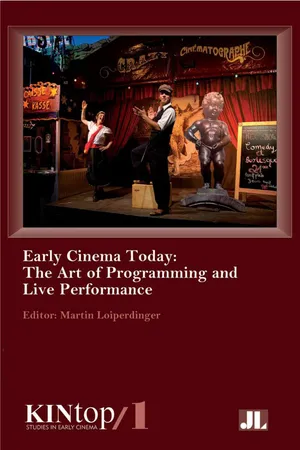
The ‘performative turn’ of today’s early cinema presentations took place in 2007, when the Cinémathèque de la Ville de Luxembourg started the Crazy Cinématographe experiment in a fairground tent. The fairground is a most demanding environment which absolutely requires fighting for the attention of the fairground visitors. The film screenings inside the tent must be preceded by a staged front-show to attract passers-by and lure them into the screening room. During the show inside the tent can be observed the resurrection of the film lecturer who had almost disappeared nearly a century ago (with some exception, i.e. the presentations of the Méliès family who still arrange live performances of some of the pioneer’s fantastic films).
While almost all live performances of early cinema today which are known to us neglect the historical institution of the film lecturer and instead are satisfied with the musical accompaniment by a piano player or a small orchestra, it is impossible to perform a fairground film show without barkers and film lecturers. Both are absolutely required by the fairground dispositif which fundamentally differs from all parameters of film screenings in th...
Table of contents
- Early Cinema Today:
- The Art of
- Early Cinema Today:
- The Art of
Trusted by 375,005 students
Access to over 1.5 million titles for a fair monthly price.
Study more efficiently using our study tools.
Frequently asked questions
Yes, you can cancel anytime from the Subscription tab in your account settings on the Perlego website. Your subscription will stay active until the end of your current billing period. Learn how to cancel your subscription
No, books cannot be downloaded as external files, such as PDFs, for use outside of Perlego. However, you can download books within the Perlego app for offline reading on mobile or tablet. Learn how to download books offline
Perlego offers two plans: Essential and Complete
- Essential is ideal for learners and professionals who enjoy exploring a wide range of subjects. Access the Essential Library with 800,000+ trusted titles and best-sellers across business, personal growth, and the humanities. Includes unlimited reading time and Standard Read Aloud voice.
- Complete: Perfect for advanced learners and researchers needing full, unrestricted access. Unlock 1.5M+ books across hundreds of subjects, including academic and specialized titles. The Complete Plan also includes advanced features like Premium Read Aloud and Research Assistant.
We are an online textbook subscription service, where you can get access to an entire online library for less than the price of a single book per month. With over 1.5 million books across 990+ topics, we’ve got you covered! Learn about our mission
Look out for the read-aloud symbol on your next book to see if you can listen to it. The read-aloud tool reads text aloud for you, highlighting the text as it is being read. You can pause it, speed it up and slow it down. Learn more about Read Aloud
Yes! You can use the Perlego app on both iOS and Android devices to read anytime, anywhere — even offline. Perfect for commutes or when you’re on the go.
Please note we cannot support devices running on iOS 13 and Android 7 or earlier. Learn more about using the app
Please note we cannot support devices running on iOS 13 and Android 7 or earlier. Learn more about using the app
Yes, you can access Early Cinema Today by Martin Loiperdinger in PDF and/or ePUB format, as well as other popular books in Media & Performing Arts & Library & Information Science. We have over 1.5 million books available in our catalogue for you to explore.