A deep dive into the history and retro appeal of musical exotica, including the Orientalism, Hawaiianesque, and Afro-tropicalism sub-sets.
Widening the Horizon is the first in-depth study of exoticism in Post-War popular music. The opening chapters analyze the work of Les Baxter, Martin Denny, Arthur Lyman, Korla Pandit, Yma Sumac—the musicians who developed (and exemplified) the style known as Exotica in the 1950s and 1960s. Other chapters address more recent developments in musical exoticism which have revived and reinflected the form, such as Haruomi Hosono's Soy Sauce Music trilogy; the works of Van Dyke Parks, on albums such as
Tokyo Rose; and the career of New Age populist/exoticist Yanni.
Contributors to this anthology include writers and academics from Australia, Canada, Japan, the United Kingdom, and the United States.
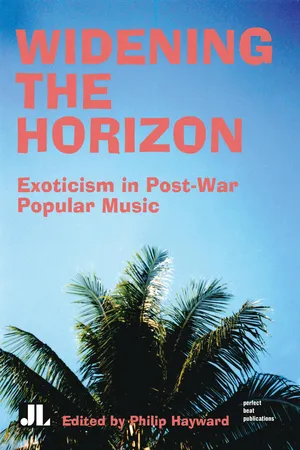
- 208 pages
- English
- ePUB (mobile friendly)
- Available on iOS & Android
eBook - ePub
About this book
Chapter One
KORLA PANDIT
Music, Exoticism and Mysticism
In 1947, Klaus Landsberg, a German emigré, begin a stint as the head of station KTLA in Los Angeles. In this period there was no network support that far west, so Landsberg had to rely on his own ingenuity in devising programming for this new station. His partiality for “bright, ethnic music” (quoted by Stan Chambers, one-time KTLA employee, in Kisseloff, 1995: 174) resulted in, amongst other things, an off-beat program called Musical Adventure with Korla Pandit, which was broadcast three times per week from 1949 to 1951. Pandit was the son of an Indian Brahman, “a member of one of India’s first families”, he has stated, and his mother was a French singer (1966: np). He played every one of his programs wearing a turban bejewelled with a ruby, and never spoke. In this chapter I want to try to situate Pandit in the cultural moment of his greatest popularity, the late 1940s-early 1950s, focusing on a few key issues: the kinds of representations of India and Indians, both visual and musical, offered in his TV show; representations by and of Pandit; and the ways that Pandit slipped in and out of these representations, finally becoming a New Age guru/musician1.
The 1950s, suburbia, nostalgia, and difference
Several national trends occurred in the same historical moment as Pandit’s popularity; the most important of these was the growth of suburbs after World War II; this has been widely discussed and so my own discussion will be fairly brief, and concentrate on the ways that suburbanisation as a cultural phenomenon relates to Pandit2. In areas such as Orange County, California (where Pandit first lived when he moved to California in 1949), the movement out of the cities into suburbs in the 1950s resulted in a near doubling in population between 1940 and 1950, rising from 130,760 to 216,224 (Jezer, 1982: 188). Nationally, as a result of the GI Bill of Rights, passed in 1944, and the tax benefits to home owners that were increased during the 1940s, housing starts rose from 114,000 in 1944 to 937,000 in 1946, 1,118,000 in 1948, to an all-time high of 1,692,000 in 1950 (Halberstam, 1993: 134). Even before this, in 1946, “for the first time a majority of the nation’s families lived in homes they owned” (May, 1988: 170). The housing industry contributed to this growth with millions of ‘cookie-cutter’ homes, made to look the same no matter in which part of the country they were intended to be built3. “Even flora varied little from place to place”, writes Marty Jezer, with the ubiquitous Colorado blue spruce becoming the conifer of choice (Jezer, 1982: 191)4.
During the 1940s, suburbs became centres of the erasure of racial and ethnic difference. Until the early 1960s they were occupied almost wholly by whites. Some residents of the whitewashed suburbs suffered a kind of nostalgia for the web of family and other social connections in the cities, as well as, seemingly contradictorily, nostalgia for the kind of ethnic diversity that cities provide. Before the early 1950s, radio and television programs had often featured a variety of ethnic groups5. But by the mid-1950s television and radio had moved toward a Father Knows Best model, in which people were white, mom stayed at home, kids were obedient, and dad was an organisation man who “had no politics, no opinions, and no connection with the world about him” (Jezer, 1982: 198)6.
These radio and then television programs (many of which made the transition from one medium to the other) mirrored the lives of their listeners (so Mama’s family in I Remember Mama moves to the suburbs, as did Lucy and Ricky in I Love Lucy). Even having moved, though, many of these characters were still caught up in the network of family and social relations that was damaged when people moved out of the cities. Many early television programs featured a wide variety of ethnic and/or age groups, and were generally diverse. Horace Newcomb describes an episode of The Texaco Star Theater (which later become The Milton Berle Show) from 2/4/51 that features a sketch in which a singer performs a number called Tenement City that lasts ten minutes, and includes the characters “Mrs. Cohen”, who makes a wonderful Irish stew, and “Mrs. Kelly”, who makes the best gefilte fish; these and other characters later listen appreciatively as a young black man sings Somewhere over the Rainbow (Newcomb, 1997: 114).
Representations of race and ethnicity found their way into suburban homes in other ways. Mark Burns and Louis DiBonis, serious collectors of 1950s objects, have written of the kinds and nature of all manner of 1950s household items, arguing that “[d]epiction of other races – generally with contented, nubile or exotic, but not threatening, overtones – was a general common feature of the ornament” (1988: 42). They also observe that:
Chinamen and Mexicans were represented as childlike, innocent, fun loving – and lazy. White folk were serious adults, brown and yellow people were engaging, the Korean war notwithstanding. These objects were born out of ignorance, reinforced by TV and the developing tourist trade and its propaganda. (Burns and DiBonis, 1988: 20).
At the same time, veterans who had returned from World War II, after having served in the South Pacific, continued their interest in Hawaiian and other Pacific cultures and their musics7. It was in this historical moment that the fad for things Hawaiian was born, a fad so potent that most popular musicians learned some of this music, although the national popularity of lounge and exotica musics – discussed at length in this volume – occurs after its heyday.
India ?
Even though various ‘exotic’ peoples and cultures made their way into mainstream North American representations, most North Americans in the 1950s knew little of India, which, when represented at all, seemed to provide a little dash of colour or exoticism. In 1952, House & Garden advertised a new living room decor, designed by Lord & Taylor, whose centrepiece was colourful fabrics that “bring you the magnificent patterns and colors of India under the name of ‘Indra’, the Hindu deity who rules the bright firmament” (House & Garden, 1952: 141). The drawing of this living room was captioned “Hot colors of the sleepy sun in a modern living room.” This ad was accompanied by a story by Rumer Godden entitled ‘Diwali Lights’, about the festival marking the Hindu New Year; Godden would have fairly been well known to her readers as a British novelist who authored many books of fiction and non-fiction that were set in India.
But most U.S. citizens knew little of India, due mainly to restrictive immigration laws. While Congress declared South Asians eligible for citizenship in 1910, in 1917 it enacted a law barring them and other Asians from becoming citizens. This changed in 1926 when an Indian lawyer successfully argued that South Asians should be considered Aryans (that is, white) and be accorded citizenship. In 1946, Congress enacted a law allowing South Asians citizenship, but the annual quota was only one hundred people8. Between the years 1923, when official immigration by South Asians ceased, and 1946, when it began again, only a few hundred South Asians came legally to the U.S.A.; most of these were students. There were also around three thousand illegals (Gibson, 1988: 41). According to Joan Jensen, “in 1942, only forty percent of Americans could locate India on a map” (1988: 278). A poll taken in Iowa in 1945 revealed that, while the majority of those asked had a rough idea of how many people lived in India and had heard of Gandhi, most hadn’t heard of Pakistan (Chandrasekhar, 1945). Even though there were some 250,000 American soldiers stationed in India during World War Two, most brought home no more knowledge than “a tale of a sordid, illiterate, depressed country” (Kiell, 1946: 204)9.
In addition to the acquisition of colour for living rooms, North America’s conceptions of India and Indians in the 1950s tended to be concerned with a clash of the mystical with the ‘real’ or scientific. For example, a 1949 photograph of an Indian landscape in House & Garden is introduced with the statement, “India, vast, imponderable and infinitely diverse, is a country where mysticism co-exists with science, where shimmering saris sing against the ash-gray hides of elephants and a whole city is colored pink”10. Likewise, the opening to the film of Rudyard Kipling’s Kim (1950) begins with an ‘Indian’ narrator (played by an uncredited actor, almost certainly not South Asian as none of the named actors in this production were) stating:
India. Gateway to the East. Empire of magnificent pageantry and exotic colour – the jewel of the Orient. Land of mysticism and reality, whose history is filled with the romance and intrigue of the nineteenth century, which already belongs to a legendary past.
Another example comes from the New Yorker, in which a doctor, Victor Barnouw, address these issues head-on. Barnouw is working with an U.S.-trained Brahman doctor, Narayan Ghodme, in a lab in India:
Sometimes, when he and I sat drinking tea in the lab, I tried to find out what his own religious views were. Once I asked him if he believed in reincarnation. For answer, he waved a thin brown hand toward the lab equipment and said, “I believe in that.”
“The plethysmograph?”
“No. Science.”
I liked to badger him. “But at home you take part in the family rituals,”
I said.
“Of course.” Narayan shrugged. “Family is one thing, science another.”
“But by taking part you give assent, don’t you? Let’s face it, Narayan – do you want people to go on worshipping elephant-headed gods?”
Narayan raised his eyebrows. “What’s wrong with elephant-headed gods?”
I couldn’t think of any sensible answer, so I dropped this line of argument. (Barnouw, 1956: 69)
Things go downhill from there when it comes time to worship tools. Barnouw is shocked that so much time and energy are spent offering puja to the automobile, and then the tools in the laboratory, that he once again accosts his friend. Ghodme again insists that he participates willingly in religious rituals in order to preserve family harmony, but the two men clearly diverge: Barnouw cannot conceive of what he views as a premodern religion coexisting with modern science.
Mysticism
North Americans seem to have been interested in India’s so-called mysticism in this period11. Perceptions of the mystical Indian were fuelled in 1942 with the publication of The Wisdom of China and India, compiled and edited by the well-known public authority on eastern religions Lin Yutang. He writes in the introduction that:
[n]ot until we see the richness of the Hindu mind and its essential spirituality can we understand India or hope to share with it the freedom and equality of peoples which we in some lame and halting fashion are trying to c...
Table of contents
- Cover
- Dedication
- Title Page
- Copyright
- Contents
- Editor’s Note
- Introduction The Cocktail Shift: Aligning Musical Exotica
- Chapter 1 Korla Pandit and Musical Indianism
- Chapter 2 Utopias of the Tropics – The Exotic Music of Les Baxter and Yma Sumac
- Chapter 3 Martin Denny and the Development of Musical Exotica
- Chapter 4 Tropical Cool: The Arthur Lyman Sound
- Chapter 5 Soy Sauce Music: Haruomi Hosono and Japanese Self-Orientalism
- Chapter 6 Musical Transport: Van Dyke Parks, Americana and the applied Orientalism of Tokyo Rose
- Chapter 7 The Yanni Phenomenon
- Information About the Authors
- Bibliography
- Index
Trusted by 375,005 students
Access to over 1.5 million titles for a fair monthly price.
Study more efficiently using our study tools.
Information
Publisher
John Libbey PublishingYear
1999Print ISBN
9781864620474
Subtopic
EthnomusicologyeBook ISBN
9780861969333
Frequently asked questions
Yes, you can cancel anytime from the Subscription tab in your account settings on the Perlego website. Your subscription will stay active until the end of your current billing period. Learn how to cancel your subscription
No, books cannot be downloaded as external files, such as PDFs, for use outside of Perlego. However, you can download books within the Perlego app for offline reading on mobile or tablet. Learn how to download books offline
Perlego offers two plans: Essential and Complete
- Essential is ideal for learners and professionals who enjoy exploring a wide range of subjects. Access the Essential Library with 800,000+ trusted titles and best-sellers across business, personal growth, and the humanities. Includes unlimited reading time and Standard Read Aloud voice.
- Complete: Perfect for advanced learners and researchers needing full, unrestricted access. Unlock 1.5M+ books across hundreds of subjects, including academic and specialized titles. The Complete Plan also includes advanced features like Premium Read Aloud and Research Assistant.
We are an online textbook subscription service, where you can get access to an entire online library for less than the price of a single book per month. With over 1.5 million books across 990+ topics, we’ve got you covered! Learn about our mission
Look out for the read-aloud symbol on your next book to see if you can listen to it. The read-aloud tool reads text aloud for you, highlighting the text as it is being read. You can pause it, speed it up and slow it down. Learn more about Read Aloud
Yes! You can use the Perlego app on both iOS and Android devices to read anytime, anywhere — even offline. Perfect for commutes or when you’re on the go.
Please note we cannot support devices running on iOS 13 and Android 7 or earlier. Learn more about using the app
Please note we cannot support devices running on iOS 13 and Android 7 or earlier. Learn more about using the app
Yes, you can access Widening the Horizon by Philip Hayward in PDF and/or ePUB format, as well as other popular books in Media & Performing Arts & Ethnomusicology. We have over 1.5 million books available in our catalogue for you to explore.