Essays exploring how reformers and charities used the "magic lantern" to raise public awareness of poverty.
Public performances using the magic or optical lantern became a prominent part of the social fabric of the late nineteenth century. Drawing on a rich variety of primary sources,
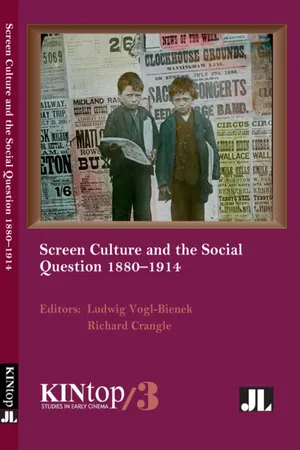
Screen Culture and the Social Question, 1880-1914 investigates how the magic lantern and cinematograph, used at public lectures, church services, and electoral campaigns, became agents of social change.
The essays examine how social reformers and charitable organizations used the "art of projection" to raise public awareness of the living conditions of the poor and the destitute, as they argued for reform and encouraged audiences to work to better their lot and that of others.
eBook - ePub
Screen Culture and the Social Question, 1880–1914
- 276 pages
- English
- ePUB (mobile friendly)
- Available on iOS & Android
eBook - ePub
Screen Culture and the Social Question, 1880–1914
About this book
Information
PART I:
Screen Culture and the Public
Sphere – Raising Awareness
of the Living Conditions
of the Poor

Magic Lantern Entertainment given to 1,450 poor and destitute children by the members of the Fulham Liberal Club and Institute, engraving from The Graphic (23 February 1889): 189.

MAN SWALLOWING RATS, lantern slide with combined rack work and lever mechanism, Carpenter & Westley, England, c. 1880.
Martin Loiperdinger
The Social Impact of Screen Culture 1880–1914
In 1889, the Liberal Club of Fulham (London) organised a lantern show for 1,450 destitute children. The weekly newspaper The Graphic published a picture of this performance in a wood engraving showing a large, packed auditorium decorated with paper lanterns and garlands. The view is toward the stage, whose back wall is covered by a lighted circle almost four metres in diameter in which a larger-than-life-size, bearded man in a nightcap lies in bed while two rodents make for his open mouth. The projection illuminant shines brilliantly in the lantern’s housing. A projectionist operates the apparatus, and a second man acting as lecturer points to the image on the screen to underline to the audience his interpretation of what is occurring. A girl sitting on the shoulders of an adult is pointing at the image, as are several people in the first row, expressing the excitement with which they are following what happens on the screen.
The audience is viewing the well-known and popular lantern slide the MAN SWALLOWING RATS. A small painted glass slide rests in the projector, creating the pictorial information for the large projected image. The operator synchronises two mechanisms in the slide to produce movement on the screen. The image tells a story: the sleeping man opens and closes his mouth as both rodents approach in an arc and disappear into his open jaws. Without even noticing, he devours them! Presumably appropriate noises of snoring and smacking lips complete the entertaining performance.
The watching children were moved because presumably they had already experienced more or less frightful encounters with rats in their housing environments (and those who had not were probably afraid of such encounters). Rats were a plague in the slums of London: they outnumbered the human inhabitants of the densely packed tenements. Imagining someone swallowing live rats was likely to make the children’s skin crawl. Seeing someone unknowingly swallowing rats while sleeping adds a comic effect to the jitters, which might relieve the children’s tension as they waver between shuddering and laughter. The fact that evidently contemporary audiences experienced the MAN SWALLOWING RATS with comic relief in the face of the harsh conditions in their own daily lives might explain the tremendous success of this particular “moving image”, standard fare in many lantern shows at that time. The performances of this rackwork slide over decades offer an instructive example of the social impact produced by showmen and lecturers who projected pictures and by their audiences who watched them.
Victorian Lantern Shows – the Screen and Social Problems
In the engraving, the girl and the people in the first row pointing to the screen draw the attention of the readers of the Graphic to a leading cultural location for experiencing images: by 1889 the screen had become firmly established in Victorian society as a major place of communication through images. Projection technology was the basis of a pronounced media culture, with technical standards, established projectors and illuminants, a differentiated offering of images on slides, reliable channels of distribution and frequent performances. The performance at the Fulham Liberal Club was part of a cultural practice widespread at the time, not only in Great Britain. The term for such slide shows is the Art of Projection, L’Art de la projection, L’arte della proiezione, Projektionskunst etc. As early as the 1870s, apparatus manufacturers, image producers and operators formed a business network of their own, as can be seen in the issues of professional journals bearing the internationally current name of the projection apparatus in their titles: The Magic Lantern (London, from 1874), Laterna magica (Düsseldorf, from 1875) or Lanterne magique (Paris, from as early as 1833).
The manufacturers of devices and images were mainly small or mid-size private businesses situated in the photographic industry, for example Bamforth in northern England. The image selection was spread over various genres: producers’ catalogues list geographic and travel images; scientific images; highlights from history; religious themes; current events; dissolving views; and “life model” slides, picture sequences consisting of up to 50 slides using amateur actors photographed against painted backgrounds to illustrate poems, ballads, fairy tales or literary narratives. A spoken text taken from a “reading” normally accompanied the slide set for the performance.1 Many life model sets told stories of the poor and thus turned social problems directly into performance.2
In Britain, the customers for lantern equipment and slides were not only travelling showpeople earning their living by performing lantern shows. As early as 1850, the lantern had become “not only an amusing and rational recreation, but a powerful aid in the work of education”.3 In the 1880s, religious charity and welfare organisations concerned with the effects of social problems relating to industrialisation bought a large portion of the technical equipment and slides offered by specialised enterprises of Britain’s photographic industry. Besides the Salvation Army, which was based on Methodist traditions, there were several large welfare and charity organisations in Anglican church circles engaged in poor relief, youth work and the temperance movement: The Church Army (CA), founded in 1882, introduced bands and lantern slides into Anglican services to return poorer groups to the fold of the Church.4 In 1892 the CA established a Lantern Department, producing around a thousand slides per week, and lent out around 1.5 million slides for projection per year.5 Starting the same year the CA began using horse-drawn mission vans in rural areas, moving from village to village to proclaim the Gospel with the aid of lantern shows, and by 1898 a fleet of 65 vans was in service.6 The United Kingdom Band of Hope Union, devoted to complete abstinence from alcohol, organised three million youths in 22,000 local groups and regional associations. The Sunday School Union, in close cooperation with Bands of Hope, reached almost six million school pupils in their Sunday schools in Britain even after the introduction of religious instruction in schools. Bands of Hope and the Sunday School Union favoured using lantern slides to make their performances attractive for their target audiences.
These organisers paid close attention to the “appropriate” mixture of instruction and entertainment. For people for whom electric lighting was unknown, large, brightly shining images from slides were in themselves an attraction. However, the aesthetic qualities of the images alone were not sufficient for successful mission work. Their performance was therefore staged primarily within a social framework using celebrations or entertainments. If there was no occasion such as Harvest Festival, a procession or a parade available, the organiser had to provide a fitting framework, through religious rituals such as prayer service, sermon, hymn singing, or performance in extravagant costumes, humorous commentary or accompanying music. For an audience of poorer people, the serving of food and drink was especially attractive. At the conclusion of their lantern shows, organisations such as the Co-operative Movement customarily distributed samples of food they or the co-operative had produced themselves. Companies from the food industry did the same in their own travelling lantern shows to introduce housewives to their novel, time-saving products such as instant soup.7 Similarly, the socialist newspaper The Clarion organised “Cinderella Clubs” providing free meals for poor children, entertaining them with music, dancing and the magic lantern. The children were given a bun and an orange upon leaving – and a sample copy of The Clarion for their parents.8
“Illustrated lectures” offered by charities, educational associations and the labour movement contained the projection of slides and an oral commentary in the hall. Projecting technically reproduced material was not sufficient in itself: personal communication was decisive for emotionally experiencing the images, normally via a lecturer explaining or commenting on the projected views.9 The large charity organisations had professional lecturers with their own repertories to perform their “illustrated lectures”. For example, Luther Hinton, a Sunday School Union lecturer, performed his commentary on the set MARTIN LUTHER, HIS LIFE AND TIMES at least 64 times. Performance reports state that, with his entertaining lecture style, he knew how to secure the attention of the audience.10 If possible, the audience was encouraged to join in: in 1890, for instance, a lantern show by the Co-operative Movement in Greenwich illustrated a popular song, The...
Table of contents
- Cover
- Title page
- Copyrights
- Contents
- Introduction
- PART I: Screen Culture and the Public Sphere – Raising Awareness of the Living Conditions of the Poor
- PART II: The Use of Lantern Shows, Photography and Early Films for Social Prevention by Charity Organisations
- PART III: Approaches to the Hidden History of Screen Culture
- Afterword by Ian Christie
- The Contributors
- Picture credits
- Back Cover
Trusted by 375,005 students
Access to over 1.5 million titles for a fair monthly price.
Study more efficiently using our study tools.
Frequently asked questions
Yes, you can cancel anytime from the Subscription tab in your account settings on the Perlego website. Your subscription will stay active until the end of your current billing period. Learn how to cancel your subscription
No, books cannot be downloaded as external files, such as PDFs, for use outside of Perlego. However, you can download books within the Perlego app for offline reading on mobile or tablet. Learn how to download books offline
Perlego offers two plans: Essential and Complete
- Essential is ideal for learners and professionals who enjoy exploring a wide range of subjects. Access the Essential Library with 800,000+ trusted titles and best-sellers across business, personal growth, and the humanities. Includes unlimited reading time and Standard Read Aloud voice.
- Complete: Perfect for advanced learners and researchers needing full, unrestricted access. Unlock 1.5M+ books across hundreds of subjects, including academic and specialized titles. The Complete Plan also includes advanced features like Premium Read Aloud and Research Assistant.
We are an online textbook subscription service, where you can get access to an entire online library for less than the price of a single book per month. With over 1.5 million books across 990+ topics, we’ve got you covered! Learn about our mission
Look out for the read-aloud symbol on your next book to see if you can listen to it. The read-aloud tool reads text aloud for you, highlighting the text as it is being read. You can pause it, speed it up and slow it down. Learn more about Read Aloud
Yes! You can use the Perlego app on both iOS and Android devices to read anytime, anywhere — even offline. Perfect for commutes or when you’re on the go.
Please note we cannot support devices running on iOS 13 and Android 7 or earlier. Learn more about using the app
Please note we cannot support devices running on iOS 13 and Android 7 or earlier. Learn more about using the app
Yes, you can access Screen Culture and the Social Question, 1880–1914 by Ludwig Vogl-Bienek, Richard Crangle, Ludwig Vogl-Bienek,Richard Crangle in PDF and/or ePUB format, as well as other popular books in Mezzi di comunicazione e arti performative & Storia e critica del cinema. We have over 1.5 million books available in our catalogue for you to explore.