A history of American cameramen covering the news of World War I, from the dangerous front line and the risk of execution to red tape and censorship.
At the start of hostilities in World War I, when the United States was still neutral, American newsreel companies and newspapers sent a new kind of journalist, the film correspondent, to Europe to record the Great War. These pioneering cameramen, accustomed to carrying the Kodaks and Graflexes of still photography, had to lug cumbersome equipment into the trenches. Facing dangerous conditions on the front, they also risked summary execution as supposed spies while navigating military red tape, censorship, and the business interests of the film and newspaper companies they represented. Based on extensive research in European and American archives,
American Cinematographers in the Great War, 1914–1918 follows the adventures of these cameramen as they managed to document and film the atrocities around them in spite of enormous difficulties.
"The first book to explore the work and working conditions of American cinematographers active on the different fronts of the First World War. It is a pioneering study which has already attracted a good deal of attention in the academic and archive world." —
Historical Journal of Film, Radio and Television
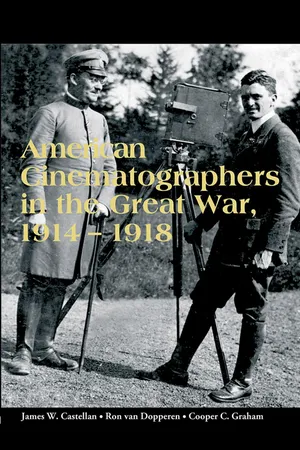
eBook - ePub
American Cinematographers in the Great War, 1914–1918
- 320 pages
- English
- ePUB (mobile friendly)
- Available on iOS & Android
eBook - ePub
American Cinematographers in the Great War, 1914–1918
About this book
Chapter 1
Over There
This book is a book on film. However, it starts as primarily a newspaper story. There are several reasons. In 1914 newsreels were still very young. While some major studios such as Pathé and Universal were already in the newsreel business, newspapers were entering into an intense period of competition and were seeking new ways to improve profits. It was a cutthroat war between vigorous and expanding entities, imitating what was happening among nations overseas. So there was a rush to send the journalists to the war. As the appeal of newsreels became ever more apparent to the newspapers, there was also a great need for cinematographers, who in many cases had been press photographers until very recently. It is a credit to them how quickly they adapted to lugging and working with 150 pounds of cumbersome film equipment after having worked for years with a Kodak or Graflex.
Since many of them were newspaper people, it was very difficult in many cases to distinguish much difference between the journalists and the cameramen, although there may have been a type of caste system giving deference to the writers. Once overseas they suffered the same problems and shared the same successes. They were in bed together, literally. In October 1914 in Antwerp as it was being shelled by the Germans, Edwin F. Weigle, cinematographer for the Chicago Tribune, Donald C. Thompson, photographer for the New York World, Arthur Ruhl of Colliers and Edward Eyre Hunt, who wrote War Bread, were cowering under the same roof at 74 rue du Péage. Later Horace Green wrote about the same shelling, and James H. Hare, another famous war photographer, photographed the battered facade of the building, American flag still flying, for Leslie’s Weekly. It was a new kind of war, and the journalists and photographers were in it together.
There was another aspect about the newspapers’ evolving relationship with the cinematographers. At least since the Civil War, the Americans had learned that having an accredited war correspondent at the scene of battles was a terrific way to sell newspapers. Perhaps the epitome of the war correspondent in America was Richard Harding Davis, whose dispatches from Cuba during the Spanish-American War had electrified the public and sold millions of newspapers for Hearst, Scribners and the New York World. Everyone wanted to emulate Davis so most newspapers called their reporters in Germany correspondents, and most at least simulated possessing expert knowledge of the country, military matters and so on, as well as having special relationships with government leaders and military experts. This became the model for cinematographers, who were then called film correspondents. David Mould and Gerry Veeder called them “photographer-adventurers” but it is really the same idea.1 They therefore made their films in a certain way: instead of just pointing a camera at the scene and shooting, as a newsreel cameraman would do, they would generally have an assistant, who was the real working cameraman, while they were in the picture themselves, interviewing a general or a statesman, or in some cases, in the actual battle. Some cameramen did this more than others. Two cinematographers who were very much in their own films were Albert K. Dawson and Wilbur H. Durborough. Perhaps it was significant that they both wrote extensively about their film adventures, true correspondents in the literary sense. Both Dawson and Durborough had assistant cameramen who actually shot their films. Other cameramen were not comfortable in this role; and Edwin F. Weigle and Nelson Edwards were not in their own films much. Nevertheless Weigle and Edwards were publicized by their papers as newspaper cameramen, with extensive articles about them in the Chicago Tribune and Hearst papers respectively.

Fig. 1. Albert Dawson on the eastern front, winter 1915–1916. World War I gave birth to a new type of war journalist, the camera correspondent. [Reproduced from Motography, 8 April 1916.]
In the period after World War I had been declared in 1914 and before America entered it almost three years later, there was a complex struggle among the combatants to influence public opinion in America. Some of this struggle was carried on by the combatants themselves through well-funded propaganda committees, foreign offices and other government agencies. Other parties involved, such as owners of newspapers and film companies, were influenced by a combination of ambition, ideology, patriotism and not least, greed.
When World War I started, while many of the powers involved believed they were prepared, they were wrong. None of them envisioned a long war; all expected the conflict to be over in six months. So there had been very little thought about propaganda, as correspondent William G. Shepherd pointed out:
The great machinery of that cyclonic blast that hit the civilized world of 1914 left newspaper correspondents entirely out of its operations. It ignored them, and therefore had no way of dealing with them. We puzzled the generals. The rules said no newspaper correspondents allowed. But there were always American newspaper correspondents around somewhere.2
And there had been even less thought about motion pictures. Even if there had been some comprehensive plan trying to reconcile the needs of the military and necessity for public relations, there would have been major problems. In most countries there was a division between the military, who felt that the war was their business, and the civilian governments, who for better or worse, had to concern themselves with civilian morale and public opinion abroad.
Germany
Most of this book will deal with the Central Powers. This is not because the authors are pro-German, but because of all the warring nations, Germany allowed correspondents a certain leeway, especially when things were going well on the battlefield and less well on the propaganda front.
Nevertheless Germany was a prime example of this rift between the military and the civil government. Although it is usually considered an authoritarian nation, Wilhelmine Germany suffered from deep conflict between the armed forces and the government. This was exacerbated by the deep fear of the conservative government and the army toward the Social Democratic party. It has been suggested that the war was a welcome way out of the upcoming elections which it was presumed would have resulted in a big win by the Social Democrats. But the declaration of war did not result in any serious thought about propaganda. And if there had been, the same rift between the liberals, social democrats and the nationalists would have resulted in the same stalemate.
At the outbreak of the war in Germany, propaganda matters for neutral countries abroad were a complete muddle. Matthias Erzberger, the prominent politician and specialist in propaganda who was well connected to the Reich Chancellor Bethmann-Hollweg, counted at least 27 different bureaus or departments inside the Reich involved with propaganda in foreign countries, none of whom had any idea of what the others were doing.

Fig. 2. Baron Mumm von Schwarzenstein, head of the German foreign propaganda agency (Zentralstelle für Auslandsdienst). [Courtesy Library of Congress.]
Erzberger was a prominent politician of the Center Catholic parties. This was an advantage for him because he was not particularly affiliated either to the right wing nationalist parties nor the Social Democrats or Communists on the left. His affiliations with the Catholics also helped him forge a good relationship with the Vatican. Later he unsuccessfully tried to keep Italy from entering the war. He was an opponent of unrestricted submarine warfare and by 1917 was a voice in trying to end the war. After the war, Erzberger was assassinated by nationalists in Germany for negotiating and signing the armistice with the Entente.
To deal with the propaganda problem, Erzberger had established the Zentralstelle für Auslandsdienst (ZfA) in October 1914. It was a very loose organization and was bound to have problems since it included conflicting representatives from the Reich Naval Section, the Army General Staff, the Auswärtiges Amt, (Foreign Office, hereafter called the AA) as well as Erzberger’s organizations.
Baron Mumm von Schwarzenstein (AKA Freiherr von Mumm), who handled propaganda matters for the AA, was the nominal head of the ZfA for its first two years. Although it was originally established only to deal with printed matter abroad, soon it also was funding propaganda films. The ZfA might have had the advantage of keeping the mutually hostile lions in one cage, but relations were bound to be tense. On the one hand, the AA, which was trying to placate German ambassadors like Count Graf von Bernstorff, Ambassador to the United States, to maintain good relations with neutrals abroad and also looking favorably on pro-German enterprises like that of Hearst who wanted to produce friendly propaganda, were almost forced to cooperate with the foreign press and neutral governments. On the other hand the Army, typical of most armies, made no bones about finding the foreign press, professional war correspondents and other observers in general nuisances at best and at worst probably spies. In answer to a telegram of 8 August 1914 asking the official position of the government with regard to the flood of requests from American journalists who wanted to come to Germany, Gottlieb von Jagow, the Secretary of Foreign Affairs, replied bluntly, “General Staff refuses in principle the entry of foreign journalists”.3 With a few exceptions forced upon it, this remained the General Staff position throughout the war. The army also ran censorship in general, including that of film, through its Reichspresseamt, part of Department IIIb, and had virtually unlimited powers to impede or stop any propaganda enterprise that it did not like.
In addition, the army, conservative to the core, was fundamentally hostile to film and photography in general, and felt that the only suitable method to communicate information to the public was through print. The Army High Command (Oberste Heeresleitung) issued the following directive, on 6 October 1914, entitled ‘Conditions for the Permission of Photography at the Front’. The Germans allowed only the following firms or their representatives:
The firms should be purely German and under patriotic-minded German leadership, have ample capital and work with German funds.
(1) Only German film cameras, German products and German film material may be used.
(2) The firms themselves not only are recognized in this regard as responsible for themselves, but also for representatives at their disposal sent to the theatres of operations.
(3) The photography at the theatres of operations and in the areas occupied by German troops is permitted only with the approval of the General Staff of the Army.4
In addition, even after the army released the films, they would have to undergo a further police censorship. For instance, it was even forbidden to photograph the streets of Berlin without permission from the Berlin police. Since it devolved on the General Staff to arrange trips to the front, grant interviews and so forth, the General Staff could cause problems simply by doing nothing. This would cause real problems for most journalists, and even more so for the cinematographers since they were held in contempt by the military. Truly, as Edward Lyell Fox said, “… photographers in warring Germany can have nothing but easy consciences; they see so little”.5
A member of the ZfA was Major Erhard Eduard Deutelmoser. In 1912, Deutelmoser...
Table of contents
- Cover
- Dedication
- Title page
- Copyrights
- Contents
- Chapter 1 Over There
- Chapter 2 Over Here
- Chapter 3 Belgium
- Chapter 4 William Randolph Hearst and the War
- Chapter 5 Behind the German Lines
- Chapter 6 Filming the Central Powers’ Drive across Russian Poland
- Chapter 7 Cameramen with the Entente
- Chapter 8 Mobilizing Movies: the U.S. Signal Corps and the Committee on Public Information
- Chapter 9 Aftermath
- Colour Plates
- Acknowledgements
- Suggestions for Further Reading
- Backcover
Trusted by 375,005 students
Access to over 1.5 million titles for a fair monthly price.
Study more efficiently using our study tools.
Information
Publisher
John Libbey PublishingYear
2015Print ISBN
9780861967179
Subtopic
North American HistoryeBook ISBN
9780861969210
Frequently asked questions
Yes, you can cancel anytime from the Subscription tab in your account settings on the Perlego website. Your subscription will stay active until the end of your current billing period. Learn how to cancel your subscription
No, books cannot be downloaded as external files, such as PDFs, for use outside of Perlego. However, you can download books within the Perlego app for offline reading on mobile or tablet. Learn how to download books offline
Perlego offers two plans: Essential and Complete
- Essential is ideal for learners and professionals who enjoy exploring a wide range of subjects. Access the Essential Library with 800,000+ trusted titles and best-sellers across business, personal growth, and the humanities. Includes unlimited reading time and Standard Read Aloud voice.
- Complete: Perfect for advanced learners and researchers needing full, unrestricted access. Unlock 1.5M+ books across hundreds of subjects, including academic and specialized titles. The Complete Plan also includes advanced features like Premium Read Aloud and Research Assistant.
We are an online textbook subscription service, where you can get access to an entire online library for less than the price of a single book per month. With over 1.5 million books across 990+ topics, we’ve got you covered! Learn about our mission
Look out for the read-aloud symbol on your next book to see if you can listen to it. The read-aloud tool reads text aloud for you, highlighting the text as it is being read. You can pause it, speed it up and slow it down. Learn more about Read Aloud
Yes! You can use the Perlego app on both iOS and Android devices to read anytime, anywhere — even offline. Perfect for commutes or when you’re on the go.
Please note we cannot support devices running on iOS 13 and Android 7 or earlier. Learn more about using the app
Please note we cannot support devices running on iOS 13 and Android 7 or earlier. Learn more about using the app
Yes, you can access American Cinematographers in the Great War, 1914–1918 by James W. Castellan,Ron van Dopperen,Copper C. Graham, James Castellan, Ron van Dopperen, Cooper Graham in PDF and/or ePUB format, as well as other popular books in Media & Performing Arts & North American History. We have over 1.5 million books available in our catalogue for you to explore.