A history of the New Zealand Film Archive and its founding director.
Jonathan Dennis (1953–2002), was the creative and talented founding director of the New Zealand Film Archive. As a Pakeha (non-Maori/indigenous New Zealander) with a strong sense of social justice, Dennis became a conduit for tension and debate over the preservation and presentation of indigenous and non-indigenous film archival materials from the time the Archive opened in 1981. His work resulted in a film archive and curatorship practice which differed significantly from that of the North American and European archives he originally sought to emulate. He supported a philosophical shift in archival practice by engaging indigenous peoples in developing creative and innovative exhibitions from the 1980s until his death, recognizing that much of the expertise required to work with archival materials rested with the communities outside archival walls. This book presents new interviews gathered by the author, as well as an examination of existing interviews, films and broadcasts about and with Jonathan Dennis, to consider the narrative of a life and work in relation to film archiving.
eBook - ePub
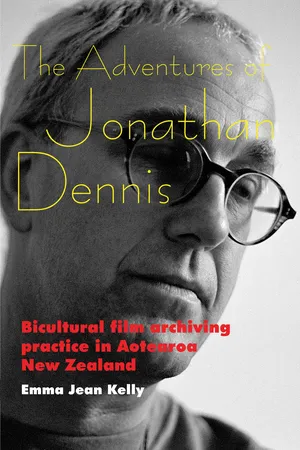
The Adventures of Jonathan Dennis
Bicultural Film Archiving Practice in Aotearoa New Zealand
- 200 pages
- English
- ePUB (mobile friendly)
- Available on iOS & Android
eBook - ePub
The Adventures of Jonathan Dennis
Bicultural Film Archiving Practice in Aotearoa New Zealand
About this book
Information
Subtopic
Film History & CriticismChapter 1
Introduction
This work explores the philosophy and nature of film archiving in Aotearoa New Zealand (NZ) through an analysis of the role played by Jonathan Dennis, firstly at the New Zealand Film Archive, Ngā Kaitiaki o ngā Taonga Whitiāhua (NZFA), from 1981 until 1990 and thereafter as a freelance film curator until his death in 2002. The construction of a film archive in the early 1980s offers a valuable moment in which to analyse the wider purpose and the more specific process for the formation of a film archive. As a national institution presenting materials from the past, an archive quickly becomes a focus point for debates about the national past, present and future. How materials from the archive are cared for and presented offers opportunities both in their presence and absence from which to critique the notion that the archive may be a biography of the nation. This exploration of Dennis, film archiving and national identity is driven by a set of questions. Firstly, what is an archive and what should it do? Secondly, what relationship does an archive have to changing concepts of the nation as expressed by social and political movements? Finally, how might a film archive and its archivists respond to the materials within and the movements outside its walls?
In order to address these questions Jonathan Dennis, founding director of the NZFA has been used as a conduit for an examination of the tensions and debates prevalent at a particular period of time in a specific country. This examination engages with indigenous and non-indigenous values in relation to audiovisual materials from the past. It considers a specific colonised country as a place in which competing perspectives are at play, and analyses how the New Zealand Film Archive and its materials became part of that competition.
During the years 1981–2002 Dennis worked to present and preserve indigenous and non-indigenous film archival materials with an awareness of the social and political changes occurring in the country. This resulted in a film archive and curatorship practice which differed significantly from that of the North American and European archives he originally sought to emulate. As a Pākehā with a strong sense of social justice, he argued for an awareness of geographical location and cultural context in his work. As a gay man he had an understanding of being an outsider and this motivated him to see things differently.2 He supported a philosophical shift in archival practice by engaging indigenous peoples in developing creative and innovative exhibitions and programmes.
Jonathan Dennis’ life did not fit the hegemonic discourse represented by the stereotypical “kiwi bloke” as Pākehā, fit, ruggedly handsome and able to drink and play rugby (Bannister, 2005; Campbell, 2000; Phillips, 1996 2nd ed.). At the time in which he was growing up “the consequences of being exposed as a homosexual were frightening: newspapers carried accounts of homosexuals on trial in New Zealand courts; homosexuals were targeted in America by McCarthy …” and local writer Frank Sargeson had been entrapped as a young man by laws criminalising homosexuals (Millar, 2010 p.vii). It was illegal to perform male to male sexual acts in New Zealand until 1986 (Brickell, 2008).3 In Jock Phillips’ seminal cultural history of the New Zealand Pākehā male, he describes how the understanding of a successful normative identity formation was closely linked to the stereotype of the pioneer, the soldier, and the rugby player whose heterosexuality was defined against indigenous identities (Phillips, 1987 first ed.). Dennis, as a homosexual man in a society which favoured heterosexual males as “defined against” the indigenous other, could easily relate to those categorised with him as unacceptable during the time when he was forced to become “transparent” during boarding school in order to survive the bullying that occurred there (Dennis in Alley, Watkins, & Dennis, 2001).
Anita Brady has recently argued specifically in the context of the NZ South Island area where Dennis grew up, that the nostalgia for “the way New Zealand ‘used to be’” in the High Country and the rural South, makes it “a complex and privileged place in the narratives of authenticity on which notions of pakeha masculinity depend … the South Island is often positioned in New Zealand media as a destination ‘back beyond the effete suburbanization of New Zealand manhood’” (Brady, 2012 p.359). Dennis was never “boysy” (Dennis in Fyfe & Dennis, 2001) and at his South Island boarding school populated with the sons of wealthy farmers, his gender identity would have been considered “effete”. There is a tension between a populist nostalgia for a “simpler” time in New Zealand which is at odds with the memory of many marginalised peoples who know that nostalgia is false, at least in their experience. In fact nostalgia is bound with power relations and used to “maintain, resist, construct and reconstruct identities in times of difficulty and change” (Matykiewicz, L. & McMurray, R. 2013 p.323).
This is not only the case for NZ. In a transnational gender identity study R. Connell discusses a similar pattern in colonised countries such as Australia, which led her work to the notion of hegemonic masculinity (Connell, 1995) which, like the concept of heteronormativity is constantly in flux but underlines the hierarchy of masculinities (Connell & Messerschmidt, 2005 p.831). Connell illustrates how, as Phillips also shows in this context, physical performance is used to ascribe gender to bodies (Connell, 1995 p.50).4 Connell goes further than Phillips in that she illustrates the synergies between the notion of hegemonic masculinities, heteronormativity and queer theory. She argues that queer theory is a useful development in relation to hegemonic masculinities, as it “celebrates the symbolic disruptions of gender categories” (Connell, 1995 p.59) and in turn homosexuality itself is a disruption of hegemonic masculinity (Connell, 1995 p.58). When young men and women in NZ were not able to express their non-heteronormative sexuality, they often silently sought representations of themselves in popular culture, to find their identity through others who may share their desires. A popular culture vehicle for doing so was the watching of films. This has been identified in queer theory as one of the ways in which young people sought to find an expression of difference. For example, in Eve Kosofsky Sedgwick’s text, Tendencies (Sedgwick, 1993), she includes a consideration of gay youth alienation survived through identifying cultural objects which have some hint of homosexuality about them. “I think that for many of us in childhood the ability to attach intently to a few cultural objects ... whose meaning seemed mysterious, excessive or oblique in relation to the codes most readily available to us, became a prime resource of survival” (Sedgwick, 1993 p.3). Sedgwick’s work in cultural studies has been fundamental in re-reading key texts as queer works, or at least, works which could be identified as having queer elements which were anchors for non-normative readers/viewers who did not identify with heterosexuality. Her Epistemology of the Closet (1990) is useful in understanding the elaborate codes through which people understood themselves and the cultural world around them at a particular moment in history.
Author and filmmaker Peter Wells supported Sedgwick’s notion of the cultural objects which create anchors for survival in relation to his and Jonathan Dennis’ experience of attending the movies as children and young men when he commented that “Cinema allows a kind of ambidextrous sexual reality” (Personal correspondence P.Wells, 30/06/2009). This “ambidextrous sexual reality” is something akin to hybridity and queerness, an in between space of otherness, an interstitial perspective or marginalised position from which the possibility of desiring and engaging imaginatively is possible beyond heteronormative assumptions.5 Cinema was Dennis and Wells’ delight and escape, and eventually their working lives would allow them to create and support narratives which explored non heteronormative identities in a more open manner as times changed, as censorship laws loosened and more diverse sexualities were able to be represented on screen. In other words, gay men and women’s stories would be able to be represented on screen.
In his work and personal life, Jonathan Dennis like other people who did not identify as heterosexual, appeared to construct his own cultural codes in his public and private lives and develop his own “schema of relations” (Foucault in discussion with Barbedette, 1982 pp.38, 39). Most of this was expressed silently – at least in his younger years. As he became an adult, aesthetically speaking, Dennis began to wear bright clothing and was described in terms of his dress and manner as “blatant rather than latent” (Personal correspondence, P.Wells op.cit.). He used elements of kitsch as well as bright colours and unusual clothing combinations incorporating materials from the South Pacific. For example, he referenced non-“kiwi bloke” cultures by often wearing items which in his time were unusual, such as colourful Italian scarves, while carrying kete (Māori woven bags). He also wore unusual spectacles in bright colours including turquoise, and some of these even glowed in the dark of the cinema (Personal correspondence S.Bartel 03/12/09; S.Dennis 06/02/09; M.Leonard 01/04/10).
Dennis’ choice of clothing was a non-verbal signifier of “otherness” which may seem inconsequential, but at that time men in NZ were not encouraged to stand out from the crowd (Phillips, 1987 1st ed.). Every interviewee for this study commented on the effect of Dennis’ sartorial style. Fellow cinéaste Professor Emeritus of Film Studies Roger Horrocks suggested Dennis had a camp aesthetic, if the meaning of “camp” is that of Susan Sontag’s Notes on Camp (Personal correspondence, R.Horrocks 25/10/11). Foucauldian scholar David Halperin’s definition of camp is similar to Sontag’s and suggests something akin to Dennis’ approach to his appearance as it was described by interviewees and observed in photographic evidence. Dennis was camp in the sense of “parody, exaggeration, amplification, theatricalization, and literalization of normally tacit codes of conduct” (Halperin, 1995 p.29). Dennis played with codes of masculinity using clothes as performance and declaration of self.
These tacit codes, these silent signals of difference, these unsaid devices for asserting ones’ agency in the world seem to have been important for Dennis. They were unspoken strategies by which he performed his sense of self in the wider world of life and work. They were the silences in the discourse, disrupting the “kiwi bloke” stereotype, creating a signal of difference. Dennis’ ability to live in Lauren Berlant’s “counterconventional” fold within the normative world is one of the in between spaces, the unspoken interstitial moments where a new or different perspective was possible for him (Berlant, L. 2011). Interviewees certainly felt this to be true and some explicitly referred to Dennis’ approach as “queer” (Personal correspondence, C. O’Leary 10/12/09).
David Halperin’s conception of camp and his work in general is part of what he refers to as “queer studies”, which for him emerged from the activist movement in the United States. The word queer is an attempt to consider a non-heteronormative sexuality without being reduced to essentialism through identity politics or binaries. In the sense that the word queer avoids an essentialist view, queer theory is a poststructuralist term denoting the provisional and contingent nature of identity (Jagose, 1996 p.7). It seeks to assert the potential for new and different relational possibilities (Halperin cited in Howe, 2004 p.35). However, unlike other subjects who are often marginalised, Dennis as a Pākehā from a middle class family always had the option to not reveal his “otherness”. Marginalised peoples do not often have this luxury. In NZ, the option of blending into the hegemonic majority (or “passing”) is generally only available to Pākehā. This leads to tension, even if Pākehā are sympathetic to the sensitivities of multiple perspectives. Indeed, it is the space between the essentialist and non-essentialist nature of identity politics and queer theory which creates the most difficulty, but is the most productive position from which to analyse Dennis and the NZFA in the geographical location of the South Pacific. “Postcolonial” and certainly the “postcolonial queer” are contested concepts which this work does not seek to resolve. However, being aware of the discourse is helpful in examining the life of a gay man who engaged with indigenous peoples. He demonstrated a strong identification with those who were marginalised in some way by a society which viewed the heterosexual Pākehā male as the mainstream norm in his lifetime.
Judith Binney suggests that any historian engaging with “a society that evolved from a divided past [which] attempts to become bicultural in its later reconstruction … must also become consciously ‘bihistorical’” in order to accept “alternative cultural codes” (Binney, 2009 p.xiii). Although Binney’s work refers to the state (governmental) perspective on the “bicultural” in relation to the Treaty of Waitangi, she, like the poststructuralist and postcolonial thinkers, advocates for a multiplicity of perspectives. The current moment in NZ is perhaps best described as a time of “cultural colonialism” which acknowledges ongoing psychological, educational and sociological assumptions regarding who “we” are as a “nation”.6 Stephen Turner suggests there is a “settler culture” of Pākehā in NZ who generally control state decisions and dominate normative values without explicitly acknowledging their role (S. Turner, 1999) just as Halperin argues the “tacit codes” of masculinity which camp resists are unspoken (Howe, 2004).
There are challenges in using European theory when speaking of indigenous experience, and indeed this study does not try to identify with or explain indigenous perspectives. Yet the balance is a fine one. An alternative to postcoloniality is the discourse of decolonisation which has become common in NZ in recent times. For example, Jo Smith and Sue Abel argue that Māori television is a tool of decolonisation for both Māori and Pākehā (J. Smith & Abel, 2008). Linda Tuhiwai Smith used Foucault in her seminal text, Decolonizing Methodologies: Research and Indigenous Peoples (Tuhiwai Smith, 1999/2012) in order to critique Western discourse in relation to indigeneity. Māori activists and scholars since the 1970s have campaigned vigorously to ensure an indigenous voice is heard in NZ, quite literally in the case of the legal status of the Māori language (Ratima, 2008). This has led to a peculiar situation where the term “bicultural”, referred to by Binney and celebrated in the 1980s as a partnership model between the two peoples of the Treaty of Waitangi, has become a theoretically and politically tired proposition. Consequently postcolonial works are sometimes useful but do not necessarily define the historical specificity and cultural context of NZ today (O’Sullivan, 2007).
NZ is a country whose national boundaries have not changed since 1840 when the Treaty of Waitangi was signed and has only ever had one independent film archive.7 The NZFA became the sole independent national repository for the film materials of a nation with stable borders.8 The founding director of that Archive, Jonathan Dennis, left rich personal materials from which to attempt to understand the development of the institution and his motivations. Dennis continued after his Directorship to engage with archives and evolve his philosophy. The most compelling reason to focus on Dennis when exploring questions of film archiving practice in NZ is that his name is repeated by many scholars, archivists and filmmakers as one which represented an emerging practice in the 1980s which was different from that of archives, museums and art galleries before that period. For example an Emeritus Professor of Film TV and Media Studies at University of Auckland remarked that Jonathan Dennis was an “… unsung hero of the film culture” (Personal correspondence, Horrocks, R. 21/10/08).
“With a strong sense of place” is the way in which authors Sarah Davy and Diane Pivac described the development of the NZFA in its founding years, in a chapter they contributed to a book on NZ film culture (Davy & Pivac, 2008). The phrase “a sense of place” was made popular by a 1984 photography book by Robin Morrison, a Pākehā New Zealander who specialised in images of the everyday in New Zealand (Morrison, 1984). Dennis, like Morrison and others had become increasingly aware that the unique aspects of NZ were its geographical location and cultural diversity.9 They consequently sought strategies through which to work regionally, nationally and internationally with a “sense of place” (Dennis in Fyfe & Dennis, 2001). Beyond this point of difference they also began to understand the history of their own country, largely because Māori insisted on remembering, rather than forgetting the colonial roots of the nation (S. Turner, 1999).
Jonathan Dennis began his work from the perspective of a European man, rich in knowledge and experience of the western world, but “ignorant” of Te Ao Māori [The Māori world] (Dennis in Alley & Dennis, 2002). By the end of his life he had shifted his view, incorporating ways of being and doing he had learned from Māori with whom he had worked for over two decades. As he learned to listen harder he became something other than European in the continental sense. This is not to claim an indigeneity for him, but to state a distinction based upon his awareness of his geographical location and personal sense of marginalisation. “Being Pākehā”, as historian Michael King discovered, is not to be embraced as indigenous, but it is to be something other than those of European descent born and living elsewhere (King, 1985). Nor does being Pākehā automatically make one sensitive to indigenous concerns. Filmmaker Barry Barclay (iwi affiliation Ngāti Apa) who worked with Dennis and critiqued the NZFA, argued that Pākehā and Māori quite literally talk past each other. He suggested that in the Pākehā world there is often a tendency to speak and debate in a linear fashion, whilst in the Māori world listening is highly valued and discussion can often be cyclic (Barclay, 1990 p.14). Barclay’s work in film and film archiving, his position as both Māori and Pākehā (of Scottish and French descent) (Martin, 1994 p.103) and his writing on his ideas is useful to this present study because he was interested in the tension between two cultures and the creative possibilities which emerged from that space.10 This book is also interested in the creative possibilities inherent in the in between space.
In 2009 a review...
Table of contents
- Cover
- Dedication
- Title page
- Copyrights
- Contents
- Acknowledgements
- Glossary of terms, Archival sources and key, Interviews
- Chapter 1 Introduction
- Chapter 2 The practice of the archive
- Chapter 3 Jonathan Spencer Dennis and the early years
- Chapter 4 Biculturalism and the NZFA
- Chapter 5 The New Zealand Film Archive become Guardians of the Treasured Images of Light/Ngā Kaitiaki o ngā Taonga Whitiāhua
- Chapter 6 Narrative of Jonathan Dennis’ archive
- Chapter 7 Beyond cinema, beyond the NZFA
- Chapter 8 Concluding discussion: Archive as biography of the nation?
- Bibliography
- Appendix I James McDonald films catalogue
- Appendix II Jonathan Dennis’ bibliography
- Appendix III Constitution Kaupapa of the NZFA 1988
- Appendix IV List of Interviewees
- Backcover
Trusted by 375,005 students
Access to over 1.5 million titles for a fair monthly price.
Study more efficiently using our study tools.
Frequently asked questions
Yes, you can cancel anytime from the Subscription tab in your account settings on the Perlego website. Your subscription will stay active until the end of your current billing period. Learn how to cancel your subscription
No, books cannot be downloaded as external files, such as PDFs, for use outside of Perlego. However, you can download books within the Perlego app for offline reading on mobile or tablet. Learn how to download books offline
Perlego offers two plans: Essential and Complete
- Essential is ideal for learners and professionals who enjoy exploring a wide range of subjects. Access the Essential Library with 800,000+ trusted titles and best-sellers across business, personal growth, and the humanities. Includes unlimited reading time and Standard Read Aloud voice.
- Complete: Perfect for advanced learners and researchers needing full, unrestricted access. Unlock 1.5M+ books across hundreds of subjects, including academic and specialized titles. The Complete Plan also includes advanced features like Premium Read Aloud and Research Assistant.
We are an online textbook subscription service, where you can get access to an entire online library for less than the price of a single book per month. With over 1.5 million books across 990+ topics, we’ve got you covered! Learn about our mission
Look out for the read-aloud symbol on your next book to see if you can listen to it. The read-aloud tool reads text aloud for you, highlighting the text as it is being read. You can pause it, speed it up and slow it down. Learn more about Read Aloud
Yes! You can use the Perlego app on both iOS and Android devices to read anytime, anywhere — even offline. Perfect for commutes or when you’re on the go.
Please note we cannot support devices running on iOS 13 and Android 7 or earlier. Learn more about using the app
Please note we cannot support devices running on iOS 13 and Android 7 or earlier. Learn more about using the app
Yes, you can access The Adventures of Jonathan Dennis by Emma Jean Kelly in PDF and/or ePUB format, as well as other popular books in Media & Performing Arts & Film History & Criticism. We have over 1.5 million books available in our catalogue for you to explore.