This comprehensive study of the Danish film company demonstrates how it became one of the most important innovators of the silent era.
Established in 1906, Nordisk Films Kompagni's rise and fall is one of the most dramatic stories of the early film industry. Based on archival research, primarily in the company's surviving business archives, this volume describes and analyzes how Nordisk Films became one of the leading players in the world market—and why the company failed to maintain this position.
Isak Thorsen examines Nordisk Film as a business and organization, from its establishment in 1906 until 1924 when founder Ole Olsen stepped back. He covers a wide range of topics, including the competitive advantages Nordisk Film gained in reorganizing the production to multiple-reel films around 1910; the company's highly efficient film production which anticipated the departmentalized organization of Hollywood; Nordisk Film's aggressive expansion strategy in Germany, Central-Europe and Russia during the First World War; and the grand plans for taking control of UFA in association with the American Famous Players in the post-war years.
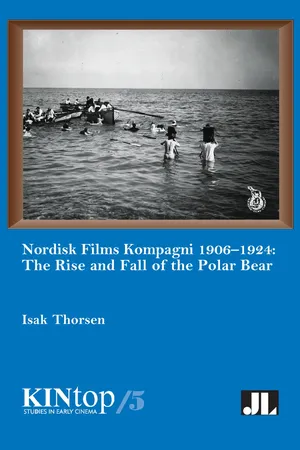
- 250 pages
- English
- ePUB (mobile friendly)
- Available on iOS & Android
eBook - ePub
About this book
Information
1910–1914
The Rise of the Polar Bear
Nordisk went through its first extensive structural changes in 1910. It became the first film company to base major parts of its production on multiple-reel films. Industry-wide, the transition to longer films led to a sweeping revolution with regard to the production, distribution and exhibition of films in the international industry.
The changes were manifest in the entire organizational structure of Nordisk. In 1911, Nordisk was converted into a limited company, and where Olsen formerly reigned supreme, he now had to answer to a board of directors and had managers working for him.
In order to plan its film production, Nordisk established a script department which was to supply the company directors with screenplays following a fixed set of rules that took into consideration the content prferences and the censorship regulations of the individual markets. In the Valby studios, Nordisk started working with several simultaneous production crews, and a sophisticated modus operandi was developed that anticipated the one which would later prove successful in Hollywood. It was not without reason that the Valby studios were dubbed “the film factory” after Nordisk’s reorganization.411
Longer films meant a change in exhibition practice in cinemas; Germany and Great Britain introduced a new so-called monopoly or exclusive distribution system of through which a distributor could purchase the exclusive rights to a film in a particular area for a given period of time. Together with the advent of longer films, this system created new conditions for competition, and in order to enhance the competitive capacity of each film, the companies started to promote their own film stars and to include their names in the marketing of the films. Another step taken to make the films attractive and legitimate as entertainment for the middle classes was the introduction of the so-called Autorenfilms, i.e. a film based on a literary work by a famous author.
The film, DEN HVIDE SLAVEHANDEL (THE WHITE SLAVE TRADE, August Blom, 1910), became an important reason for Nordisk’s thorough reorganization.
Nordisk was not the only film company in Denmark. Among the other Danish companies was the Aarhus-based Fotorama that would come to play a decisive role in the development of Nordisk on several occasions. In 1906, photographer Thomas Sørensen Hermansen had obtained a license for the cinemas Fotorama and Biografteatret in Aarhus, and in 1908, with a capital of 125,000 kroner, he formed the limited company A/S Th. S. Hermansen for the purpose of renting out and selling films, and of running cinemas wherever possible. Frede Skaarup, a former grocer in Ringkøbing, was employed as a manager, and the following year Eduard Schnedler-Sørensen, who would become Skaarup’s most trusted employee, was hired to help out.

Figure 16. Anna (Ellen Diedrich) is about to be saved from the brothel by her childhood friend George (Lauritz Olsen) in DEN HVIDE SLAVEHANDEL. Courtesy of DFI/Stills & Posters Archive.
In 1909, A/S Th.S. Hermansen started iss own film production. The company’s first film, DEN LILLE HORNBLÆSER (The Little Hornblower, Fotorama, 1909), directed by Schnedler-Sørensen, was a success. In May 1910, when the company decided to expand into film manufacturing as well, it changed its name to Aktieselskabet Fotorama (Limited Company Fotorama). With Skaarup as manager, the business grew quickly in an occasionally aggressive way. Instead of charging a fixed rental fee, Skaarup demanded 20 to 25 per cent of the cinema owners’ profits from the popular DEN LILLE HORNBLÆSER. Many cinema owners felt threatened by Skaarup, and as a reaction, Biograf Teater Foreningen for Provinsen (The Cinema Theatre Association of the Provinces) was founded in March 1910. But many cinema owners did not dare join the association for fear of not getting access to other films from A/S Th.S. Hermansen. In a very short time the company had gained control of large parts of the Danish cinema market.412
The connection between Nordisk and Hermansen goes back to the very beginnings of Nordisk. Hermansen purchased films from Nordisk, and the two companies appear to have been on friendly terms initially. Since Hermansen was such a good customer, Olsen gave him exclusive rights to Nordisk’s films in Aarhus in 1907. Olsen and Hermansen may also have had a common interest, for as Olsen writes: “Mr. le Tort has wanted films from us, but we deemed it prudent to have only one buyer in that location.”413 Hermansen obtained the rights to Nordisk’s films while Olsen kept his old partner le Tort at bay. Nordisk and Hermansen also stood together in 1909 when the Danish film industry succeeded in keeping Pathé out of the Danish market.414
Fotorama opened a branch in Copenhagen in early 1910 for buying and selling films, and also opened the cinema Løvebiografen (The Lion Cinema) on the ground floor of their Copenhagen office. On 11 April 1910, Fotorama’s film DEN HVIDE SLAVEHANDEL (THE WHITE SLAVE TRADE, Alfred Cohn, Fotorama, 1910) premiered in Løvebiografen and was an instant success. The film tells the story of the young girl Anna (Ellen Diedrich) who accepts a position as a lady’s companion in London far away from home, but soon discovers, to her great horror, that the position is in a brothel. Luckily her childhood friend George (Lauritz Olsen) discovers the deception, travels to London and manages with the aid of Scotland Yard to catch the villains and rescue Anna.
Audiences flocked to the film, and it was shown about 400 times in Løvebiografen.415 What was extraordinary about the film was its length of 706 metres, approximately 35 minutes. Olsen’s reaction was to send his director August Blom to the cinema to note down every scene from Fotorama’s film.416 Less than four months later, on 2 August, Nordisk released a nearly identical version of DEN HVIDE SLAVEHANDEL with the exact same title, 603 metres long. Only Nordisk’s version is extant in its entire length. Engberg has compared the surviving fragments of the Fotorama version with the Nordisk version and convincingly argues that not only the plot but also camera angles and the composition of images are remarkably alike in the two versions.417 Nordisk did not in any way attempt to conceal its plagiarism. The company wrote to a Swedish cinema owner:
By request, we open with DEN HVIDE SLAVEHANDEL on August the first, executed in the exact same way as the one that ran here at the Løvebiografen but performed by better artists and with Miss Diedrich in the lead. It is a role she performs to perfection.418
The film was even described to a Norwegian business acquaintance as “a picture whose content is exactly the same as the film of Scandinavian fame from Hermansen in Aarhus”.419 Just three days after the premiere of the Nordisk version, on 5 August, Fotorama reacted by placing adverts in the Copenhagen newspapers with the headline: “Warning to the Public.”420 Nordisk’s version was called a bad copy which should not be compared with the Fotorama original, and the advert stated that “[…] this can only take place because the law as yet provides no protection against such things”.
The circumstances surrounding DEN HVIDE SLAVEHANDEL scandal are some of the best-known incidents in early Danish film history, and Engberg’s interpretation is the generally accepted one.421 Engberg writes that Fotorama threatened to take Nordisk to court, and, to avoid any “unpleasantness”, Olsen entered into an agreement with Fotorama under which Fotorama was granted, among other things, the rights to distribute films from Nordisk in Denmark, Norway, and later Sweden. Skaarup became a manager at Nordisk, and Schnedler-Sørensen was employed as a film director in Valby.422 According to Engberg, the agreement was “fatal” to Nordisk in the long run.423 In early 1911, when the agreement was finally signed, only a small percentage of Nordisk’s sales went to the Scandinavian countries. But when World War I broke out, the borders closed and the export of film to nearly everywhere else than Scandinavia stopped, it was Fotorama that made the money on the films from Nordisk.424 Nordisk and Fotorama did enter a distribution agreement on 3 December 1910,425 which was finally confirmed on 6 February 1911,426 and it is true that the text of this agreement...
Table of contents
- Cover
- Title Page
- Copyright
- Contents
- Acknowledgements
- Preface
- Introduction
- 1906–1909 The Birth of the Polar Bear
- 1910–1914 The Rise of the Polar Bear
- 1914–1917 The Growth of the Polar Bear
- 1918–1924 The Fall of the Polar Bear
- Recapitulation
- Sources and Bibliography
- Appendices
- Index
Trusted by 375,005 students
Access to over 1.5 million titles for a fair monthly price.
Study more efficiently using our study tools.
Frequently asked questions
Yes, you can cancel anytime from the Subscription tab in your account settings on the Perlego website. Your subscription will stay active until the end of your current billing period. Learn how to cancel your subscription
No, books cannot be downloaded as external files, such as PDFs, for use outside of Perlego. However, you can download books within the Perlego app for offline reading on mobile or tablet. Learn how to download books offline
Perlego offers two plans: Essential and Complete
- Essential is ideal for learners and professionals who enjoy exploring a wide range of subjects. Access the Essential Library with 800,000+ trusted titles and best-sellers across business, personal growth, and the humanities. Includes unlimited reading time and Standard Read Aloud voice.
- Complete: Perfect for advanced learners and researchers needing full, unrestricted access. Unlock 1.5M+ books across hundreds of subjects, including academic and specialized titles. The Complete Plan also includes advanced features like Premium Read Aloud and Research Assistant.
We are an online textbook subscription service, where you can get access to an entire online library for less than the price of a single book per month. With over 1.5 million books across 990+ topics, we’ve got you covered! Learn about our mission
Look out for the read-aloud symbol on your next book to see if you can listen to it. The read-aloud tool reads text aloud for you, highlighting the text as it is being read. You can pause it, speed it up and slow it down. Learn more about Read Aloud
Yes! You can use the Perlego app on both iOS and Android devices to read anytime, anywhere — even offline. Perfect for commutes or when you’re on the go.
Please note we cannot support devices running on iOS 13 and Android 7 or earlier. Learn more about using the app
Please note we cannot support devices running on iOS 13 and Android 7 or earlier. Learn more about using the app
Yes, you can access Nordisk Films Kompagni 1906–1924 by Isak Thorsen in PDF and/or ePUB format, as well as other popular books in Business & Entertainment Industry. We have over 1.5 million books available in our catalogue for you to explore.