The story of how the motion-picture device was developed, and its role in Victorian society and early cinema.
The position of the kinetoscope in film history is central and undisputed; indicative of its importance is the detailed attention American scholars have given to examining its history. However, the Kinetoscope's development in Britain has not been well documented and much current information about it is incomplete and out of date.
This book, for the first time, presents a comprehensive account of the unauthorized and often colorful development of British kinetoscopes, using many previously unpublished sources. The commercial and technical backgrounds of the kinetoscope are looked at in detail; the style and content of the earliest British films analyzed; and the device's place in the wider world of Victorian popular entertainment examined. In addition, a unique legal case is revealed and a number of previously unrecorded film pioneers are identified and discussed.
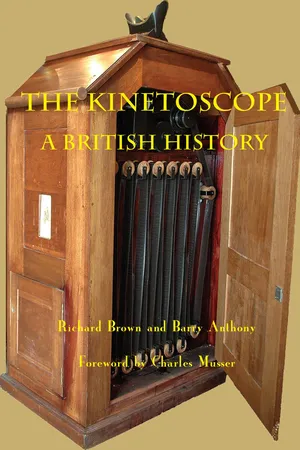
- 180 pages
- English
- ePUB (mobile friendly)
- Available on iOS & Android
eBook - ePub
About this book
Chapter One
The Kinetoscope: An International Perspective
Inventions multiply with increasing rapidity, and discoveries flash as lightning over the land. We cannot, if we would, shut our eyes to the results. J. B. McClure, Edison and his Inventions, 1889.1
The world’s first practical devices for taking and viewing motion pictures were developed in the United States during the early 1890s. Thomas Alva Edison, the ‘Wizard of Menlo Park’, had been prompted to begin experiments after a meeting with the celebrated chronophotographer Eadweard Muybridge in 1888. During their conversation, it was suggested that they should combine the phonograph and the Zoopraxiscope projector to create sound-accompanied, motion pictures of famous actors and singers. The limitations of Muybridge’s machine made such a scheme impracticable, but Edison, in collaboration with his employees William Kennedy Laurie Dickson and William Heise, started to work on a system which ‘does for the eye what the phonograph does for the voice’.2
By 1892 the Edison Laboratory had constructed an electrically driven movie camera, employing a 35mm film format that was to become the international standard for many years to come. It did not take long before Edison was predicting the imminent arrival of full-length reproductions of plays and operas, projected life size onto a screen with closely synchronised sound. But prophecy was replaced by pragmatism when the prototype ‘Kinetoscope’ was publicly unveiled at the Brooklyn Institute on 9 May 1893. The device proved to be an unassuming cabinet peepshow delivering a tiny moving image that lasted for just 20–30 seconds. A 40-foot celluloid band ran continuously (not intermittingly) over rollers and was viewed by electric light through a revolving shutter. Financial considerations based on the exploitation of the phonograph had caused Edison to reject the uncertain profitability of projection for the assured income of coin-operated devices. Since the late 1880s he had witnessed the rapid spread of automatic vending machines, at first providing simple items such as sweets and matches and later offering an extended range of products and services. In a flourishing network of ‘nickel-in-the-slot’ phonograph parlours across the United States, Edison had ready-made exhibition venues for his invention.
The Birth of Commercial Films
Following the construction of a studio, nicknamed ‘The Black Maria’ after a supposed resemblance to a police arrest vehicle, commercial production of films started on 6 March 1894. The choice of the first subject demonstrated an attachment to celebrity that had been present at the earlier meeting of Muybridge and Edison. Back in 1888 it was proposed that images of renowned Shakespearian actor Edwin Booth were married to phonograph recordings of his voice, now, in March 1894, the internationally famous strongman Eugene Sandow was asked to flex his impressive muscles for public admiration. With the heavy, studio-bound Kinetograph camera and a restricted stage area, performers from the theatre, music hall and circus proved dependable participants in the first films. As Charles Musser observes ‘Dickson and Heise kinetographed over seventy-five motion pictures in 1894, and virtually everyone drew on some type of popular commercial amusement’.3 Although at first attractive, such predictable content was eventually to become a key factor in the kinetoscope’s decline.
The Edison Manufacturing Company assumed responsibility for producing the motion picture hardware, whilst marketing was put in the hands of the Kinetoscope Company, a consortium that included Alfred O. Tate (Edison’s former business manager); Norman C. Raff; Frank R. Gammon and the Canadian entrepreneur Andrew M. Holland. Already leading exponents of Edison’s phonograph, the brothers Andrew and George Holland became the first commercial exhibitors of motion pictures. Ten kinetoscopes were put on display at 1155 Broadway, New York, on 14 April 1894, followed by the same number at a Masonic Temple, Chicago on 17 May. By the end of the year the proliferation of machines throughout the United States had provided a substantial boost to Edison’s fortunes. But, following an extremely lucrative financial year (April 1894 – February 1895), sales of film-related business fell away dramatically, giving a clear indication that, in its current form, the kinetoscope had a limited future. In April 1895 Edison attempted to revive public interest by coupling the phonograph and kinetoscope to create the kinetophone, but the lack of genuine synchronisation between sound and image meant that the device received an unenthusiastic reception. The same month saw the multi-talented Dickson leaving Edison’s employment to concentrate on developing projected motion pictures.
The story so far will be familiar to students of early film history. Edison’s archives and those of Raff and Gammon have provided generations of scholars with a rich source of primary evidence to be interpreted and re-interpreted. Historians such as Terry Ramsaye, Gordon Hendricks, Charles Musser, David Robinson,
Ray Phillips and Paul Spehr have differed on important aspects of emphasis and attribution, but all have agreed on the position occupied by the kinetoscope as the earliest practical means of motion picture exhibition. In the rest of the world the lack of similar archives and sometimes, it seems, a reluctance to accept the kinetoscope as anything more than a historical curiosity, have largely impeded research. It was not until widespread digitalisation of original material that it became possible to construct a detailed account of the kinetoscope’s British, and to a lesser extent, international development.
* * *
Continental Commerce
Edison’s kinescope was shown, at a private preview, in London on 17 October 1894. The device’s debut, and consequently the birth of moving pictures in Britain, would probably have taken place around two months earlier had the master plan of Colonel George Edward Gouraud, late of the 3rd New York Cavalry, come to fruition. As Edison’s European agent for many years, Gouraud (1842–1912) had been responsible for the exploitation of the new ‘Perfected’ phonograph since 1888. With a close relationship to Edison and a network of technically minded associates it came as no surprise when, on 17 May 1894, he agreed to pay $20,000 for 100 kinetoscopes. But the colonel’s suitability for exploiting the new form of entertainment was open to question. Some felt that he had mishandled Edison’s earlier invention in Britain and Europe, continuing to promote the phonograph as an isolated scientific novelty at the time it was rapidly becoming a popular form of recreation in the United States. Whether he sensed he was not the right man for the new venture or whether the large financial outlay proved beyond his means, he was happy to step away from the deal when two fellow Americans made their bid to become Edison’s kinetoscope agents in territories beyond the United States and Canada. On 12 August 1894 Franck Zevely Maguire (1859–1910) and Joseph Deyhoe Baucus (1864–1928) were granted the concession for the kinetoscope in South America, the West Indies, Australia and Mexico. Within a month, on 3 September, they obtained sole European rights, an agreement that was extended on 30 October to cover Africa and Asia. To consolidate their international campaign Maguire and Baucus joined with Irving Ter Bush (1869–1948) to found the Continental Commerce Company on 12 September 1894.
The triumvirate seemed well-suited to introduce the kinetoscope to the world. Although he was the youngest of the three, Bush had already travelled widely, circumnavigating the globe on a sailing ship in 1888. On the death of his oil tycoon father in 1890 he became a millionaire, although he continued to work as a clerk for the Standard Oil Company. Franck Maguire was an entrepreneur who had promoted the Edison phonograph and other inventions during the 1880s. A colleague, Charles Urban, remembered that ‘he dressed well, was bright and convincing in his arguments and inspired confidence’.4 As the son of a respected Democrat politician, Baucus had received a good education, attending Princeton University and Columbia Law School before becoming an attorney in a Wall Street law firm. He recovered from a railway accident that killed his wife on their honeymoon to become an urbane pleasure-seeker with a fondness for Paris. The three men were keen to impress Edison with their energy and business acumen, hoping to establish centres throughout Europe from which they could promote all his inventions.
Earliest European Exhibitions
The introduction of the kinetoscope into Europe had already been widely anticipated in the scientific and popular press and several machines had made their way across the Atlantic by the summer and early autumn of 1894. Colonel Gourard had acquired a sample kinetoscope which he returned to Edison by November 1894, while Irving Bush probably arrived in London by August 1894, ordering ten kinetoscopes and five films.5 Early in 1895 it was reported that six kinetoscopes sent by Edison to ‘a friend on the Continent’ had been seized by foreign customs authorities and sold.6 But the first exhibition of an Edison kinetoscope in Europe was arranged by a group who were outside the inventor’s circle of associates. In July 1894, a kinetoscope, owned by American entrepreneurs and purchased in the United States was shown in Paris to Henri Flamans, the editor the periodical Le Magazine Pittoresque.7 Two films were demonstrated, a Spanish Dance (presumably Carmencita) and, one of the most popular early kinetoscope subjects, the 1893 version of Barber Shop Scene. Falsely claiming to have worked as an electrical engineer in Edison’s laboratory for nearly two years, the owner of the device identified himself as Monsieur Georgiadeo.
On 16 July 1894, the same (or perhaps a companion) machine gave the first public display of motion pictures in Europe. The venue, on one of Paris’ four grand boulevards, was appropriate for the unveiling of a new entertainment technology. Opened in June 1891, the Salle des Dépêches of the popular weekly newspaper Le Petit Parisien provided Parisians with instant news updates, relaying parliamentary debates, stock market details and sporting commentary via a series of telegraph printers. Situated at 20 Boulevard Montmartre, the establishment was redolent of the Belle époque, standing out from the busy pavement cafes and up-market shops with an ornate glass and cast-iron entrance canopy. Inside, original designs for some of Paris’ most famous illustrated periodicals and a selection of theatrical memorabilia adorned the walls. On its installation, the kinetoscope attracted a rush of curious visitors, including the famed chronophotographer Ètienne-Jules Marey. An account of the show published in Le Petit Parisien on 18 July 1895 provided a detailed description of the device, although just how the august analyst of human and animal locomotion reacted to the slapstick antics of Barber Shop Scene was not recorded.8 The initiators of this historic exhibition can be identified as ‘the Greeks’, a partnership of hitherto obscure merchants who have been likened by Deac Rossell to ‘fast-disappearing quarks influencing the chain reaction in a laboratory and then vanishing forever’.9
Although previously recorded as consisting of only two individuals, the alliance formed to promote the kinetoscope in Europe appears to have been four, possibly five-sided. Until now the only background details concerning the Greeks have been passing references by Frederick A. Talbot and Terry Ramsaye. The former, in 1912, wrote that they were ‘a greengrocer; the other was a toymaker’,10 whilst the latter, in 1926, reported that ‘according to tradition, they had been candy merchants or green grocers’.11 Both sources agree that they had been based in London and had travelled to the United States where they came across the kinetoscope. In fact, they had not made the journey from London or any other European city, but were already ensconced in New York as members of the large Greek immigrant community. Research has established that the men were naturalised Americans, originating in Turkey, but of Greek extraction. George A. Georgiades, who was born in Smyrna in 1859, left Turkey in 1877 and became an American citizen in 1883. On his passport application of 9 November 1893 (witnessed by George Tragidis) he described himself as a cabinet maker. Demetrius Anastas Georgiades (1860-?) had left Smyrna in 1875, settling in New York and applying for naturalisation in 1885. When he witnessed George Tragidis’ naturalisation application in 1888 he gave his occupation as engineer. George John Tragidis (1867–1923) had arrived in America from Turkey in 1882 and in 1888 was recorded as a salesman. His younger brother, Themistocles John Tragidis (1873–?), might also have been involved with the group. An older man, George Malamakis or Malamackis (1849–1927), may have provided funds for the enterprise. Born in Constantinople, he was variously described as a manufacturer, merchant and, at the time he made his historic trip to France, a confectioner.12

Fig. 1. Venue for the first commercially exhibited films in Europe, the Petit Parisien’s Salle des Dépêches, 20 Boulevard Montmartre.
By 1894 Demetrius Georgiades and George Tragidis were trading as florists from premises at 1 Columbus Avenue.13 As New Yorkers they would have been well placed to witness the first kinetoscope exhibitions and, with their business partners, to purchase some of the earliest machines. They chose not, however, to exploit the kinetoscope in their adopted homeland, but instead displayed considerable business acumen by taking it to Paris and London. Following their brief, controversial motion picture venture the partners appear to have gone their separate ways. Although nothing further is known about either of the Georgiades, Tragidis returned to New York where, in 1896, his company was involved in a major fraud case.14 While continuing to work as a florist, and later a cigarette manufacturer, he became bankrupt at least twice, ending his days as a fruit stand operator. The eldest of the four men, George Malamakis, returned to the US, from England, early in 1896. By 1900 he had found his way to Corunna, Michigan, with a candy store business that added an element of accuracy to Ramsaye’s otherwise ...
Table of contents
- Cover
- Dedication
- Title Page
- Copyright
- Contents
- Acknowledgements
- Foreword
- Chapter 1 The Kinetoscope: An International Perspective
- Chapter 2 The Arrival of the Kinetoscope in Britain and Early Developments
- Chapter 3 Cameras and Conflict
- Chapter 4 The Legal and Intellectual Property Context
- Chapter 5 Marketing the Kinetoscope in Britain
- Chapter 6 Commercial Decline and New Beginnings
- Chapter 7 Edison’s Latest
- Chapter 8 The First British Films
- Chapter 9 A Premiere at the Nag’s Head
- Chapter 10 Magic, Magnates and Galvanic Forces
- Chapter 11 Birt Acres and the Kaiser’s Kinetoscope
- Chapter 12 Transatlantic Filming
- Chapter 13 Making an Exhibition
- Chapter 14 The Machine as Evidence: The Survival or otherwise of the British Kinetoscopes
- Appendix 1 Kinetoscope Exhibitions in the UK, 1894–1895
- Appendix 2 Paul/Acres and Acres Films of 1895
- Appendix 3 ‘Outcasts of London’ and the first portrayal of movie-making on stage
- Appendix 4 British Dealers in Kinetoscopes
- Appendix 5 The Kinetoscope Legal Action
- Bibliography
- Index
- Biographies of the Authors
Trusted by 375,005 students
Access to over 1.5 million titles for a fair monthly price.
Study more efficiently using our study tools.
Information
Publisher
John Libbey PublishingYear
2017Print ISBN
9780861967308
Subtopic
Modern British HistoryeBook ISBN
9780861969319
Frequently asked questions
Yes, you can cancel anytime from the Subscription tab in your account settings on the Perlego website. Your subscription will stay active until the end of your current billing period. Learn how to cancel your subscription
No, books cannot be downloaded as external files, such as PDFs, for use outside of Perlego. However, you can download books within the Perlego app for offline reading on mobile or tablet. Learn how to download books offline
Perlego offers two plans: Essential and Complete
- Essential is ideal for learners and professionals who enjoy exploring a wide range of subjects. Access the Essential Library with 800,000+ trusted titles and best-sellers across business, personal growth, and the humanities. Includes unlimited reading time and Standard Read Aloud voice.
- Complete: Perfect for advanced learners and researchers needing full, unrestricted access. Unlock 1.5M+ books across hundreds of subjects, including academic and specialized titles. The Complete Plan also includes advanced features like Premium Read Aloud and Research Assistant.
We are an online textbook subscription service, where you can get access to an entire online library for less than the price of a single book per month. With over 1.5 million books across 990+ topics, we’ve got you covered! Learn about our mission
Look out for the read-aloud symbol on your next book to see if you can listen to it. The read-aloud tool reads text aloud for you, highlighting the text as it is being read. You can pause it, speed it up and slow it down. Learn more about Read Aloud
Yes! You can use the Perlego app on both iOS and Android devices to read anytime, anywhere — even offline. Perfect for commutes or when you’re on the go.
Please note we cannot support devices running on iOS 13 and Android 7 or earlier. Learn more about using the app
Please note we cannot support devices running on iOS 13 and Android 7 or earlier. Learn more about using the app
Yes, you can access The Kinetoscope by Richard Brown,Barry Anthony in PDF and/or ePUB format, as well as other popular books in Media & Performing Arts & Modern British History. We have over 1.5 million books available in our catalogue for you to explore.