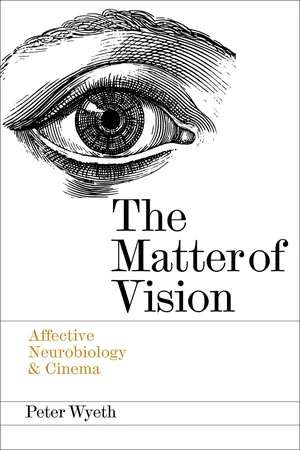
A filmmaker draws on the fields of neuroscience and evolutionary biology to focus on cinema's visual nature.
Cinematic analysis has often supported the notion that cinema can be understood by drawing parallels with language. Peter Wyeth contends that this analytical framework often fails to consider the fundamental fact of cinema's visual nature.
In
The Matter of Vision, Wyeth seeks to redress this oversight by grounding his analysis in neuroscience and evolutionary biology, finding herein the potential for a qualitatively superior understanding of the cinematic medium.
- 226 pages
- English
- ePUB (mobile friendly)
- Available on iOS & Android
eBook - ePub
About this book
Information
Subtopic
Film History & Criticism1
The Matter of Vision
Modern society3 has been the prisoner of three stern gaolers, Language, Consciousness and Reason. Each member of the troika has succeeded in imposing an image of its hegemony upon the mind of modern culture. The result has been the incarceration and repression of their opposite number, the target of this relentless campaign; Vision, the Automatic4 and Emotion.
The task of those images is to boost the prestige of their masters at the expense of their opposite numbers, and in that they have been remarkably successful. Jealously painting-out the real role of their opponents, they have consistently sought to reduce their status.
Language, Consciousness and Reason (LCR) are seen here in terms of their status as cultural5 artefacts, that is not things themselves, but the ‘ideology’ attached to each of them that reifies them above their real status. The question is not of their real relationship to their opposite numbers but the ideological ones that have developed around them.
This project suggests that Language, Consciousness and Reason, in contrast to their image in the public mind, are not quite the peaks of being human that have been promulgated, but more limited in their achievements and reach than their ‘ideologies’ would claim. Those ideologies also have an aggressive attitude towards their opposite numbers and have set out to demote and ‘denigrate’6 Vision, the Automatic, and Emotion (VAE).
The aim of this project is to restore Vision to its real status as the noblest and wisest facility of man, and to turn the tables on the vulgar upstart Language. Likewise, to promote the massive role of the Automatic compared to that of Consciousness, and to aid the return of Emotion to the prestige and position proposed for it as early as 1739 by David Hume in the face of the inflations of Reason.

In the late 1950s it was calculated that the eyes absorb a million times the information of which consciousness is aware.7 In 1965 a physiologist put it that “only one millionth of what our eyes see, our ears hear, and our other senses inform us about appears in our consciousness”.8 Of the range of external stimuli Consciousness handles a millionth, but for internal activity the figures for the brain as a whole suggests it handles between ten and thirty billion times the information of Consciousness.9 That would suggest the possibility that the rest of the information is handled outside Consciousness, yet Language provides us with only a negative term for that activity – the ‘unconscious’. The proposal here is to dedicate an independent term to that area – the Automatic.
Although Consciousness has a limited capacity for information-processing, as in the fabled seven objects that can be held in Consciousness at any one time, it has evolved for the tasks it carries out, and information-processing capacity is not coterminous with value. In other words, Consciousness is more than Information. The brain works to reduce information that is not necessary, a reducing valve,10 and Consciousness in particular does not necessarily require large numbers of neurons to carry out it important functions. However, given that caveat, the issue remains that both the very substantial work of the Automatic and its significance is arguably consistently undervalued, even by neuroscientists.11 It is not that Consciousness is not valuable but that arguably in relation to the Automatic it is an epiphenomenon, an effect rather than a cause, a by-product of brain-function, whereas the image often proposed is of an all-powerful phenomenon, and that of the Automatic a shadowy and uncertain one.
It is suggested here that the Automatic does nearly all the work and directs the limited capacities of Consciousness to attend to the few stimuli it is capable of handling at any one time, effectively tasking it with reporting back on the significance of, and any changes to, those stimuli as part of a feedback loop energised by the Automatic.
The image this project disputes is that LCR are the Major partners and VAE are the Minor partners. This nomenclature echoes an old distinction that used to be made between left and right hemispheres of the brain, with the Left, language-oriented hemisphere, termed Major, and the Right, vision-oriented hemisphere – termed Minor. That terminology reflected an old prejudice that Language is more important than Vision, a prejudice that is the prime target of this project.
Again in raw numbers, Language processes an average of around ten bits per second of information. Vision processes around ten million bits per second, again a differential of a million times.12 Yet the ideology around Language, here referred to as Logocentrism, unequivocally suggests that Language is superior to Vision – with Vision characterised as superficial and lacking in depth compared to the profundities of which language is capable. The proposition here is that quite the opposite is true, Vision is deeper and broader, more sophisticated and mature than Language could ever hope to be. Wisdom resides in Vision, not in Language, which is a narrow medium of translation. Thought, for example, takes place not in Language but in Vision, and only in Vision. Thought is translated into and manipulated in Language, but only actually takes place in Vision.
Neuroscience has also revolutionised our understanding of the relation between Reason and Emotion. From twenty years’ work with brain-damaged patients, Antonio Damasio13 concluded that Emotion is possible without Reason, but that Reason is only possible with Emotion. In other words, Reason is contingent upon Emotion and it is Emotion that is autonomous. That conception turns upside-down the conventional valorisation of Reason and concomitant pejorative image of Emotion. In relation to Cinema, Hitchcock said that Cinema is stronger than Reason, and Godard went further to declare that Cinema is Emotion. The conception here is that Emotion is the alarm-system that the body/brain uses to alert itself to a threat to survival.
The other side of that pairing is Reason, seen here as more of a noble ambition than a universal truth. Man’s ineluctable subjectivity inevitably condemns him to rationalisation rather than grand Reason. And it in that rationalisation that we witness the operations of the subjective in the body of Reason. Recent neuroscience has turned the negative aspects of subjectivity into strengths. Subjective experience should be seen not as out-of-bounds, but as right at the heart of understanding consciousness, for example, by treating it not as evidence, but as raw data.14 A similar approach has yielded valuable insights both with Dreams and with the study of Emotion, and it is in that last area that I would suggest that by including Emotion within a reformed paradigm of scientific method, a revolution of Newtonian proportions has quietly occurred, reinvigorating empiricism and substantially extending its reach. The proposition here is to view Emotion as the raw-material of the brain, the fuel that drives it, and also gives it ignition in its constant movement. It is a commonplace that to live is to feel, but that has a deeper and profound truth in the very mode of the operations of the brain and the body/brain system as a whole.
This project would restore liberty to Vision, the Automatic and Emotion and in so doing repair a serious imbalance in our culture. Lacking a proper hearing for Vision, the Automatic and Emotion we are not losing one half of the picture but in fact sustaining a greater loss. The Major factors have been painted as Minor and the Minor factors as Major. The aim should not, however, be simply to turn the tables, replacing one structure of dominance with another, but to restore the balance in a context that understands how evolution developed such apparent opposites into an integrated whole where both sides play an invaluable role. The reverberations from properly correcting the imbalance would be a revolution in how man thinks of himself in the world.
LCR v VAE
Vision
The starting-point of this enquiry was a sense that Cinema is more powerful than it is given credit for, and that power comes from its nature as a visual medium. The conception of Vision that accompanies that view sees it as the source of virtually all our knowledge about the World. Unlike Language, we do not in general have to practice Vision.15 With Language there is a search for every word, sometimes conscious, often unconscious or Automatic. With Vision we do it without thinking (even where we get it wrong first time around). There is immediately an irony in that situation in that we tend to take the power of Vision for granted. That might be thought of as the Tragedy of Vision.
Language is said to be around 40,000 years old, with recent estimates putting it as 100,000 years old, and speculation that it might be considerably older, even up to a million years old or more. Man is said to be around 2.4 million years old, depending on how you set the boundary between Man and his predecessors, but the first anatomically modern human fossils date back only 195,000 years, however primates with semantic communication seem possibly to predate ‘man’ which could set the origins of language further back.
Vision is eons older, evolutionarily, than Language. The notion that Cinema, a visual medium, could even be imagined to be ‘structured like a Language’,16 a relatively addition to the evolutionary scene, makes little sense (when added to the disparity in processing capacity). The reduction of Cinema to Language would be ahistorical in the extreme and Idealist in philosophical terms. From the perspective of evolution, Language can be argued on the contrary to be contingent upon Vision. For example, between two-thirds and three-quarters of words are said to represent Vision (or Sound, but with a much lesser number devoted to Sound). Language is a development that is based upon Vision.
One element of my interest in Vision was to look at the development of the eye. What could that tell us about Vision? The evolution of the eye can be traced fairly accurately and linked to certain geological changes on Earth. At the time in question the planet was covered with mist and geological changes raised the ambient temperature a few degrees, sufficient to disperse the mists. Before that, vision was useful but of only local significance. Afterwards, vision was at a premium, as the ability to see a potential predator, or indeed potential prey, obviously possessed biological value. Following these events, the eye accelerated in development over a relatively short period in biological terms, a period known as the ‘Cambrian explosion’, between 542 and 543 million years ago.17 By the end of that million year period, the sophistication of the eye was not much different from ours today.
The eye developed as the most efficient method of alerting creatures to a survival-threat. The reason for its efficiency is its capabilities in registering movement – as in the movement of a predator. Movement is the best sign as an early-warning of the approach of a threat to survival. Our eyes respond with alacrity to movement in peripheral vision, and that is an inheritance of evolution. It is, of course, also significant for Cinema, for moving-pictures.
The Wisdom of Vision
Vision may be vastly older and vastly more powerful than Language, but what I would like to draw attention to here again is the quality of Vision. There is a common view in my culture that it is Language that is the subtle medium, capable of the depths of expression of Shakespeare, while the visual sense, and in particular Cinema, is crude, obvious, and superficial. I would guess that part of that attitude comes from the fact that Language has to be practiced to gain its effects. We are more conscious of making an effort to manipulate it on a daily, hourly, constant basis. With Vision, as I have said, it is automatic, often unconscious and we are much less aware of any effort involved.
This conception has Vision as an intelligent medium. In other words it is not merely a passive vessel through which information passes, but an active mediator that has a role in identifyin...
Table of contents
- Cover
- Half title
- Dedication
- Title
- Copyright
- Contents
- Foreword War of the Word
- Chapter 1 The Matter of Vision
- Chapter 2 The Matter of Vision: Aphorisms
- Chapter 3 Commentaries
- Chapter 4 Cinema
- Chapter 5 On method
- Bibliography & Filmography
- Acknowledgements
- Index
Trusted by 375,005 students
Access to over 1.5 million titles for a fair monthly price.
Study more efficiently using our study tools.
Frequently asked questions
Yes, you can cancel anytime from the Subscription tab in your account settings on the Perlego website. Your subscription will stay active until the end of your current billing period. Learn how to cancel your subscription
No, books cannot be downloaded as external files, such as PDFs, for use outside of Perlego. However, you can download books within the Perlego app for offline reading on mobile or tablet. Learn how to download books offline
Perlego offers two plans: Essential and Complete
- Essential is ideal for learners and professionals who enjoy exploring a wide range of subjects. Access the Essential Library with 800,000+ trusted titles and best-sellers across business, personal growth, and the humanities. Includes unlimited reading time and Standard Read Aloud voice.
- Complete: Perfect for advanced learners and researchers needing full, unrestricted access. Unlock 1.5M+ books across hundreds of subjects, including academic and specialized titles. The Complete Plan also includes advanced features like Premium Read Aloud and Research Assistant.
We are an online textbook subscription service, where you can get access to an entire online library for less than the price of a single book per month. With over 1.5 million books across 990+ topics, we’ve got you covered! Learn about our mission
Look out for the read-aloud symbol on your next book to see if you can listen to it. The read-aloud tool reads text aloud for you, highlighting the text as it is being read. You can pause it, speed it up and slow it down. Learn more about Read Aloud
Yes! You can use the Perlego app on both iOS and Android devices to read anytime, anywhere — even offline. Perfect for commutes or when you’re on the go.
Please note we cannot support devices running on iOS 13 and Android 7 or earlier. Learn more about using the app
Please note we cannot support devices running on iOS 13 and Android 7 or earlier. Learn more about using the app
Yes, you can access The Matter of Vision by Peter Wyeth in PDF and/or ePUB format, as well as other popular books in Media & Performing Arts & Film History & Criticism. We have over 1.5 million books available in our catalogue for you to explore.