Why does time seem to speed up as we get older? Why does it seem to drag when we're bored or in pain, or to go slowly when we're in unfamiliar environments? Why does it slow down dramatically in accidents and emergency situations, when sportspeople are 'in the zone', or in higher states of consciousness?
Making Time explains why we have these different perceptions of time, suggesting that there are five basic 'laws' of psychological time and uncovering the factors which cause them. It uses evidence from modern physics and unusual states of consciousness to suggest that our normal sense of time is an illusion, 'created' by our minds. But perhaps more importantly, on a practical level, this book shows us what we can do to control our sense of time passing, to make it pass slowly or quickly in different situations. It suggests that it is possible for us to live through more time in our lives, and so effectively increase the amount of time which we are alive for.
In the final chapter, Steve Taylor uses insights from Buddhism - investigating the practices of mindfulness and meditation - to show how we can actually transcend linear time, and learn to live fully in the present moment.
eBook - ePub
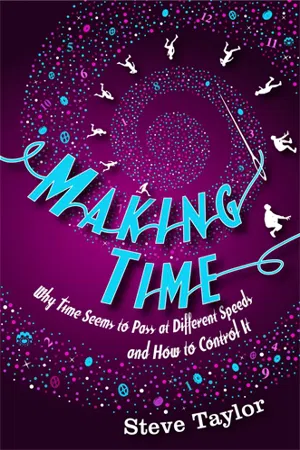
Making Time
Why Time Seems to Pass at Different Speeds and How to Control it
- 320 pages
- English
- ePUB (mobile friendly)
- Available on iOS & Android
eBook - ePub
About this book
Information
Subtopic
History & Theory in PsychologyIndex
Psychology1
The First Four Laws of Psychological Time
1. Time speeds up as we get older*
Here’s another example of vanishing time, which was given me by a friend. At the age of fifteen he went on a school trip to France. He had the misfortune to go to an all-boys’ school, but the special feature of this trip was that girls from the local girls’ school were going too. He had a great time, as you can imagine. He drank lots of French beer, smoked French cigarettes, and started a fumbling teenage affair with one of the girls.
A year later he was sitting on a bus and realised that two girls sitting opposite him seemed familiar. After a while it clicked: they were two of the girls who went on the trip with him. He realised that it was almost a year to the day that they went on the trip, and it made him feel nostalgic. As he told me:
That year seemed like such an enormously long period of time, so long that I’d forgotten what the girls looked like properly, even though I spent most of the holiday drooling over them. I wanted to go up and speak to them but it seemed so long ago that I was afraid they wouldn’t remember me (although maybe I was just making up excuses for my shyness) … If I had to put it in terms of how time is passing for me now, I’d say it was the equivalent of about four years.
Of course, this first law of psychological time is so familiar that it doesn’t really need to be illustrated with examples. We’ve all remarked on it: how Christmas seems to come round quicker every year; how you’re just getting used to writing the date of the new year on your cheques when you realise that it’s almost over; how your children are about to finish school when it doesn’t seem long since you were changing their nappies …
Every time I give a lecture or run a course or workshop, I present this law and ask if people agree or disagree with it, noting down the figures and adding them together as a kind of ongoing survey. And at the moment over 93 per cent of people I’ve surveyed feel that time has sped up as they’ve got older. In fact the people who disagree with the law are almost always young people, in their early or mid-twenties, who presumably haven’t yet become aware of a speeding-up of time. Other, more formal questionnaires by psychologists have shown that almost everyone – including college students – feels that time is passing faster now compared to when they were half or a quarter as old as now.1 And perhaps most strikingly, a number of experiments have shown that, when older people are asked to guess how long intervals of time are, or to ‘reproduce’ these intervals, they guess a shorter amount than younger people.2
The two lives
It’s sometimes said that human beings live two lives, one before the age of five and another one after, and this idea probably stems from the enormous amount of time which those first five years of our lives contain. It’s possible that we experience as much time during those years as we do during the seventy or more years which come after them. As Bill Bryson puts it in his recent memoir of his childhood, The Life and Times of the Thunderbolt Kid: ‘Because time moves more slowly in Kid World … [childhood] goes on for decades when measured in adult terms.’3
It seems that during the first months of our lives, however, we don’t experience any time at all. According to the research of the psychologist Jean Piaget (who conducted a massive number of experiments in order to trace the cognitive development of children), during the first months of our lives we live in state of ‘spacelessness’, unable to distinguish between different objects or between ourselves and objects. We are fused together with the world, and don’t know where we end and where it begins. And we also experience a state of timelessness, since – in the same way that we can’t distinguish between objects – we can’t distinguish one moment from the next. We don’t know when an event begins or when it ends. As the transpersonal psychologist and philosopher Ken Wilber writes, for a newly born child ‘there is no real space ... in the sense that there is no gap, distance or separation between the self and the environment. And thus, there is likewise no time, since a succession of objects in space cannot be recognised.’4
We only begin to emerge from this timeless realm as our sense of separation begins to develop. According to Piaget, this begins at around seven months. We start to become aware of ourselves as separate entities, apart from the world, and also to perceive the separation between different objects. And as a corollary of this, we begin to be aware of separation between different events. We develop a sense of sequential time, a sense of the past and the future, which is encouraged by the development of language, with its past, present and future tenses. According to Piaget, this process follows four stages. First, we recognise that people arrive and events begin; second, we recognise that people leave and events end; third, we recognise that people or objects cover distances when they move; fourth, we become able to measure the distance between different moving objects or people – and at this point we have developed a sense of sequential time.5
After this point of ‘falling’ into time, we become more and more subject to it. The sense of time speeding up isn’t something that we just experience as adults; it probably happens from early childhood onwards. If the sense of sequence is the result of our development of a separate sense of self, we can probably assume that the more developed our sense of self becomes, the more developed the sense of sequence will be – meaning that time will move faster. Time may pass for a two-year-old child, but probably only at an incredibly slow speed. But as the child’s sense of self becomes more developed, the speed of time increases too. Time probably moves faster to a child of four than it does to a child of three, and faster to a child of seven than it does to a child of six.
However, as my childhood journey to Conway showed, even at this age time passes many times more slowly than it does for adults. This is why, as any parent knows, young children always think that more time has gone by than actually has, and often complain of it dragging. As Bill Bryson puts it, to children time moves ‘five times more slowly in a classroom on a hot afternoon, eight times more slowly on any car journey of over five miles’.6 Primary-school teachers should be mindful of this when their pupils’ attention starts to wander – what seems to be a fairly short 40-minute lesson to them (and a fairly short day from 9 am to 3.30 pm) is stretched many times longer to the children. This could have some bearing on childcare practices too. There’s been a lot of debate recently about the effects of children being looked after by childminders or nurseries, and one factor which should be considered here is how children perceive the time they spend away from their parents. Let’s say a parent drops his or her son off at the childminder’s at eight in the morning and picks him up at 5.30 pm, and spends two and a half hours with him before putting him to bed. Those nine and a half hours of separation are long enough even from an adult perspective, but for the child they’ll feel significantly longer. And this ‘stretched out’ time could intensify the negative effects of separation, such as a subconscious feeling of rejection, or a weakening of the bond between the child and parents.
Young children’s sense of time is undeveloped in other ways too. They can’t accurately guess how long events last – in fact they only become able to do this in terms of seconds at the age of six or seven.7 They don’t have a clear sense of the sequence of past events either. When children between the age of two and four talk about what they have done, or retell the story of something that’s happened to them, they almost always mix up the order of the events, usually grouping them together in terms of association rather than sequence. Similarly, they generally aren’t able to arrange a set of pictures in sequence so that they make a story.8
Their awareness of the future is usually very limited too. We tend to forget that the future and the past don’t really exist. They only exist in our minds. All that really exists is the present, and it’s just that, while we’re in the present, we have thoughts about the future and the past. We remember what’s happened to us before the present and we anticipate what’s going to happen to us after it. As St Augustine wrote: ‘The past is only memory and the future is only anticipation, both being present facts.’9 And because young children don’t have the ability to think abstractly or rationally (according to Piaget, this doesn’t begin to develop until the age of 7), they find it difficult to conceive of the past or the future. A couple of years ago my wife decided to take her nephews and nieces to the theatre. That morning she saw her five-year-old nephew Charlie, who was crying for some reason. ‘Don’t be upset Charlie’, she said to him. ‘We’re going to see Puss in Boots this evening.’ Charlie just looked at her blankly, as if he didn’t understand what ‘this evening’ meant, and carried on crying. This reminded my wife of one Christmas time when she was a young child. She was having a tantrum and her older brother tried to cheer her up by saying: ‘Don’t worry Pam, it’s Christmas tomorrow – you’ll be getting lots of presents.’ She remembers that the idea of ‘tomorrow’ meant absolutely nothing to her. She shouted back: ‘But it’s not Christmas now!’
According to the German developmental psychologist, Erik Erikson, human beings’ sense of time becomes fully developed between the ages of fifteen and sixteen. After living in a state of ‘temporal confusion’, we now have a clear ‘temporal perspective’.10 This is because, by this stage, our sense of self has become fully developed, including our sense of separation from the world and the ability to think abstractly and rationally. Our ‘fall’ into time is now complete, but in adolescence and early adulthood our lives are still so full of new experiences that time seems to move fairly slowly. Most people only begin to notice a speeding-up of time in their late twenties or early thirties. By this time we have often ‘settled down’. We’ve settled into our jobs, our marriages and our homes, and our lives have become ordered into routines – the daily routine of working, coming home, having dinner and watching TV; the weekly routine of (for example) going to the gym on Monday night, going to the cinema on Wednesday night, going for a drink with friends on Friday night, etc.; and the yearly routine of birthdays, bank holidays and two weeks’ holiday in the summer. After a few years we start to realise that the time it takes us to run through these routines seems to be decreasing, as if we’re on a turntable which is picking up speed with every rotation. As the French philosopher Paul Janet noted more than a hundred years ago:
Whoever counts many lustra in his memory need only question himself to find that the last of these, the past five years, have sped much more quickly than the preceding periods of equal amount. Let any one remember his last eight or ten school years: it is the space of a century. Compare with them the last eight or ten years of life: it is the space of an hour.11
Forward telescoping
I’d like you to pause for a moment to answer a few questions. I’d like you tell me the year in which the following events happened.
1. The Lockerbie air disaster
2. The terrorist gas attack in a Tokyo tube station
3. The fall of the Berlin Wall
4. The Bill Clinton/Monica Lewinsky scandal
5. The death of George Harrison of the Beatles
6. The death of Princess Diana
You’ll find the answers to these questions at the back of the book on p. 230, and most of you should find that – as long as you’re old enough to remember the events – you have, on average, dated these events too recently. This is the phenomenon which psychologists call ‘forward telescoping’: the tendency to think that past events have happened more recently than they actually have. Marriages, deaths, the birth of children – when we look back at these and other significant events, we’re often surprised that they happened so long ago, shocked to find that it’s already four years since a friend died when we thought it was only a couple of years, or that a niece or nephew is already ten years old when it seems like only three or four years since they were born. As one 83-year-old man told me: ‘I can never guess how long ago things happened. People ask me things like “When did so and so get married?” or “When did so and so die?” and I’m always way out. If I say it was two years it turns out to be five years. If I say six months, it’s two years.’ The same holds true for national and international events, such as the list above: studies have shown that people usually date these too recently as well.12 And perhaps this is because time moves more quickly as we get older, with every month and year shorter than the one before. It doesn’t seem like four years since a friend died or a baby was born, or since a famous person died, because during those four years time has been speeding up without you realising.
As adults our sense of the past and the future becomes very acute too. Our ability to deliberate and think discursively means that the past and the future become as important to us as the present. Children live in the here and now – they don’t worry about whether they’re going to get on with others at the birthday party they have to go to next week, or ruminate over what happened to them at nursery last week. Instead they give complete attention to the present moment, to what they’re doing, and to the people, objects and other phenomena immediately around them. But as adults we start to live inside our own heads rather than in the world and in the moment – we start to daydream, to deliberate, to worry and to plan. Instead of giving our attention to the her...
Table of contents
- Cover
- Title
- Contents
- Introduction
- 1 The First Four Laws of Psychological Time
- 2 How Information Stretches Time: The First Two Laws Explained
- 3 Absorption and Time: The Third and Fourth Laws Explained
- 4 When Time Stands Still: The Fifth Law of Psychological Time
- 5 Time Across Cultures
- 6 The Timeless Moment: Higher States of Consciousness and Time
- 7 The Illusion of Time
- 8 Controlling and Expanding Time
- 9 Expanding and Transcending Time
- Acknowledgements
- Appendix 1
- Appendix 2
- Notes
- Bibliography
- Index
- Copyright
Trusted by 375,005 students
Access to over 1.5 million titles for a fair monthly price.
Study more efficiently using our study tools.
Frequently asked questions
Yes, you can cancel anytime from the Subscription tab in your account settings on the Perlego website. Your subscription will stay active until the end of your current billing period. Learn how to cancel your subscription
No, books cannot be downloaded as external files, such as PDFs, for use outside of Perlego. However, you can download books within the Perlego app for offline reading on mobile or tablet. Learn how to download books offline
Perlego offers two plans: Essential and Complete
- Essential is ideal for learners and professionals who enjoy exploring a wide range of subjects. Access the Essential Library with 800,000+ trusted titles and best-sellers across business, personal growth, and the humanities. Includes unlimited reading time and Standard Read Aloud voice.
- Complete: Perfect for advanced learners and researchers needing full, unrestricted access. Unlock 1.5M+ books across hundreds of subjects, including academic and specialized titles. The Complete Plan also includes advanced features like Premium Read Aloud and Research Assistant.
We are an online textbook subscription service, where you can get access to an entire online library for less than the price of a single book per month. With over 1.5 million books across 990+ topics, we’ve got you covered! Learn about our mission
Look out for the read-aloud symbol on your next book to see if you can listen to it. The read-aloud tool reads text aloud for you, highlighting the text as it is being read. You can pause it, speed it up and slow it down. Learn more about Read Aloud
Yes! You can use the Perlego app on both iOS and Android devices to read anytime, anywhere — even offline. Perfect for commutes or when you’re on the go.
Please note we cannot support devices running on iOS 13 and Android 7 or earlier. Learn more about using the app
Please note we cannot support devices running on iOS 13 and Android 7 or earlier. Learn more about using the app
Yes, you can access Making Time by Steve Taylor in PDF and/or ePUB format, as well as other popular books in Psychology & History & Theory in Psychology. We have over 1.5 million books available in our catalogue for you to explore.