- 208 pages
- English
- ePUB (mobile friendly)
- Available on iOS & Android
eBook - ePub
The Discovery of the Germ
About this book
20 incredible years that revolutionised our understanding of disease. Breathtakingly rapid, the discovery that germs cause disease was both revolutionary and rich in human drama. John Waller describes the scientific virtuosity, outstanding intellectual courage and bitter personal rivalries that gave birth to this exceptional sea-change in scientific thinking.
Information
PART I
BEFORE THE GERM
. CHAPTER 1 .
THE WORLD ACCORDING TO WILLIAM BROWNRIGG
We start with an extract taken from the medical casebook of the eighteenth-century English physician William Brownrigg. A cultivated and learned man, trained in the best medical academies of the time, Brownrigg was at the leading edge of medical science. On 13 November 1738, he was called to attend to a ‘spotty, delicate girl’ called Miss Musgrave, who was suffering from a serious fever. ‘Her face’, Brownrigg later noted,
was puffed up into a swelling, which first appeared on her forehead and then spread downward to her nose, upper lips and cheeks. It was attended with great pain and her urine was pale … She was bled seven times within six days and a large quantity was obtained each time, so that the patient often felt faint.
Then, Brownrigg continued, with the use of ‘local plasters applied to the back of the neck and lower legs, nitrous powders and tartar, and a suitable cooling diet, the disease completely cleared up’.
We can now be fairly confident that Miss Musgrave had a nasty bacterial infection called erysipelas, from which she was lucky to recover. But while Brownrigg was happy to attribute her survival to his care, he obviously had no conception that micro-organisms were the cause of the condition. Instead, he blamed Miss Musgrave’s fever on her ‘delicate constitution’, a build-up in her body of ‘peccant humours’ and the fact that the weather had been ‘excessively wet & rainy and moist and cold with Westerly Winds’. William Brownrigg was too well educated and too upstanding a member of his local community to have been a charlatan. So how can one make sense of this frankly bizarre diagnosis and treatment?
Medicine’s Sense of Humour
In the venerable tradition of Hippocrates and Galen, eighteenth-century doctors saw illness as a deviation from a state of health, caused by the violation of natural laws. These laws took into account a wide range of environmental, physical and psychological factors known as the ‘non-naturals’, including air, food and drink, movement and repose, sleeping and waking, excretion and retention, as well as a person’s state of mind. Whenever a disharmony arose between any of these non-naturals and the individual’s physical being, ill health was the inevitable result. For example, poor quality air, an excess of venous spirits, a melancholy frame of mind, suppressed sweating, even an overly sedentary lifestyle could all be seen as the direct causes of what we now know to be infectious disease.
Again drawing on the ancients, physicians of the 1700s believed that the non-naturals caused illness by disturbing the body’s fluids or humours, whether blood, phlegm, bile, urine, sweat or something else. A person became unwell when an oversupply of one of their fluids produced a disequilibrium or when they became corrupted or ‘peccant’. So if a patient developed a build-up of phlegm, most physicians unhesitatingly identified this as the underlying disease and its removal the only possible cure. By helping to evacuate the phlegm, the physician saw himself as aiding the body in restoring a proper balance of its humours or ridding it of noxious fluids.
Take, for instance, Brownrigg’s description of the case of a nobleman suffering from erysipelas. The patient’s fever indicated to Brownrigg that his body’s attempts to expel noxious or excess fluids were being thwarted by an internal blockage. To overcome this, the nobleman was prescribed a heady cocktail of ‘mercury dissolved in wine’, the effect of which was to cause his sinuses to start expelling large quantities of phlegm. A few days later, Brownrigg felt able to proclaim the verdict ‘cured completely’. The medicine, he explained, had strengthened the ‘expulsive faculty hence the material of erysipelas was removed by blowing of the nose’.
This kind of logic explains the medical profession’s widely remarked-upon obsession with the texture of blood, and the odour, consistency and colour of the patients’ stools. It also accounts for the rich armoury of emetics, cathartics, diuretics and diaphoretics to which their patients were subjected. Suffice to say, ‘peccant’ and ‘balance’ were among the three most popular terms in the medical lexicon. The other was ‘inflammation’. Many physicians saw the body as a kind of hydraulic machine, with its veins, arteries and pores analogous to the pipes, valves, pumps and ducts used in water mills. The non-naturals, they argued, could also disturb these solid components of the body, causing swelling and impeding the free flow of the humours. These then built up and became poisonous, producing anything from typhoid to scurvy. Reducing inflammation was thus another major preoccupation of Brownrigg’s age.
Causes and Effects
A fundamental feature of the humoural theory, and the variants of it that survived into the nineteenth century, is that there was no such thing as a specific disease. The precise form an illness took was seen to be dependent on the humours involved, the place in the body where they had accumulated, and the site at which the body was seeking to expel them. Since all these were highly unpredictable, few physicians spoke of diseases having predictable courses. Naturally, they could tell the difference between measles, plague and scarlet fever. But there was always an expectation that one condition, through bad luck or improper treatment, would suddenly turn into another.
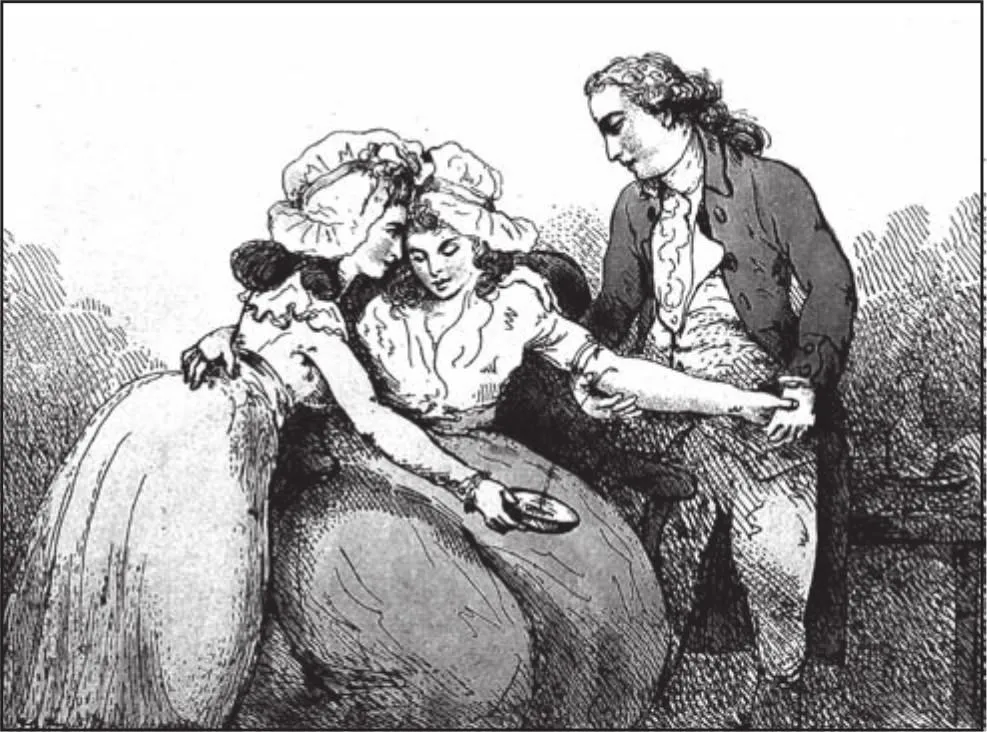
Illustration 1: A typical eighteenth-century medical encounter: a woman being bled by a surgeon as she is comforted by a female friend. Coloured etching by Thomas Rowlandson (1756–1827). Source: The Wellcome Library, London.
Physicians and patients alike fretted that ‘peccant humours’ might quit one part of the body and settle in a much more delicate area. ‘By drinking too freely of cooling Liquers in order to dilute my Blod and put off the Gout,’ wrote one William Abel in 1718, ‘I flung myselfe into a diabetes, much the more dangerous distemper of the two.’ A century and a half later, we find the same idea in the writings of the English heroine, Florence Nightingale. ‘I have seen diseases begin, grow up and pass into one another. The specific disease doctrine’, she harangued, ‘is the grand refuge of weak, uncultured and unstable minds.’
Another striking feature of this framework of ideas is that doctors very seldom relied on mono-causal explanations of illness. In explaining outbreaks of, say, food poisoning or influenza, today we wouldn’t look much further than the viruses or bacteria responsible. In contrast, eighteenth-century notions of causality were nearly always pluralistic. A good example is Brownrigg’s account of the causes of haemorrhoids. As a sufferer himself, Brownrigg did lots of ruminating on this subject, but there was nothing unconventional about his description:
bad digestion, arising from a strong strain of melancholy humour, which often affects those who use thick foods, hard to digest, who wear themselves out with strenuous drinking bouts or who are weighed down all day with cares and sadness or live a sedentary life or, finally, those who apply themselves too earnestly to their studies, especially at night.
Physicians like Brownrigg also divided up the various causes of disease into ‘predisposing’ and ‘exciting’ factors, both of which were needed to cause ill health. ‘Predisposing’ causes usually had to do with the preexisting state of the individual’s humoural constitution, the prevailing climate and the quality of the air they breathed. ‘Exciting’ causes encompassed such things as poisonous fumes floating in the atmosphere (usually known as miasmas), periods of mental anxiety and just about any form of over-indulgence.
Crucially, these notions of exciting and predisposing cause dispensed with the need to think in terms of specific diseases with specific causes. Rather, entirely different ailments were often seen as each person’s individual response to the same noxious agent. Nearly all doctors assumed, for instance, that those who inhaled noxious fumes succumbed to diseases like cholera, typhoid, diphtheria and dysentery. But the particular sickness developed was felt to depend on the person’s own history and susceptibilities, and not on the type of poison ingested.
Conversely, where two patients had identical symptoms, doctors often invoked a very different combination of causal factors. For instance, according to William Buchan’s 1774 best-seller Domestic Medicine, a factory labourer with scurvy would be told that his rotten gums, painful joints, tiredness and ulcerations were the result of ‘vitiated humours’ caused by poor clothing, a lack of personal hygiene and his unwholesome diet. In contrast, a lord of the manor with scurvy would probably be chastised for eating too much rich and hard-to-digest food and spending far too much time sitting in his armchair rather than being outside inhaling pure air. The cause of illness was in each case a matter of individual lifestyle.
To summarise, eighteenth-century ideas about the cause and the cure of ill health all rested on a fundamental belief that disease results from a disharmony between the individual’s physiological state and their mode of life. And if illness was seen to be an individual response to unhealthy lifestyles, it makes sense that physicians tailored their diagnosis and treatment to each client. Ways of combating their unique predispositions were therefore combined with appropriate dietary tips and practical methods of removing their noxious or over-abundant bodily fluids.
So when Brownrigg assessed what was wrong with the sickly Miss Musgrave, he wasn’t hedging his bets by producing a long list of causes. On the contrary, thoroughly in keeping with contemporary medical thought, he first presented a credible predisposing cause, her ‘sickly constitution’, then an exciting cause, ‘excessively wet & rainy’ weather and ‘Westerly Winds’ and, finally, he deduced the diseased state caused by these conditions, ‘a build up of peccant humours’. Next, and again according to the wisdom of the time, Brownrigg made every effort to remove the toxic fluids from her body and gave her a cooling diet to reduce inflammation. In short, Miss Musgrave’s parents had every reason to commend themselves for selecting a skilful and learned physician.
Good Science, Bad Medicine
If, as the above account suggests, Brownrigg and his colleagues were neither rogues nor fools, why didn’t they so much as speculate on the role of germs in causing disease? One answer to this question is that the evidence for germ theory remained very weak until the late nineteenth century. But it is also important to appreciate the many strengths of Brownrigg’s medical worldview. Like all good scientific theories, his provided a simple explanation for a vast number of distinct physical phenomena. Coherent and easy to visualise, the idea of vitiated and imbalanced humours made complete sense of most aspects of health and disease.
After all, many sicknesses are strongly correlated with the production, expulsion and retention of rather unpleasant bodily fluids. If you vomit as a consequence of food poisoning, the body expels bile with the offending material. If you have tuberculosis, you cough up bloody sputum. If you have plague, large lymph-filled buboes develop under the arms and in the region of the groin. Likewise, in most cases, if the vomiting or coughing stops, or the swellings go down and the bumps disappear, the patient has recovered. In the absence of modern knowledge about disease-causing microbes, this kind of observational evidence lent real credence to the idea that disease is nothing but the excessive build-up or corruption of bodily fluids.
The humoural theory also drew strength from its extreme versatility. If therapy failed, despite copious bleeding and almost every conceivable form of induced excretion, then the individual’s equilibrium was declared beyond restoration. Conversely, if therapy succeeded, the doctor had yet another confirmation of the veracity of the theories he had been taught. But again, lest this sound like quackery, it has to be recognised that central to the success of humoural theory was its acceptance by doctor and patient alike. Not only did these ideas seem to fit reality, they were also mostly drawn from ancient texts that both doctors and laymen revered. Humouralism survived largely because it was part of the common intellectual heritage of the civilised world.
Bedside Manners
Another reason why Brownrigg’s medical worldview persisted is that it mapped so neatly onto the cleavages of eighteenth-century society. In this age of rigid hierarchy, wealthy patients usually called the shots and physicians had to observe strict rules of deference. This subservience took several forms. Most obviously, it was the physician’s duty to visit his patients, not vice versa. But, as a result of spending most of their time at the bedside of individual patients, most doctors acquired an oddly individualised impression of the nature of disease. Focusing on single patients and their lifestyles, the peculiarities of their ailments stood out and the common features of illness receded from view. Alas, this narrow focus left physicians much less open to the recognition that many of their patients were suffering from the same illnesses with identical causes.
The same sense of social inferiority discouraged the physician from developing any theory likely to conflict with the common sense and general knowledge of his genteel clients. Where novelty might well be seen as putting on intellectual airs, sticking close to ancient theory, with just a few modern trappings, was much the safer course. Social propriety equally deterred the physician from conducting proper physical examinations. Edinburgh’s John Rutherford, for instance, wrote in 1768 of a female patient who explained that her ill health was caused by ‘the mismanagement she underwent in childbed’. She says, Rutherfor...
Table of contents
- Title Page
- Dedication
- Contents
- List of Illustrations
- Acknowledgements
- Introduction: Revolutionary, by any standards
- Part I: Before the Germ
- Part II: The Germs of Revolution, 500 BC–1850 AD
- Part III: Cue, Louis Pasteur
- Part IV: Worms, Chickens and Sheep
- Part V: Koch’s Postulates
- Part VI: The Four Big Ones, 1881–1899
- Conclusion: A New Science
- Bibliography and Further Reading
- Copyright
Trusted by 375,005 students
Access to over 1.5 million titles for a fair monthly price.
Study more efficiently using our study tools.
Frequently asked questions
Yes, you can cancel anytime from the Subscription tab in your account settings on the Perlego website. Your subscription will stay active until the end of your current billing period. Learn how to cancel your subscription
No, books cannot be downloaded as external files, such as PDFs, for use outside of Perlego. However, you can download books within the Perlego app for offline reading on mobile or tablet. Learn how to download books offline
Perlego offers two plans: Essential and Complete
- Essential is ideal for learners and professionals who enjoy exploring a wide range of subjects. Access the Essential Library with 800,000+ trusted titles and best-sellers across business, personal growth, and the humanities. Includes unlimited reading time and Standard Read Aloud voice.
- Complete: Perfect for advanced learners and researchers needing full, unrestricted access. Unlock 1.5M+ books across hundreds of subjects, including academic and specialized titles. The Complete Plan also includes advanced features like Premium Read Aloud and Research Assistant.
We are an online textbook subscription service, where you can get access to an entire online library for less than the price of a single book per month. With over 1.5 million books across 990+ topics, we’ve got you covered! Learn about our mission
Look out for the read-aloud symbol on your next book to see if you can listen to it. The read-aloud tool reads text aloud for you, highlighting the text as it is being read. You can pause it, speed it up and slow it down. Learn more about Read Aloud
Yes! You can use the Perlego app on both iOS and Android devices to read anytime, anywhere — even offline. Perfect for commutes or when you’re on the go.
Please note we cannot support devices running on iOS 13 and Android 7 or earlier. Learn more about using the app
Please note we cannot support devices running on iOS 13 and Android 7 or earlier. Learn more about using the app
Yes, you can access The Discovery of the Germ by John Waller in PDF and/or ePUB format, as well as other popular books in Biological Sciences & Medical Theory, Practice & Reference. We have over 1.5 million books available in our catalogue for you to explore.