Today George Peabody College is a part of Vanderbilt University, as it has been since its merger in 1979. Its prior history was rich and complex. In this book, Paul Conkin, author of the award-winning history of Vanderbilt, Gone with the Ivy, tells the story of Peabody's many lives, of its successes and failures, and of its many colorful leaders and professors.
It all began as a small frontier academy in 1785. The institution that would become Peabody experienced its first reinvention two decades later as it became Cumberland College, and then, in 1826, the University of Nashville. The University maintained an elite undergraduate college until 1850, and, despite the success of its medical school and a military institute, it failed in three subsequent efforts to restart its undergraduate program.
In 1875 the University offered its campus and degree-granting authority to the first normal school in the state of Tennessee, a school funded by the Peabody Education Fund. The Peabody Normal College was the best in the South, and, as such, exerted an enormous influence on education in the region.
A new era began in 1909. The trustees of the Peabody Fund, at its liquidation, provided an eventual $1.5 million to establish a graduate-level George Peabody College for Teachers. It opened for classes in 1914, on its present campus, where it quickly became the premier teachers' college in the South. As was the case with many private, independent institutions, Peabody faced intermittent financial struggles, which finally ended with its union with Vanderbilt. Today Peabody is, by almost any criteria, one of the five or six strongest colleges of education in the United States.
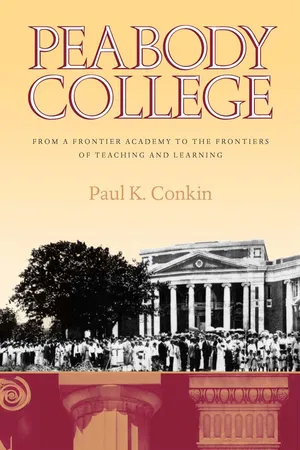
eBook - PDF
Peabody College
From a Frontier Academy to the Frontiers of Teaching and Learning
- 465 pages
- English
- PDF
- Available on iOS & Android
eBook - PDF
Peabody College
From a Frontier Academy to the Frontiers of Teaching and Learning
About this book
Information
Publisher
Vanderbilt University PressYear
2002Print ISBN
9780826514257
9780826514257
eBook ISBN
9780826591685
Topic
ÉducationSubtopic
Éducation généraleTable of contents
- Cover
- Contents
- List of Illustrations
- Preface and Acknowledgments
- Chapter One
- Chapter Two
- Chapter Three
- Chapter Four
- Chapter Five
- Chapter Six
- Chapter Seven
- Chapter Eight
- Chapter Nine
- Chapter Ten
- Chapter Eleven
- Chapter Twelve
- Chapter Thirteen
- Chapter Fourteen
- Epilogue
- Notes
- Index
Trusted by 375,005 students
Access to over 1.5 million titles for a fair monthly price.
Study more efficiently using our study tools.
Frequently asked questions
Yes, you can cancel anytime from the Subscription tab in your account settings on the Perlego website. Your subscription will stay active until the end of your current billing period. Learn how to cancel your subscription
No, books cannot be downloaded as external files, such as PDFs, for use outside of Perlego. However, you can download books within the Perlego app for offline reading on mobile or tablet. Learn how to download books offline
Perlego offers two plans: Essential and Complete
- Essential is ideal for learners and professionals who enjoy exploring a wide range of subjects. Access the Essential Library with 800,000+ trusted titles and best-sellers across business, personal growth, and the humanities. Includes unlimited reading time and Standard Read Aloud voice.
- Complete: Perfect for advanced learners and researchers needing full, unrestricted access. Unlock 1.5M+ books across hundreds of subjects, including academic and specialized titles. The Complete Plan also includes advanced features like Premium Read Aloud and Research Assistant.
We are an online textbook subscription service, where you can get access to an entire online library for less than the price of a single book per month. With over 1.5 million books across 990+ topics, we’ve got you covered! Learn about our mission
Look out for the read-aloud symbol on your next book to see if you can listen to it. The read-aloud tool reads text aloud for you, highlighting the text as it is being read. You can pause it, speed it up and slow it down. Learn more about Read Aloud
Yes! You can use the Perlego app on both iOS and Android devices to read anytime, anywhere — even offline. Perfect for commutes or when you’re on the go.
Please note we cannot support devices running on iOS 13 and Android 7 or earlier. Learn more about using the app
Please note we cannot support devices running on iOS 13 and Android 7 or earlier. Learn more about using the app
Yes, you can access Peabody College by Paul K. Conkin,Paul Conkin in PDF and/or ePUB format, as well as other popular books in Éducation & Éducation générale. We have over 1.5 million books available in our catalogue for you to explore.