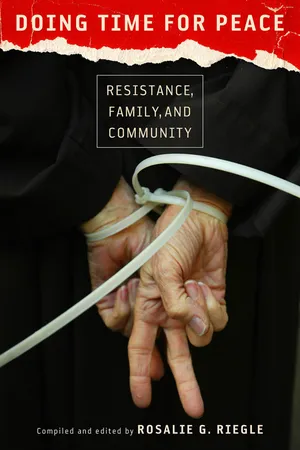
In this compelling collection of oral histories, more than seventy-five peacemakers describe how they say no to war-making in the strongest way possible--by engaging in civil disobedience and paying the consequences in jail or prison. These courageous resisters leave family and community and life on the outside in their efforts to direct U.S. policy away from its militarism. Many are Catholic Workers, devoting their lives to the works of mercy instead of the works of war. They are homemakers and carpenters and social workers and teachers who are often called "faith-based activists." They speak from the left of the political perspective, providing a counterpoint to the faith-based activism of the fundamentalist Right.
In their own words, the narrators describe their motivations and their preparations for acts of resistance, the actions themselves, and their trials and subsequent jail time. We hear from those who do their time by caring for their families and managing communities while their partners are imprisoned. Spouses and children talk frankly of the strains on family ties that a life of working for peace in the world can cause.
The voices range from a World War II conscientious objector to those protesting the recent war in Iraq. The book includes sections on resister families, the Berrigans and Jonah House, the Plowshares Communities, the Syracuse Peace Council, and Catholic Worker houses and communities.
The introduction by Dan McKanan situates these activists in the long tradition of resistance to war and witness to peace.
- 384 pages
- English
- ePUB (mobile friendly)
- Available on iOS & Android
eBook - ePub
About this book
Information
1
Precursors to the Plowshares Movement
Like most, I was taught US history with an emphasis on wars and westward expansion. Only as an adult did I learn that there have always been citizens opposing war and actively living their lives in opposition to armed conflict.1 The few conscientious objectors (COs) to World War I received harsh sentences and little institutional support. The founding of the Women’s International League for Peace and Freedom (WILPF) in 1914 and the US Fellowship of Reconciliation (FOR) in 1915 was a start, and in 1923 the War Resisters League (WRL) began supporting COs who signed a pledge renouncing participation in war, regardless of religious affiliation. After the debacle of World War I, groups such as these made the 1930s a decade where peace seemed respectable; they were aided by socialists and others on the left as well as the traditional peace churches—Quakers, Brethren, and Mennonites—and some mainline congregations. Their parades, prayer services, and protests against war toys helped a nation to remember the carnage of the supposed “war to end all wars.”
Pacifists saw the dangers of Nazism early on and protested vigorously when President Franklin D. Roosevelt refused to lower immigration barriers to allow escaping Jews into the country. But when the draft was reinstated and war fever swept the land, almost all the peace groups except the WRL and the Catholic Worker at least temporarily buried their pacifist ideals.2 Fifty-two thousand men were classified as COs during World War II and 6,086 men refused to cooperate with the draft and went to prison. (Over 75 percent of the latter were Jehovah’s Witnesses.)3 David Dellinger and seven other ministerial students at Union Theological Seminary received wide publicity for refusing to register for their draft deferment and going to prison.
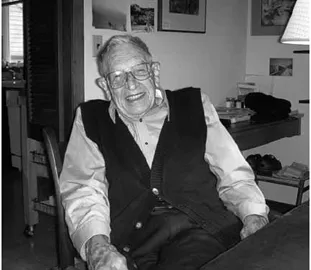
Dick Von Korff, 2011. (Photo courtesy of Dick Von Korff.)
. . .
Dick Von Korff went by himself, unheralded and unknown. A man who knows his own mind, Dick was born in 1916 and decided “war was stupid” when he was in high school. After going to Sandstone Prison for refusing induction into the army in World War II, he completed his education with a PhD in chemistry. His research career finally took him to the Michigan Molecular Institute in Midland, Michigan. He was eighty-nine when I interviewed him in 2004, with a mind still going a million miles a minute. We looked at his scrapbooks as we talked.
. . .
Dick Von Korff
“I pled guilty and I was guilty because my draft orders came and I disobeyed them. There was no way around it, I violated the law. But wars are wrong. The only way we’re going to stop them is to refuse to participate.”
My wife, Jane, convinced me. This was in 1944 and we lived in Peoria, Illinois. I was working in a lab, doing top secret work on penicillin, without a graduate degree, even. I told the people at the lab I wouldn’t go, and they said that I was crazy, that I’d ruin my career. [Reading his refusal statement.] “I am unable to report because of my religious belief.” That’s not right. I should have said, “I will not report.” Sure, I was able to, I just wasn’t going to do it.
After I didn’t report, the lab tried to make me quit, and I said, “Oh, no no no! In this country you’re innocent ’til you’re proven guilty.” So I went on working until the FBI said they had a warrant for my arrest. Then I went in immediately, with Jane, who was pregnant at the time. Got out on bail and was able to start graduate school in Minnesota before finally being sentenced to eighteen months at Sandstone, the federal penitentiary.
I was treated very nice. I never encountered any nastiness, ever! Nowhere. In prison, I found that if you respect the other guy, they’ll leave you alone and respect you, no matter what. My problem was being away from my wife and child. He was four months old when I went in, and he and Jane came up every month. But I got my revenge because once Jane accidentally left a diaper full of BM under the bench. And it served them right.
Oh, I used to live for those visits! No one else came, though. My parents were probably 550 miles away. My dad had been working on the [Long Island] Arsenal making gun sights, and [my refusal] was hard on him, but he backed me a hundred percent. So, loneliness—that’s what I remember most about Sandstone.
Ro: What were the other prisoners like?
Dick: They were mostly COs but not all. Two fellows next to me were in for six months for stealing alcohol from the college pharmacology department for parties. Six months! Men who were in there for taking women across the state line for immoral purposes got less than the COs, by far. I remember two CO brothers, whose father had been a CO in World War I. They were sentenced to five years. Served the five years—or less, because you get a day a month good time—were released, drafted again, and sent back for another five years.
Ro: Do you keep in contact with any of the COs you met there?
Dick: A few. I remember Bill Schulz. He was a Unitarian leader, and he’s now president of Amnesty International.4 Oh, and Art Weiser. He was the son of a minister, and his son was a CO who talked to the soldiers in Iraq.
Now, these other guys that were in the Sandstone CO group—they called themselves “The Sandstone Amnesty and Recreation Society” and had walked out of a Civilian Service camp because they felt they’d become part of the war effort. They felt their integrity [would be compromised] if they became part of the prison system—part of the war system—by working in prison. So they refused to work and got locked up for while and couldn’t participate in the regular freedoms of the prison. Now, I didn’t feel that way. Whether it was fear, I don’t know. It’s hard to analyze your own motives.
I will say one thing I learned in prison. Don’t ever sacrifice your integrity. Because if you do, you have nothing left.
Ro: Did you practice any religion while you were in prison?
Dick: All the while I was there, Jane and I tried to read the New Testament together. We read the same sections at the same time and wrote back and forth about it. I still have the little pocket Bible that I used.
I’ve bounced around a bit as a Christian. When I was growing up, I was first nothing, really. And then a Presbyterian after my first wife died, then a Quaker, and then a Methodist, and then I went to Unity, and now I go to the Unitarian Universalist fellowship. I can say now that I’m rather unsympathetic with [all this going to different churches]. It’s not logical. I used to say I was an atheist, and then I’d say I was a nontheist. (That’s less irritating.)
Now I say I define God in a different way. I now believe that what others call God, for me is embodied in all the good, the kindness, the love in humankind. Yes, people are doing God’s work, but it comes from within them, not from a supernatural source. I feel that the great prophets, Jesus and Mohammed, were keen observers of human nature, and they saw what worked and what didn’t work. That’s what their teachings are about.
Ro: When you tell people today why you are a pacifist, what reasoning do you give?
Dick: Well, war is a dead end. It just leads to more wars. I’ve always felt that war was wrong, ever since high school. I pled guilty and I was guilty because my draft orders came and I disobeyed them. There was no way around it, I violated the law. But wars are wrong. The only way we’re going to stop them is to refuse to participate.
Ro: Did you serve the whole eighteen months?
Dick: I served six months and got out on the first day I could be paroled. Didn’t have any trouble adjusting, none whatsoever. I’m not an easy guy to get along with, you know? I have a problem of always wanting to be in control, so I was just as glad as hell to get out.
Went right back to school and also worked. My wife got me an orderly job at University Hospital. This was the year of the big polio epidemic, and I was the only orderly for the entire hospital on the second shift. I’d bring one kid in the front door, take him up to one of the nineteen iron lungs, take another kid to the morgue.
Hey, wanna know something? Our younger son got a CO from the “Berrigan board” in Catonsville, when we were living in Maryland. (This was after Vietnam was over.) I volunteered as a witness for him and was allowed to hear part of the hearing. After I came out, I heard the clerk say to two young kids, “You have to register, but the war’s over so you won’t be called.” After they left, she said to me, “I wish I could [have told] all the boys that! These wars are caused by nothing but greed.”
Woot! That was the Berrigan board, where they poured the blood on the draft files. And my son got the full CO!
Ro: How did going to prison affect your later life?
Dick: Oh, I think it was great. It had a tremendous effect. I’ve always told people I went to prison, just like I tell people I was in a special hospital for depression. It used to bother my wife. I said, “What the heck! It’s a fact. I was.”
Ro: Did you put being in the penitentiary on your résumé?
Dick: You have to say, even if you’re pardoned. They ask you, “Were you ever arrested?”
“Yes.”
“What was the disposition?”
“Penitentiary. Pardoned by President Truman in 1948.” I have the pardon letter right here. [Looking at scrapbooks.] And I’m proud of it all.5
. . .
While Dick continued his career as a research chemist, other COs, such as Dellinger and his companion George Houser, became professional civil rights and peace activists. The Catholic Worker (CW) movement, founded in 1933 by Dorothy Day and Peter Maurin, had successfully lobbied for Roman Catholics to be accepted as COs and remained staunchly pacifist throughout the war, to the horror of many liberal Catholics who had previously welcomed its threefold program of houses of hospitality, agronomic universities where workers could become scholars, and clarification of thought to address the ills of society.
Day, a convert from a secular socialism, became a complete pacifist when she saw how the teachings of Jesus fit her ideals for a world where “it would be easier to be good.” After the bombing of Hiroshima, the Catholic Worker wrote that the nation should “put on sackcloth and ashes, weep and repent.”6 The nation didn’t, but instead built more and more nuclear weapons and perfected both surveillance techniques and the methods of delivering larger and more lethal bombs.
People in the small peace movement went to work. Using Gandhi as a touchstone, they defined and refined nonviolent resistance, learning to live and work together in both nationwide organizations and small intentional communities. An alphabet of new groups such as CNVA (Committee for Nonviolent Action) and SANE (Committee for a Sane Nuclear Policy) joined the WRL and the American Friends Service Committee (AFSC) to forge alliances and plan sometimes theatrical actions to alert the public. A responsible and responsive press got the message out and people listened, but government policy rarely changed as we fought a very, very Cold War.
Communities such as the New England CNVA and the Catholic Worker demonstrated that nonviolent direct action was able to succeed only if buttressed by communities who themselves “studied war no more” and attempted to live peaceably both within their small communities and with those in disagreement.
. . .
Brad Lyttle says he was “born a pacifist,” taking his lead from a Unitarian mother who was also a socialist and a feminist. Born in 1927, he decided as a young man that peacework would be his profession. After serving an apprenticeship prison sentence for draft refusal, he worked first with the AFSC and later with CNVA and other groups. Brad’s skill with logistics helped with dramatic actions at the Nevada nuclear test site, Mead (now Offutt) Air Force Base in Nebraska, and the submarine works at New London, Connecticut. (These sites remain targets of contemporary peace activists.) He also coordinated several long peace walks, including one from San Francisco to Moscow, and one through the southern United States, attempting to get to Guantanamo and to protest its use as a US base. After a hiatus to care for his aging parents, Brad returned to resistance, and in 2010 he was arrested both at Creech Air Force Base in Nevada, protesting the drones, and at the Oak Ridge, Tennessee, nuclear weapons research facility.
. . .
Bradford Lyttle
“I found I had a natural talent for logistics. . . . But five thousand miles in ten months! Madness!”
My father was a minister and we lived a comfortable middle-class life here, near the University of Chicago. The summer I was eighteen, I heard the news about the atomic bomb on Japan, and I said to myself, “Either the human race has to end war or war is going to end the human race.”
At Earlham College, I was thinking about making the peace movement my life’s work, and I knew that would mean spending some time in jail, so I decided to refuse alternative service in the draft, partly to get the experience of jail.
My sentence was a year and a day at Springfield, but I only served nine months. Saw a great deal of racism and segregation and I couldn’t cooperate with that, so they transferred me to something called “the Honor Ward.” Much less crowded. And not segregated. You had a separate cell and room for a little desk.
I met some extraordinary people there and learned a lot. The library was excellent, and the librarian told me why. He was a famous Communist—I’ve forgotten his name now—who’d been put in prison under the Smith Act.7 He told me, “We got control of the libraries at some of the military bases and brought in all these books on sociol...
Table of contents
- Cover
- Title Page
- Copyright
- Dedication
- Epigraph
- Contents
- Preface: Coming to the Project
- Acknowledgments
- Introduction by Dan McKanan
- 1. Precursors to the Plowshares Movement
- 2. “Let’s Do It Again!” The Berrigans and Jonah House
- 3. Beating Swords into Plowshares: Plowshares Communities and Their Actions
- 4. Catholic Worker Communities and Resistance
- 5. Resister Communities: Syracuse, New York, and Hartford, Connecticut
- 6. Resister Families
- 7. After the Millennium
- Epilogue: “Winter Begins” by Morgan Guyton
- Afterword by Bill Quigley
- Appendix A: Brief Biographies of the Narrators
- Appendix B: For Further Reading
- Notes
- Index
Trusted by 375,005 students
Access to over 1.5 million titles for a fair monthly price.
Study more efficiently using our study tools.
Frequently asked questions
Yes, you can cancel anytime from the Subscription tab in your account settings on the Perlego website. Your subscription will stay active until the end of your current billing period. Learn how to cancel your subscription
No, books cannot be downloaded as external files, such as PDFs, for use outside of Perlego. However, you can download books within the Perlego app for offline reading on mobile or tablet. Learn how to download books offline
Perlego offers two plans: Essential and Complete
- Essential is ideal for learners and professionals who enjoy exploring a wide range of subjects. Access the Essential Library with 800,000+ trusted titles and best-sellers across business, personal growth, and the humanities. Includes unlimited reading time and Standard Read Aloud voice.
- Complete: Perfect for advanced learners and researchers needing full, unrestricted access. Unlock 1.5M+ books across hundreds of subjects, including academic and specialized titles. The Complete Plan also includes advanced features like Premium Read Aloud and Research Assistant.
We are an online textbook subscription service, where you can get access to an entire online library for less than the price of a single book per month. With over 1.5 million books across 990+ topics, we’ve got you covered! Learn about our mission
Look out for the read-aloud symbol on your next book to see if you can listen to it. The read-aloud tool reads text aloud for you, highlighting the text as it is being read. You can pause it, speed it up and slow it down. Learn more about Read Aloud
Yes! You can use the Perlego app on both iOS and Android devices to read anytime, anywhere — even offline. Perfect for commutes or when you’re on the go.
Please note we cannot support devices running on iOS 13 and Android 7 or earlier. Learn more about using the app
Please note we cannot support devices running on iOS 13 and Android 7 or earlier. Learn more about using the app
Yes, you can access Doing Time for Peace by Rosalie G. Riegle in PDF and/or ePUB format, as well as other popular books in Politics & International Relations & Peace & Global Development. We have over 1.5 million books available in our catalogue for you to explore.