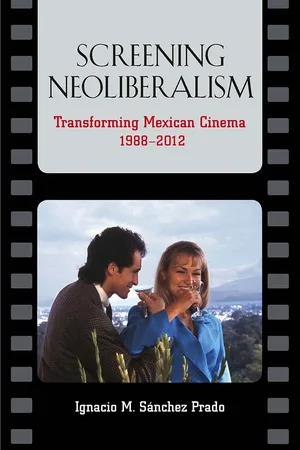
Cavernous, often cold, always dark, with the lingering smell of popcorn in the air: the experience of movie-going is universal. The cinematic experience in Mexico is no less profound, and has evolved in complex ways in recent years. Films like Y Tu Mama Tambien, El Mariachi, Amores Perros, and the work of icons like Guillermo del Toro and Salma Hayek represent much more than resurgent interest in the cinema of Mexico. In Screening Neoliberalism, Ignacio Sanchez Prado explores precisely what happened to Mexico's film industry in recent decades. Far from just a history of the period, Screening Neoliberalism explores four deep transformations in the Mexican film industry: the decline of nationalism, the new focus on middle-class audiences, the redefinition of political cinema, and the impact of globalization. This analysis considers the directors and films that have found international notoriety as well as those that have been instrumental in building a domestic market. Screening Neoliberalism exposes the consequences of a film industry forced to find new audiences in Mexico's middle-class in order to achieve economic and cultural viability.
- English
- ePUB (mobile friendly)
- Available on iOS & Android
eBook - ePub
About this book
Information
Table of contents
- Cover
- Title Page
- Copyright
- Contents
- Acknowledgments
- Introduction: The Reinvention of Mexican Cinema
- 1. Nationalism Eroded: Mexican Cinema in Times of Crisis
- 2. Publicists in Love: Romantic Comedy, Cinema Privatization, and the Aesthetics of the Middle Class
- 3. The Neoliberal Gaze: Reframing Politics in the “Democratic Transition”
- 4. The Three Amigos and the Lone Ranger: Mexican “Global Auteurs” on the National Stage
- Conclusion: Mexican Cinema after Neoliberalism
- Notes
- Bibliography
- Index
Trusted by 375,005 students
Access to over 1.5 million titles for a fair monthly price.
Study more efficiently using our study tools.
Frequently asked questions
Yes, you can cancel anytime from the Subscription tab in your account settings on the Perlego website. Your subscription will stay active until the end of your current billing period. Learn how to cancel your subscription
No, books cannot be downloaded as external files, such as PDFs, for use outside of Perlego. However, you can download books within the Perlego app for offline reading on mobile or tablet. Learn how to download books offline
Perlego offers two plans: Essential and Complete
- Essential is ideal for learners and professionals who enjoy exploring a wide range of subjects. Access the Essential Library with 800,000+ trusted titles and best-sellers across business, personal growth, and the humanities. Includes unlimited reading time and Standard Read Aloud voice.
- Complete: Perfect for advanced learners and researchers needing full, unrestricted access. Unlock 1.5M+ books across hundreds of subjects, including academic and specialized titles. The Complete Plan also includes advanced features like Premium Read Aloud and Research Assistant.
We are an online textbook subscription service, where you can get access to an entire online library for less than the price of a single book per month. With over 1.5 million books across 990+ topics, we’ve got you covered! Learn about our mission
Look out for the read-aloud symbol on your next book to see if you can listen to it. The read-aloud tool reads text aloud for you, highlighting the text as it is being read. You can pause it, speed it up and slow it down. Learn more about Read Aloud
Yes! You can use the Perlego app on both iOS and Android devices to read anytime, anywhere — even offline. Perfect for commutes or when you’re on the go.
Please note we cannot support devices running on iOS 13 and Android 7 or earlier. Learn more about using the app
Please note we cannot support devices running on iOS 13 and Android 7 or earlier. Learn more about using the app
Yes, you can access Screening Neoliberalism by Ignacio Sanchez Prado in PDF and/or ePUB format, as well as other popular books in History & Mexican History. We have over 1.5 million books available in our catalogue for you to explore.