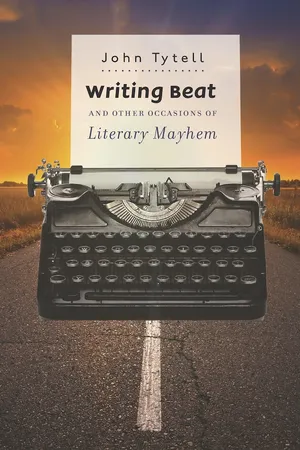
The story and history of the Beats couldn't be found in the traditional libraries or archives of academic research. For preeminent historian of Beat culture John Tytell, it had to be found in the bars, towns, roads, and hangouts of these writers and figures. And as Writing Beat demonstrates, the same techniques apply to new and future writers.Approaching the history of post-war twentieth century American literature, and in particular the Beat literary movement of Kerouac, Ginsberg, Burroughs, and others, Tytell finds himself uniquely positioned as an eyewitness to many of these stories. In this book, he shares his insight with the reader. As he interviewed, drank, traveled, and survived countless moments with some of these literary legends, Tytell discovered much about the craft of nonfiction, biography, and the nature of history. Writing Beat demonstrates, through Tytell's growth as a professor and historian of the Beats, lessons learned and hazards encountered for those aspiring to become writers themselves.As we approach the sixtieth anniversary of Allen Ginsberg's Howl, Writing Beat reminds us writers do not spring to life fully formed, and the struggle to get to literature can be a blast.
- English
- ePUB (mobile friendly)
- Available on iOS & Android
eBook - ePub
Writing Beat and Other Occasions of Literary Mayhem
About this book
Information
One
Engagement
CHAPTER 1
HOW TO WRITE AN ESSAY
Reading could lead to a trance of utter lucidity in which, unknown to oneself, one could make the deepest resolutions.
—Henry Miller, Tropic of Capricorn
I don’t wish to sound arch, dogmatic, presumptuous, or sententious, but the chemistry is fundamental: I’ve been relying on it for the past half century.
One begins with a subject. It is preferable to discover a subject that hasn’t been entirely sucked dry by St. Augustine and a thousand predecessors, but if you must approach such a subject with the kind of universal appeal validated by all that past interest, the least one can provide is a new perspective. My procedure is to jot down notes as they first flicker in the brain in a rough sort of outline. Sometimes, these reflections can occur at inconvenient moments, such as in the middle of the night when you are dreaming of lost love, or while you are driving a car too fast, late for work, relying on a manual shift with your notebook, your trusty depository, in the cold seat next to you.
Your opening sentence is a signal, as intriguing, elegant, and striking as you can make it. The writer David Shields begins a recent essay with the declaration that “all criticism is a form of autobiography.” His terse line is a ring of surprise, coming with the taut certainty of fiat. Fabricating a sentence involves a mental dance of the imagination, a pirouetting and balancing act that is essentially musical. Many writers have honed this craft by reading. As the critic Susan Sontag once observed, “Reading usually precedes writing. And the impulse to write is almost always fired by reading. Reading, the love of reading, is what makes you dream of becoming a writer.”
We can learn a lot about how to write by reading, in the same way we all imitate our mother’s lip movements in infancy, and learn how to speak by hearing our parents enunciate, watching them manipulate their mouths to form vowels and consonants. That may be why the children of immigrants are left with an accent that is just barely discernable. An immigrant child myself, I read Poe and Jack London, then in adolescence Melville and Joseph Conrad, though I cannot now measure with any accuracy whatever influences any of these writers had on my evolving sense of how to form a sentence. I am certain, however, as Sontag urges, that they motivated me.
In terms of the sentence, I can be prescriptive. The explosive heart of any sentence can reside in a memorable, pungent, or provocative phrase, one that may seem baffling or mysterious at first, but that ultimately makes sense. William James’s observation in his Varieties of Religious Experience that the affinity between religion and fiction depends on a shared “willing suspension of disbelief”—which he discerns by reading Samuel Taylor Coleridge—exists as an apt illustration.
Such phrases can leap so quickly from the mind that they are best apprehended by a hand notation in a pocket notebook, that venerable practice we neglect in the speeded blur of our computer age. While the phrase may provide the punch in a particularly important sentence, the construction of a deft sentence, like any architecture, requires a conceived plan. As a model for the qualities of poise and delicacy this sometimes requires, I would recommend William James’s younger brother Henry, who once explained the secret ingredient of memoir, how the writer uses history: “I draw courage from the remembrance that history is never, in any rich sense, the immediate crudity of what ‘happens,’ but the much finer complexity of what we read into it and think of in connection with it.” The polar tension in James’s line depends on the juxtaposed antithesis of rich and crude; it is like a beam that supports the words and makes them hang together so effectively. But James’s sometimes ramified and reflexive sentence structure may suggest too carefully calculated and corseted a Victorian model for younger writers today who will seek more gaiety, more swirling, more rhythmic exuberance, as in the opposite model provided by Jack Kerouac in a famous line describing his characters in the beginning of On the Road:
But then they danced down the streets like dingledodies, and I shambled after as I’ve been doing all my life after people who interest me, because the only people for me are the mad ones, the ones who are mad to live, mad to talk, mad to be saved, desirous of everything at the same time, the ones who never yawn or say a commonplace thing but burn, burn, burn like fabulous yellow roman candles exploding like spiders across the stars and in the middle you see the blue centerlight pop and everybody goes “Awww!”
Beauty requires no explanations, but the antic pell-mell of this extended line depends on the repeated drumbeats of “mad” and “burn,” with each clause building a little longer than the one preceding. Part of its vitality comes from invented words like “dingledodies,” a word that connotes something dizzy or jerky, like slaphappy, Harpo Marx in a tub of whipped cream. The power of the line, however, depends on that defining image of the Roman candle bursting among the stars in the firmament. What we are left with is the gasping, breathless excitement of American vernacular with an explosive momentum that just sings. It is an energy that James’s more measured propriety perhaps excludes, and James might have shuddered at Kerouac’s “Awww!” There may be room for both approaches; one’s choice of the formal or more idiomatic usually depends on what is being described.
Sometimes the intricacy of James’s constructions, or the headlong rhapsody of Kerouac’s, needs the counterpunch of compactness and brevity, a quality one can find in Catullus or Sappho, or more recently in Emily Dickinson or Emerson in his cardinal precept that “Life is our dictionary!” or his more sweepingly romantic observation that “Society everywhere is in conspiracy against the manhood of every one of its members.” Emerson’s short sentences, like a surprise uppercut in boxing, often express a ringing, profound truth that can lead to epiphany, the knockout of recognition in any essay.
The writer’s resources are the tools of analysis, fact, history, or memory, but the two latter categories are subjective and often manipulative, subject to misinterpretation or fabrication, and need to be used with considerable integrity. Personality, as Virginia Woolf once observed, is the “most dangerous and delicate tool” the essayist can employ. While personal experience is often dramatic and compelling, it is not always available or appropriate, and it can appear to be as narcissistic or self-serving as it may be informative or central.
What is crucial is that one sentence should lead to another if you have a story to tell, and narrative is a key element no matter whether the genre you have chosen is fiction or nonfiction. Continuity is the cohesive glue that keeps the reader’s fickle eye—and the restless, impatient, and often importunate brain behind it—concentrated on the page. An imperfect analogy, perhaps, would be the jeweler scrutinizing a diamond, his face screwed into his loupe to assess the infinitesimal fractures they call flaws. Reading is a more difficult act of detection because we must consider a series of quite abstract signs that signify best when we can picture the action being described. In general, the writer learns to shun the general, to fear abstraction, to avoid cliché and empty words like “nice,” to sacrifice the extraneous word ruthlessly, to pitch the idea in a visible image so graphic that we can see the diamond sparkle or smell, taste, or feel the portrayed object.
Poetry often provides excellent models for such tactile responses, such as the red wheelbarrow in William Carlos Williams’s famous little poem, the one he situates in a glaze of rainwater beside the white chickens. Williams provides another clue for the writer. His ears were tuned perfectly to an uninflated diction that is related to actual speech, so natural it never seems self-consciously literary but authentically felt. You can hear it in a poem like “This Is Just to Say,” a “found” poem that originated as a simple note that Williams placed on his refrigerator door apologizing to his wife, Flossie, for having eaten the delicious plums she was saving for her breakfast. This tradition of what I would call natural speech is particularly present in American writing: in Whitman the flaneur listening to the slang of apprentice butcher boys on the Bowery in 1854, or Mark Twain, working on the Mississippi and never forgetting the intonations of midwesterners, in Sherwood Anderson’s Winesburg, Ohio, in Hemingway’s “Indian Camp” stories, or in Henry Miller’s Tropics novels. The writer’s work is listening as much as imagining, and what is heard becomes as much an attribute of style as vision does.
Any gathering of sentences into the unit of a paragraph requires connection, a sober or sometimes more riskily poetic logic of association, the knee connected to the thigh, the thigh to the hip and up the spinal cord to the brain that evaluates all. The principle of the paragraph is unity, a relationship of parts acting congruously, helping to advance an argument. While unity or continuity may seem like hopelessly old-fashioned Aristotelian constructs in a postmodernist universe, the comforting harmony it provides helps any writer persuade a reader. The devil of distraction is digression, valid enough in an exfoliating confabulation by Gabriel García Márquez or Roberto Bolaño, but less convincing in an essay.
The essayist—and Orwell is a model—needs to remember the reader’s delight and indeed dependence on sheer narrative, as well as clarity in intention and expression. A collection of cohering paragraphs, with the vital transitions provided between them to continue the essential flow, becomes the stream of thought that constitutes the essay. Transitions—at least since Stravinsky’s “Rites of Spring” in 1913—have tended to become less logically connected, more associative and imaginative, but they are still necessary for coherence. Then what is important, whether conceived before or after the formation of the essay, is a name to help identify it. The essay title is a trumpet call, a key factor in attracting the reader’s attention, a sort of banner or flag preceding the argument and announcing it to an indifferent public.
In the world of journalism or commercial publishing, the writer may not have ultimate control of a title, which is a sort of headline, and may find it replaced by a dry, lifeless substitution. I consider myself lucky to have convinced publishers to use titles like Naked Angels or Paradise Outlaws, but to record my losses in this regard would only sound like feeble complaining. The editing process commences with one’s first sentence and ends as a negotiation in compromise that only occurs if and when the writer has had the good fortune to find an editor to sponsor the work in the first place. Publication is a dark horse, always a long shot, and for every acceptance the writer—at least this writer!—has had to weather a dozen rejections. These can take the form of notes addressed to “Dear Writer” in an e-mail explaining that the publication wants to “pass on this one” (doesn’t it sound as painful as passing a kidney stone?) or the submission “does not fit our list”—a euphemism for “we will not go there.” The most dismissive and patronizing curt cut omnisciently advises that “this is not your best work.”
Even the brutal formulaic rejection, however, may have its benefits, allowing another opportunity for gestation—that potentially most creative space when you reconsider your work and permit it to grow. The best time for me is early in the morning when all is silent except for the first tentative birdcalls. Just changing a word can open a door or lead to a new perspective. Writing is an incremental process, and rereading one’s writing, sentence by sentence, preferably aloud to voice the music in a phrase, is critical to any writing process and should recur at every step along the way. Some writers insist they need a critical reading by another reader before any formal submission. This can be quite dangerous if the chosen reader is either too zealous or jealous. What you need is someone who knows how to be constructive rather than quarrelsome, a person who won’t deny your style and individuality. I am still looking for such a person though my wife, Mellon, has helped me more than anyone else over the years.
I admit I may have approached the subject of writing an essay too mechanistically for some of my readers and neglected a vital spiritual component. The writer’s strength is mostly in a donkey stubbornness, a refusal to accept the negative verdicts of the magazine editors or publishers who feel the work will not profit them. The will to persevere, the power to believe in oneself, even in the face of anonymity, as Walt Whitman or Emily Dickinson did in the nineteenth century, and Franz Kafka in the twentieth, is often what separates a writer from less Nietzschean peers.
Undoubtedly, this is easier for me to write than for any of us to live. Even Polonius might agree that persistence has its limits as a moral principle. The writer may use self-doubt constructively and revise, or it can become a crippling intellectual paralysis diagnosed as the dreaded writer’s block. Perhaps the greatest victim of this psychic affliction was the novelist Joseph Conrad, who gave us a glimpse into the extent of his suffering in a letter to his literary agent, Edward Garnett:
I sit down religiously. I sit down for eight hours every day—and the sitting down is all. In the course of that working day of eight hours I write three sentences which I erase before leaving the table in despair. . . . It takes all my resolution and power of self-control to refrain from butting my head against the wall. I want to howl and foam at the mouth but I daren’t do it for fear of waking that baby and alarming my wife.
Conrad was writing in English, which happened to be his fourth language. Born in Poland, his second language was an uneducated Russian heard in one of the czar’s prisons where both his parents developed tuberculosis and died young. He learned French as a seaman in the French merchant marine. Retired from a career as a British seaman where he advanced from cabin boy to captain, he struggled to write. However, with his East European accent, he was forever insecure about his command of the English language, which was not the result of schooling but acquired pragmatically by work at sea. He had adventures to relate—stories of enigmatic spies, anarchists, and smugglers—the result of voyages around the world, and despite encouragement from writers like Ford Madox Ford and Henry James, finding the right words and the proper diction was a protracted torture for him. But he persevered, wrote Heart of Darkness and many other novels, and received the recognition that he deserved. Nevertheless, Conrad’s efforts assume mythic proportion.
As George Orwell admitted in his essay “Why I Write”: “Writing a book is a horrible, exhausting struggle, like a long bout of some painful illness.” Over the years, as I conducted workshops in nonfiction or creative writing, many students have approached me, explaining that they could not fulfill the assignment, complaining that they were “blocked.” The fear they felt develops from a failure of confidence. The offer of more time might merely prolong the block and turn it into a Sisyphean boulder. I would hesitate to tell such a student writer that travel to a remote and very different culture might release the block and lead to the discovery of a subject because then they might never complete the course or might hazard a journey that may be too dangerous today. I certainly would not share the story of William Seward Burroughs, who ended a protracted block by shooting his wife at close range in Mexico City in 1951 and then wrote Junky and Queer during the year of his trial. Homicide is clearly too insufficiently therapeutic, too drastic a strategy for me to propose.
Instead, seeking to encourage, I used to tell them a story that may be partly apocryphal, but like most good stories it serves an instructive purpose. The writer Jack London lived with his mother in Oakland, California, early in the twentieth century. They were quite impoverished and London earned his keep working in a cannery and then shoveling coal for ten cents an hour. He had been writing, writing, writing since his teens, but all he had received were condescending notices of rejection. He gathered all the rejected material and placed it in a pile, stating that when it reached his height, he would accept that as a karmic sign to stop trying. The material accumulated to over five feet. London was a good-looking young man, but only five foot four. When his stepsister’s sixty-year-old husband approached him and said he needed help to go north to the Klondike because gold had been discovered, London decided to accompany him. He felt he had nothing to lose and digging in the coal was backbreaking labor. The sketches he wrote about life in the mining camps were immediately accepted—a new subject matter often creates a platform for any writer, which may be why so many writers like Orwell or Hemingway began as journalists.
London ended up as the most successful writer in the history of California with a forty-thousand-acre estate and a yacht he would use to sail around the world. I just loved White Fang and The Call of the Wild when I was a boy, and I would have had less occasion to rejoice in my youth had I been deprived of the ability to read those books. That quality of spiritual stamina and the sheer monumental will to continue the work had sustained Jack London when he was an inch away from failure, which is why I have suggested that persistence may be even more useful to the writer than talent itself. It is an inspiring story: I believe it may have helped some of my former students, and I hope it encourages you.
Note to the reader: I must admit that the chapter you have just read was rejected by some thirty editors of magazines like the Hudson Review and the Kenyon Review, cooler publications like McSweeney’s and Tin House, and more desperate possibilities like the New Yorker or the Paris Review, where one’s work can linger in the slush pile for months before being scanned by an apprentice. After more than a year of lonely circulation, an angelic editor in South Carolina heard its message and offered to publish it, and for that I am grateful.
CHAPTER 2
THE WRITER AS PEEPING JOHN
ON THE NATURE OF BIOGRAPHICAL INQUIRY
The artist is present in every page of every book from which he sought so assiduousl...
Table of contents
- Cover
- Title Page
- Copyright
- Dedication
- Contents
- Acknowledgments
- Epigraphs
- A Prefatory Note
- Part I. Engagement
- Part II. Reconsidering the Beats
- Part III. The Metaphysics of Writing
Trusted by 375,005 students
Access to over 1.5 million titles for a fair monthly price.
Study more efficiently using our study tools.
Frequently asked questions
Yes, you can cancel anytime from the Subscription tab in your account settings on the Perlego website. Your subscription will stay active until the end of your current billing period. Learn how to cancel your subscription
No, books cannot be downloaded as external files, such as PDFs, for use outside of Perlego. However, you can download books within the Perlego app for offline reading on mobile or tablet. Learn how to download books offline
Perlego offers two plans: Essential and Complete
- Essential is ideal for learners and professionals who enjoy exploring a wide range of subjects. Access the Essential Library with 800,000+ trusted titles and best-sellers across business, personal growth, and the humanities. Includes unlimited reading time and Standard Read Aloud voice.
- Complete: Perfect for advanced learners and researchers needing full, unrestricted access. Unlock 1.5M+ books across hundreds of subjects, including academic and specialized titles. The Complete Plan also includes advanced features like Premium Read Aloud and Research Assistant.
We are an online textbook subscription service, where you can get access to an entire online library for less than the price of a single book per month. With over 1.5 million books across 990+ topics, we’ve got you covered! Learn about our mission
Look out for the read-aloud symbol on your next book to see if you can listen to it. The read-aloud tool reads text aloud for you, highlighting the text as it is being read. You can pause it, speed it up and slow it down. Learn more about Read Aloud
Yes! You can use the Perlego app on both iOS and Android devices to read anytime, anywhere — even offline. Perfect for commutes or when you’re on the go.
Please note we cannot support devices running on iOS 13 and Android 7 or earlier. Learn more about using the app
Please note we cannot support devices running on iOS 13 and Android 7 or earlier. Learn more about using the app
Yes, you can access Writing Beat and Other Occasions of Literary Mayhem by John Tytell in PDF and/or ePUB format, as well as other popular books in Letteratura & Biografie nell'ambito delle scienze sociali. We have over 1.5 million books available in our catalogue for you to explore.