Rather than being properties of the individual self, emotions are socially produced and deployed in specific cultural contexts, as this collection documents with unusual richness. All the essays show emotions to be a form of thought and knowledge, and a major component of social life—including in the nineteenth century, which attempted to relegate them to a feminine intimate sphere.The collection ranges across topics such as eighteenth-century sensibility, nineteenth-century concerns with the transmission of emotions, early twentieth-century cinematic affect, and the contemporary mobilization of political emotions including those regarding nonstate national identities. The complexities and effects of emotions are explored in a variety of forms—political rhetoric, literature, personal letters, medical writing, cinema, graphic art, soap opera, journalism, popular music, digital media—with attention paid to broader European and transatlantic implications.
eBook - ePub
Engaging the Emotions in Spanish Culture and History
- English
- ePUB (mobile friendly)
- Available on iOS & Android
eBook - ePub
Engaging the Emotions in Spanish Culture and History
About this book
Information
CHAPTER ONE
Reasonable Sentiments
Sensibility and Balance in Eighteenth-Century Spain
MÓNICA BOLUFER
Etching number 32 in Goya’s Caprichos series, published in 1799, is entitled “Porque fue sensible” (“Because She Was Sensitive”; see Fig. 1.1). It depicts a deeply sorrowful woman locked in a dark cell, barely illuminated by weak rays of light that filter in through a small window. A few years later, the accounts of the Spanish people’s uprising against the Napoleonic invasion would reinforce two of the ideas suggested by the etching: the dangers inherent in sensibility and its particular association with women, both already characteristic of a Romantic vision of the emotions. In a fine study of Spanish sentimental fiction, Ana Rueda used this image to represent the growing distrust of sensibility and of its power to solve moral and social conflict that developed at the dawn of the nineteenth century (“‘Virtue in Distress’” 201). However, in the previous century, there was a moment when the Enlightenment concept of “sensibility” was conceived as being able to reconcile reason and sentiment, although this ideal was wrought with tensions that Goya’s etching—and, as we shall see later, the episode that inspired it—embody.
In effect, the eighteenth century constitutes, in Spain as in the rest of Europe, a key period in the formation of new emotional codes, which in certain respects anticipate those of the nineteenth century and in others clearly differ from them. It was in the eighteenth century that the earlier discourse on the passions as domineering impulses was toned down in favor of a more pleasant image of feelings as spontaneous affective manifestations, signs of an innate natural morality not at odds with Providence. When Gaspar Melchor de Jovellanos (1744–1811)—man of letters, politician, and friend of Goya—declared in his “Memoria sobre educación pública” (“Report on Public Education”), written in 1802 during his exile in Majorca, that moral truths are “verdades de sentimiento” (truths of sentiment; 455) engraved in human hearts as the true expression of God’s will, he was echoing ideas widespread among enlightened Spaniards, supported by readings of key texts in European moral philosophy like those of Shaftesbury, Hutcheson, David Hume, Adam Smith, and Condillac (Gies 216–19; Polt). According to Jovellanos, although reason helps us to “discernir y conocer la ley moral” (assess and know moral law), behavior must be guided above all by such “verdades de sentimiento”: “El hombre, por decirlo así, las halla antes en su espíritu, las siente más bien que las conoce, o las conoce y ve de una ojeada y sin necesidad de profundas reflexiones. Una luz clara que el Criador infundió en su corazón, se las descubre, y una voz secreta que excitó en su interior, se le anuncia y recuerda poderosamente aun en medio del tumulto de las pasiones” (Man, we might say, encounters them sooner in his spirit, feels them rather than knows them, or knows and sees them at first glance with no need for deep reflection. A clear light infused in his heart by the Supreme Creator reveals them to him, and a secret inner voice aroused by Him announces and evokes them even amid the passions’ turmoil; Jovellanos, “Memoria” 455).
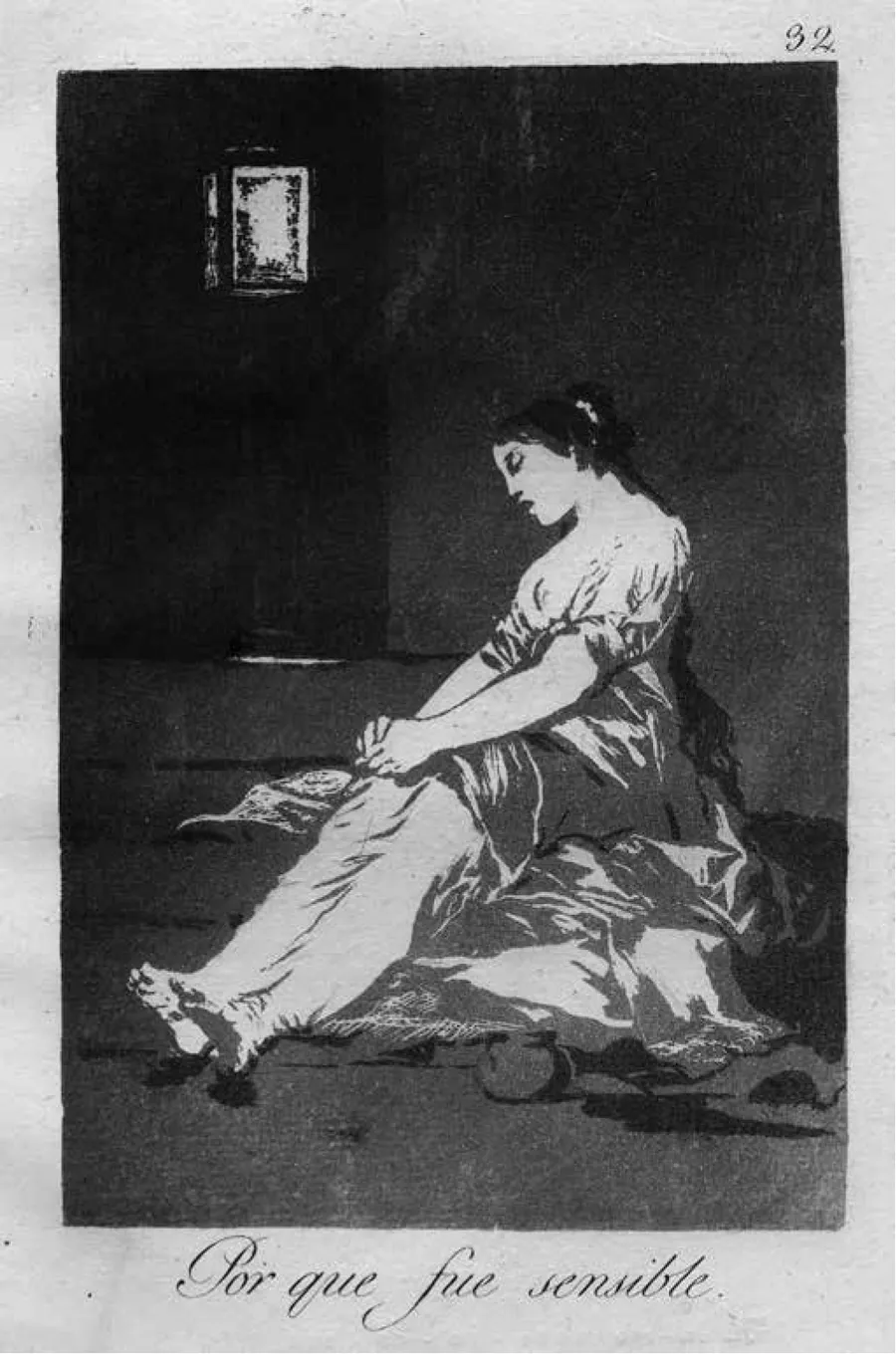
Figure 1.1. Goya, “Because She Was Sensitive.” Los caprichos. Courtesy of the Trustees of the British Museum.
In this period, such feelings were not referred to as “emotions,” a term that, as historians know well, was not used to refer to feelings before the nineteenth century (emoción makes its first appearance in a Spanish dictionary in 1843 (Nuevo diccionario 413). In the early modern period, the words used most often to speak about states of the heart or mind were “afectos” (affects), “afecciones” (affections), or “pasiones” (passions), understood as passing—and often undesirable—commotions or disturbances (Dixon 1–6, 62–68; Tausiet and Amelang 8–9). The new idea of an inner impulse that inspires moral judgment emerged with the change of meaning undergone by the concept “sentimiento” (sentiment), previously defined as “opinion” or “sorrow,” which increasingly came to be used to mean both the act of perceiving objects through the senses (as theorized by sensist epistemology) and a feeling of the heart, as defined in the 1791, third edition of the Real Academia Española’s Diccionario de la lengua castellana: “La percepción del alma en las cosas espirituales con gusto, complacencia o movimiento interior” (Perceptions of the soul in spiritual matters with pleasure, complaisance, or inner movement; 759). Since this was a relatively new usage, in a 1792 preface to her Spanish translation of a French philosophical novel, María Rosario Romero felt the need to clarify her language to her readers: “por la palabra sentimiento no se ha de entender solamente el que se recibe de alguna pesadumbre, sino también por el gusto y complacencia que recibe el alma, según las diferentes impresiones” (by the word “sentiment” we must understand not only that provoked by sorrow, but also the pleasure and complaisance received by the soul, according to different impressions; 18). But above all, these new meanings were evidenced, in Spain as in other countries, by growing use of the term “sensibility” to designate not only the capacity to react to stimuli—the “involuntaria y como maquinal” (involuntary and almost machinelike) sensibility of which the poet and jurist Meléndez Valdés speaks in 1798 (1084)—but also the capacity to experience emotions through sympathy or affinity with the feelings of another, which awakens compassion that in turn incites action: a “sensibilidad oficiosa” (officious sensibility) that “inspira dulcemente virtudes sociales y domésticas” (sweetly inspires social and domestic virtues; 1099).
In this chapter, I hope to underscore the differences between this eighteenth-century emotional style of sensibility and that of Romanticism, two markedly different cultures, although the former contains within it the paradoxes and tensions that will end up exploding in the form of open contradictions in the latter.1 At the same time, I will attempt to point out some specificities of the Spanish case within the context of eighteenth-century European sentimental culture. My approach will be based on a history of the emotions that has a longer and more complex trajectory than the current “affective turn” in the English-language humanities and social sciences tends to acknowledge (Burke 36–38; Tausiet and Amelang 19–24). Specifically, I will draw on several historiographical traditions—some of them too abruptly dismissed and others not mentioned in a fine and now classic essay by Barbara Rosenwein (821–23, 831–32)—including the legacy of the French Annales school (from Lucien Febvre to Roger Chartier) and of British and French scholarship on the history of the family (Lawrence Stone, Philippe Ariès, Jean-Louis Flandrin). But, above all, I am indebted to the insights of cultural history and gender history, which have been crucial in dismantling a residual notion of the emotions as basic natural facts, universal in time and space and immune to change, whose history would simply be that of the “repression” or “tolerance” of preexisting spontaneous impulses. By contrast, the works of Knott, Carter, Barker-Benfield, Rosenwein, Reddy, Morant, and de la Pascua Sánchez, among others, have explored the ways in which the emotions mediate between the individual and the social (Bourke 124) by analyzing the cultural construction of emotional codes, and the shaping and expression of personal and social experience through the use and manipulation of the languages and resources made available by them. The material discussed in this chapter will include eighteenth-century Spanish sentimental literature, plus other documents ranging from political reports and legal papers to personal writings (memoirs, autobiographies, and letters). Taken together, these sources can help us understand, at least partially, not only how sentiments were expressed in writing, but also how a specific language (that of sensibility) was used in ways that, in keeping with William Reddy’s notion of “emotives,” were neither completely constative nor totally performative, but “at once managerial and exploratory” (Plamper 240). In other words, this is a language likely to have produced particular ways of feeling and of relating to others, while being flexible enough to accommodate individual and collective appropriations and reworkings (Bolufer, “La realidad y el deseo”).
Although the contrary has sometimes been argued, sentimental literature was not unknown in Spanish society in the eighteenth century; rather, there was an active process of reception, consumption, appropriation, and production of sentimental genres. New forms of drama and comedy—including the comédie larmoyante (lachrymose comedy)—were introduced in select aristocratic and literary circles such as the Madrid tertulia (salon) of the Marquesa de Sarria, Josefa de Zúñiga, in the 1750s and that of Pablo de Olavide in Seville in the 1770s (Fuentes 104–9). Promoted by the state in its efforts at aesthetic and moral reform of the theater, these new theatrical forms would reach a broader public in the century’s last two decades, through original works but especially through versions of French and German plays (García Garrosa, La retórica; “Unión de voluntades”). In the 1790s, the sentimental novel began to develop, also through adaptations of English works such as those of Samuel Richardson (Pamela, 1794–1795; Clara Harlowe, 1794; Carlos Grandison, 1798), and Henry Fielding (Amelia, 1796; Tom Jones, 1796), and of French works such as Stéphanie de Genlis’s Adela y Teodoro (1782), Jeanne-Marie Leprince de Beaumont’s La nueva Clarisa (1797), and Gatrey’s La filósofa por amor (1799). These adaptations were later supplemented by the belated production of original novels in Spanish, including very successful works such as Pedro de Montengón’s Eusebio (1786–1788), Antonio Valladares de Sotomayor’s La Leandra (1797–1807), and Gaspar Zavala y Zamora’s Oderay (1804) and La Eumenia (1805), continuing throughout the nineteenth century and outliving the birth of realism (Rueda, Cartas). Such novels, usually marketed via subscription, were extremely successful with a broad and varied public, including a high percentage of women readers (ranging between 14 percent and 28 percent, remarkable in a country with low literacy rates).2
State and inquisitorial censorship kept a close watch on the novel, refusing printing licenses and controlling access to works in foreign languages. Finally, a formal ban on the genre (only partially effective) was decreed in May 1799. As a result, Spanish authors, translators, and publishers of sentimental fiction tended to defend the genre even more emphatically than their European counterparts. To counter those who distrusted the novel for its power to stimulate the imagination, they presented it as an excellent instrument of moral education, precisely because of its power to touch and move its readers, helping them to identify and educate their feelings—as Alfonso, the protagonist of José Mor de Fuentes’s La Serafina (1798), claims of “Clarisa y sus semejantes, que están brotando por todos sus renglones la moral más acendrada” (Clarissa and its likes, whose every line exudes the most distilled morality; Mor de Fuentes, La Serafina 1: 100). At the same time, translators went to great lengths to adapt their versions to “las costumbres nacionales” (national customs) and to stress (crucial in a Catholic country) the basic equivalence between natural morality and divine Providence. For example, the translator of Pamela, Ignacio García Malo, not only bowdlerized the text (more radically than the French version from which he worked) of any allusion to sensuality but also Christianized its heroine in his prologue, coming close to martyrological hagiography in his praise of her chastity (García Malo, Pamela 5: vi).
Sentimental rhetoric was not, of course, limited to explicitly “sentimental” genres. It also pervaded other types of texts, from moral and didactic literature to political speeches and medical treatises. And the public that enthusiastically received sentimental ethics and aesthetics was broad and diverse: male and female, more or less educated, ranging from aristocrats, politicians, intellectuals, and artists like Jovellanos (who owned all of Richardson’s major works) or Goya (who subscribed to the Spanish version of Clarissa), to broad sectors of the middle and even popular classes—in the latter case, in a society with low literacy rates, largely through the theater rather than the novel. These heterogeneous reading publics may have appreciated different aspects of the code of sensibility: its claim to universality as a virtue allegedly transcending class, and its implicit ability to convey distinction as the alleged attribute of educated and refined people.
How did the affective models proposed by sentimental literature influence the ways in which people assigned meaning to their feelings and relations? Unsurprisingly, this is more difficult to evaluate, since private writings, even if we assume that shifts in the way people narrate their emotions alter their subjective experience (Bourke 120), are often opaque or ambiguous in this respect. On the one hand, at the end of the century letters exchanged by married couples or lovers timidly incorporated inflections of the new sentimental language into the amorous formulas inherited from earlier moral and religious literature or from the baroque novel (de la Pascua Sánchez, Mujeres solas 124–25, 291–92). At the same time, private correspondence between intimate male friends displayed a language of even higher affective intensity clearly influenced by the sentimental style—as seen, for example, in the letters of Jovellanos and Meléndez Valdés, who address each other as “muy amado” (beloved) and “mi dulcísimo amigo” (my sweetest friend), and revel in their mutual “sentimiento” (sentiment), “íntimo amor” (intimate love), and tenderness (Meléndez Valdés 1175–82, 1207–8), or in those sent by Goya to Martín Zapater where he addresses him as “amigo y amigo y más amigo” (friend and friend and closest friend), and “querido de mi alma” (dear to my soul; Goya 65, 68, 121). On the other hand, different types of ego documents—autobiographies, diaries, moral advice—were shaped by the model not so much of sentimental confession (as in Rousseau’s Confessions, dismissed by Jovellanos in 1794 as “impertinencias bie...
Table of contents
- Cover
- Title Page
- Copyright
- Contents
- Illustrations
- Acknowledgments
- Introduction: Engaging the Emotions—Theoretical, Historical, and Cultural Frameworks
- 1. Reasonable Sentiments: Sensibility and Balance in Eighteenth-Century Spain
- 2. “How Do I Love Thee”: The Rhetoric of Patriotic Love in Early Puerto Rican Political Discourse
- 3. Emotional Readings for New Interpretative Communities in the Nineteenth Century: Agustín Pérez Zaragoza’s Galería fúnebre (1831)
- 4. Emotional Contagion in a Time of Cholera: Sympathy, Humanity, and Hygiene in Mid-Nineteenth-Century Spain
- 5. “Hatred alone warms the heart”: Figures of Ill Repute in the Nineteenth-Century Spanish Novel
- 6. “You will have observed that I am not mad”: Emotional Writings inside the Asylum
- 7. A Sentient Landscape: Cinematic Experience in 1920s Spain
- 8. The Battle for Emotional Hegemony in Republican Spain (1931–1936)
- 9. Love in Times of War: Female Frigidity and Libertarian Revolution in the Work of Anarchist Doctor Félix Martí Ibáñez
- 10. From the History of Emotions to the History of Experience: A Republican Sailor’s Sketchbook in the Civil War
- 11. Affective Variations: Queering Hispanidad in Luis Cernuda’s Mexico
- 12. Sentimentality as Consensus: Imagining Galicia in the Democratic Period
- 13. Emotional Competence and the Discourses of Suffering in the Television Series Amar en tiempos revueltos
- 14. From Tear to PixelPolitical Correctness and Digital Emotions in the Exhumation of Mass Graves from the Civil War
- 15. Public Tears and Secrets of the Heart: Political Emotions in a State of Crisis
- Afterword: Shameless Emotions
- Contributors
- Index
Trusted by 375,005 students
Access to over 1.5 million titles for a fair monthly price.
Study more efficiently using our study tools.
Frequently asked questions
Yes, you can cancel anytime from the Subscription tab in your account settings on the Perlego website. Your subscription will stay active until the end of your current billing period. Learn how to cancel your subscription
No, books cannot be downloaded as external files, such as PDFs, for use outside of Perlego. However, you can download books within the Perlego app for offline reading on mobile or tablet. Learn how to download books offline
Perlego offers two plans: Essential and Complete
- Essential is ideal for learners and professionals who enjoy exploring a wide range of subjects. Access the Essential Library with 800,000+ trusted titles and best-sellers across business, personal growth, and the humanities. Includes unlimited reading time and Standard Read Aloud voice.
- Complete: Perfect for advanced learners and researchers needing full, unrestricted access. Unlock 1.5M+ books across hundreds of subjects, including academic and specialized titles. The Complete Plan also includes advanced features like Premium Read Aloud and Research Assistant.
We are an online textbook subscription service, where you can get access to an entire online library for less than the price of a single book per month. With over 1.5 million books across 990+ topics, we’ve got you covered! Learn about our mission
Look out for the read-aloud symbol on your next book to see if you can listen to it. The read-aloud tool reads text aloud for you, highlighting the text as it is being read. You can pause it, speed it up and slow it down. Learn more about Read Aloud
Yes! You can use the Perlego app on both iOS and Android devices to read anytime, anywhere — even offline. Perfect for commutes or when you’re on the go.
Please note we cannot support devices running on iOS 13 and Android 7 or earlier. Learn more about using the app
Please note we cannot support devices running on iOS 13 and Android 7 or earlier. Learn more about using the app
Yes, you can access Engaging the Emotions in Spanish Culture and History by Luisa Elena Delgado, Pura Fernandez, Jo Labanyi, Luisa Elena Delgado,Pura Fernandez,Jo Labanyi in PDF and/or ePUB format, as well as other popular books in Literature & European History. We have over 1.5 million books available in our catalogue for you to explore.