The contributors ask the following questions: • What are the different rhetorical strategies employed by writers, artists, filmmakers, and activists to react to the degradation of life and climate change?
• How are urban movements using environmental issues to resist corporate privatization of the commons?
• What is the shape of Spanish debates on reproductive rights and biotechnology?
• What is the symbolic significance of the bullfighting debate and other human/animal issues in today's political turmoil in Spain? Hispanic Issues Series
Nicholas Spadaccini, Editor-in-Chief Hispanic Issues Online
hispanicissues.umn.edu/online_main.html
eBook - ePub
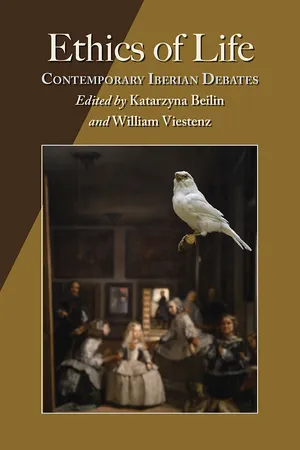
Ethics of Life
Contemporary Iberian Debates
- English
- ePUB (mobile friendly)
- Available on iOS & Android
eBook - ePub
Ethics of Life
Contemporary Iberian Debates
About this book
Information
PART I
Genealogies of Ecological and Animal Rights Movements in Modern and Contemporary Iberia
1
The Environment in Literature and the Arts in Spain
Carmen Flys-Junquera and Tonia Raquejo
According to Joaquín Fernández, Spain has not had a strong environmentalist tradition, partially due to the Franco regime (Ecologismo español). In his study, Fernández notes that the Civil War marked a fracture between any previous incipient Spanish activism, and that real consciousness only started in the 1970s, together with democracy and the economic boom known as the “Spanish miracle” (44). An early study by Josep Vicent Marqués, Ecología y lucha de clases (1978), illustrates the leftist, Marxist influence in most initial environmental movements, clearly linked to social injustice. Only with the increase of urban speculation as the result of massive construction, which threatened the entire coast and large tracts of rural space, and the uncontrolled growth of cities did the environmental impact become an issue within the greater population. And as such, most debates are closely tied to social and economic problems rather than with the agenda to preserve wilderness which resonates so strongly in the United States. In the last two decades, environmental debates have appeared in political, social, economic, and scientific discourses; but, sadly, the financial and economic crisis has stunted this momentum of environmental awareness and dried up all funding. Despite the urban sprawl, there is still no strong “green” political party with parliamentary representation in Spain, although there are prominent activists, such as Juan López de Uralde, longtime president of Greenpeace Spain and founder of a new environmentalist political party, Equo, whose major test was to have been the European and local elections in 2014 and 2015, respectively. However, this test was weakened due to the rise of new populist parties with which Equo made alliances. These alliances were very successful in both elections, but the actual weight of Equo and environmental issues was diluted.
During this period there has been significant environmental awareness in the sciences and social sciences, but the humanities and arts in Spain were largely disconnected from environmental concerns. In the journal Ixquic 2 (2000), critics Jorge Paredes and Benjamin McLean assert that environmental literature in Spanish could only stem from Mesoamerica and was virtually impossible in the Iberian Peninsula, given its strong Judeo-Christian tradition, and the importance of humanism, rationalism, capitalism, and positivism, which made the culture insensitive to the environment (25). Even if their concept of environmental literature as direct denunciation of environmental degradation is restrictive, it is true that there has not been much environmental concern in the humanities. However, things are changing. Research groups with an environmental focus have been created within both literary and art criticism. Various novels and poetic works have recently addressed environmental concerns and there are numerous artists with a clear ecological purpose in their creative work. This essay aims to present an overview of the recent research within the fields of literature and the fine arts.
Literature and Ecocriticism
While ecocriticism has become a significant literary approach in the United States and the United Kingdom, an ecocritical school of thought is merely incipient amongst Spanish Hispanists. It is clear, as Paredes and McLean state, that literature coming from the indigenous peoples of the American continent has cried out in protest over the degradation of the environment and natural landscapes (20), while this has not happened in Spain, with the exception of a few recent cases. Most Spaniards have had a strong sense of place-attachment to their region, but the approach from criticism has usually been either one of nationalism and identity or some variation of the classic locus amoenus and the pastoral.
Prior to the 1970s, Spanish literature took up the thematization of nature without, however, being ecologically oriented. Paredes and McLean discuss the Spanish Renaissance and Baroque literature (9–16) while Pratt and Gordon, in one of the earliest ecocritical articles about Spanish literature, point out that during the Romantic period, Spanish literature tended to focus on the sublime of nature (249). Nevertheless, despite the clear influences of the environment on Spanish culture and literature—which both writers point out—there has been little ecological awareness.
Miguel Delibes’s speech upon entering the Royal Academy of Language in 1975 was the major wake-up call. In his speech he interprets his own work based on an environmental approach derived from the report The Limits to Growth (1972) commissioned by the Club of Rome, an approach which dominates the little work carried out in the late twentieth century in environmental writing in Spain. This can be considered, as Marrero Henríquez states, the first critical interpretation of literary work based on environmentalist thinking (“Ecocrítica” 208). Delibes’s approach, rather than a nostalgic view of rural life, can be interpreted as associating rural life with a healthier and more sustainable lifestyle in contrast to the so-called progress of the cities. Although Delibes does not make a direct denunciation of environmental degradation, his work is informed by clear environmental thinking, opting for an indirect approach, tinged with poetic tones which he considers more effective (Pérez Abad 94). While Delibes is considered the first environmentalist writer (Paredes and McLean 8), other writers have started to deal with these topics. Julio Llamazares shows in his novel La lluvia amarilla (1988, based on the flooding of a valley for a reservoir) a clear ecological understanding of life, though he maintains a nostalgic and almost romantic tone, rather than one of direct denunciation. The abandoned village represents the end of the dialogue between nature and humankind because modern city life has turned a blind eye and nature slowly reclaims the village. Another significant contribution is Jesús López Pacheco’s poetic volume Ecólogas y Urbanas (1996), where the title is a play on ecology and eclogues. The collection is full of witty poems, sayings, absurd skits, and rhymes, which nonetheless have deep social and environmental messages such as his “Epigrama de un ingenio de la corte imperial” (37) (Epigram by a genius of the imperial court), which characterizes our consumer society by the garbage and smoke it produces: Consumer society / has its own culture: / to produce garbage and smoke, / or, if not, smoke and garbage (my translation). Another short poem also illustrates the Spanish concern of linking economic growth and progress to environmental devastation: “Pequeña corriente de conciencia en versos de plástico” (94) (Small current of conscience in plastic verses). This poem plays on the programed obsolescence of our consumer society which produces things that create waste only to produce something new to take care of the waste or to create a demand for more ecological products and processes, in order to make profit out of them.
Selling products produced
only to be sold
produces great pollution
offering as a solution
the demand created for recycling
and alternative products
natural organic healthy
reinvesting in the new scheme
to receive benefits with both hands
good life for the living
(above all one must be postmodern)
only plastic and God are eternal (my translation)
Both poems, which rhyme in Spanish, play with the titles of traditional Spanish poetry, only to highlight the current skepticism of capitalist economic cultures.
Moving into the twenty-first century, a number of writers have directly engaged environmental issues. Foremost among them is the poet and essayist Jorge Riechmann. His book, Un mundo vulnerable: Ensayos sobre ecología, ética y tecnociencia (2000), is considered a landmark and his collections of poetry, in particular Con los ojos abiertos (2007), are invariably linked to environmental issues, once again with a critical view of consumer society and its effects on culture. For example, in his poem “Tratamiento de residuos” (Waste treatment) he lists the types of waste in which both the human and nonhuman become the waste of progress:
El principal problema estriba actualmente
en la eliminación de los residuos
. . . .
El agua es un residuo
de la producción de imprescindible energía
animada e inanimada. El aire, residuo
de combustiones en benéficos motores.
Fauna y flora son ya propiamente residuos
de las industrias cárnica y farmacéutica. El trabajo
humano, residual residuo
de la actividad incansable de las máquinas.
La historia es residuo
de la conquista del espacio y el arte residuo
altamente tóxico
de la televisión por cable.
. . . . (40)
(The main problem currently
is the elimination of waste
. . . .
Water is a residue
of the production
of the necessary energy
animate and inanimate. The air, residue
of combustion in beneficial motors.
Fauna and flora are clearly residues
of the meat and pharmaceutical industries. Human labor,
residual residue
of the untiring work of machines.
History is the residue
of the conquest of space and art is the residue
highly toxic
of television by cable. . . . ; my translation).
In 2001, the well-known poet Juan Cobos Wilkins published a lyrical novel, El Corazón de la tierra, later taken to the screen by Antonio Cuadri in 2007. The novel combines the historical narrative of what was perhaps the first demonstration for environmental justice in Spain, at the British owned mines of Río Tinto in 1888, with the fictional encounter between two women, one Spanish and one British, in the 1950s. The character Blanca, witness to the historical events and an old woman at the time, clearly portrays ecofeminist values.1 Other acclaimed novelists, such as Rafael Chirbes, have also directed their attention to environmental issues. His award-winning novel Crematorio (2007), developed into a TV series in 2011, is a clear denunciation of the urban speculation that has ruined the Spanish landscape and economy. Philosopher and writer Marta Tafalla has also published recently a novel with clear environmentalist concerns, La Biblioteca de Noé (2007). This futuristic novel develops a plot to free animals being held captive for the fur trade, as it reflects on the importance and fascination of skin, of all species, as the site of the writing of our culture—books, furs, bodies. In the same year, another philosopher, Paula Casal, also published a novel for young adults, Martina y el mar (2007), with an explicit environmental and pedagogical spirit as well as an ecofeminist sensibility, much as Laura Gallego’s Donde los árboles cantan (2011), a fantasy novel for young adults which clearly depicts the agency of nature.
Young novelists are also dealing directly with environmental issues beyond the traditional sense of place. Many of these relate capitalism, growth, and progress with environmental devastation. For example, Alberto Vázquez Figueroa’s El mar en llamas (2011), examines the relationship between economic growth and fossil fuel dependency. José Luis Sampedro and Olga Lucas, in their novel Cuarteto para un solista (2011), also reflect on the lack of sustainability of our lifestyle and the limits to growth.2 In 2008 Virginia Ferrer published Recuerda Mundo: Novela ecológica en la tierra de Oliva Sabuco, where water becomes the central theme among others such as gender, disability, scientific abuse, and the environment. Likewise, there is an incipient trend of Spanish science fiction dealing with environmental issues, such as Rosa Montero’s Lágrimas en la lluvia, Jose Ardillo’s El salario del gigante, and Pablo Tusset’s Oxford 7, all published in 2011.3 Poetry with environmental concerns has also begun to develop. Other than the previously mentioned Jorge Riechmann, Julia Barella’s last collection, Praderas de posidonia (2013) has a clear environmental sensibility, as does Sofia Rhei’s recent Bestiario microscopico (2012), where she highlights the semiosis of nonmammalian organisms, taking her poetry into the realm of the very recent trend of material ecocriticism. There have also been small inroads into theater and the environment. The well-known naturalist writer Joaquín Araújo wrote the script for a theater production Bosque de Bosques, a play directed by Oscar Miranda and produced by the theater company Vistapalabra, a...
Table of contents
- Cover
- Title Page
- Copyright
- Series Page
- Contents
- Introduction. Ethics of Life: Contemporary Iberian Debates
- Part I: Genealogies of Ecological and Animal Rights Movements in Modern and Contemporary Iberia
- Part II: Ecological Crisis and the Neoliberal Appropriation of Public Space
- Part III: Iberian Bio-Power: Life as a Political Matter
- Part IV: Reassembling the Archive through the Concept of Life
- Afterword. Spain: Taking the Alternative?
- Contributors
- Index
- Series List
Trusted by 375,005 students
Access to over 1.5 million titles for a fair monthly price.
Study more efficiently using our study tools.
Frequently asked questions
Yes, you can cancel anytime from the Subscription tab in your account settings on the Perlego website. Your subscription will stay active until the end of your current billing period. Learn how to cancel your subscription
No, books cannot be downloaded as external files, such as PDFs, for use outside of Perlego. However, you can download books within the Perlego app for offline reading on mobile or tablet. Learn how to download books offline
Perlego offers two plans: Essential and Complete
- Essential is ideal for learners and professionals who enjoy exploring a wide range of subjects. Access the Essential Library with 800,000+ trusted titles and best-sellers across business, personal growth, and the humanities. Includes unlimited reading time and Standard Read Aloud voice.
- Complete: Perfect for advanced learners and researchers needing full, unrestricted access. Unlock 1.5M+ books across hundreds of subjects, including academic and specialized titles. The Complete Plan also includes advanced features like Premium Read Aloud and Research Assistant.
We are an online textbook subscription service, where you can get access to an entire online library for less than the price of a single book per month. With over 1.5 million books across 990+ topics, we’ve got you covered! Learn about our mission
Look out for the read-aloud symbol on your next book to see if you can listen to it. The read-aloud tool reads text aloud for you, highlighting the text as it is being read. You can pause it, speed it up and slow it down. Learn more about Read Aloud
Yes! You can use the Perlego app on both iOS and Android devices to read anytime, anywhere — even offline. Perfect for commutes or when you’re on the go.
Please note we cannot support devices running on iOS 13 and Android 7 or earlier. Learn more about using the app
Please note we cannot support devices running on iOS 13 and Android 7 or earlier. Learn more about using the app
Yes, you can access Ethics of Life by Katarzyna Beilin, William Viestenz, Katarzyna Beilin,William Viestenz in PDF and/or ePUB format, as well as other popular books in Literature & Italian Literary Criticism. We have over 1.5 million books available in our catalogue for you to explore.