At a time when women are being exhorted to "lean in" and work harder to get ahead, Letting Go: Feminist and Social Justice Insight and Activism encourages both women and men to "let go" instead. The book explores alternatives to the belief that individual achievement, accumulation, and attention-seeking are the road to happiness and satisfaction in life. Letting go demands a radical recognition that the values, relationships, and structures of our neoliberal (competitive, striving, accumulating, consuming, exploiting, oppressive) society are harmful both on a personal level and, especially important, on a social and environmental level.There is a huge difference between letting go and "chilling out." In a lean-in society, self-care is promoted as something women and men should do to learn how to "relax" and find a comfortable work-life balance. By contrast, a feminist letting-go and its attendant self-care have the potential to be a radical act of awakening to social and environmental injustice and a call to activism.
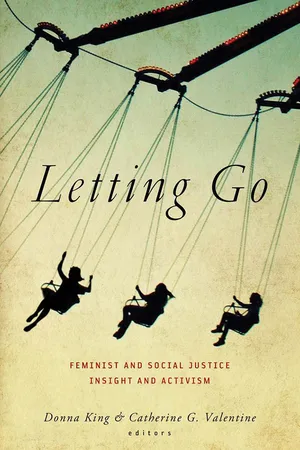
eBook - ePub
Letting Go
Feminist and Social Justice Insight and Activism
- English
- ePUB (mobile friendly)
- Available on iOS & Android
eBook - ePub
Letting Go
Feminist and Social Justice Insight and Activism
About this book
Information
Part One
Theoretical Perspectives
1
Toward a Feminist Theory of Letting Go
Donna King
During an interview on NPR’s All Things Considered (2011), David Greene asked Brian Henneman of the band The Bottle Rockets, “You’ve played with some pretty big names . . . you guys have become big. [But] you’re not as commercial . . . as big as Wilco . . . I mean, what takes you to the next level?” Henneman laughed and replied, “It’s too late to go to the next level. We’re too comfortable where we’re at. Why would we want to move now if everything will just be more of a pain in the butt? So, yeah . . . this is a real awesome comfortable place, and we like it. And by golly, that’s our story, and we’re sticking to it.”
Setting aside the self-conscious coda, what strikes me about this exchange is Henneman’s genuine satisfaction with his band’s level of success. You can hear it in his voice, he means it. He is okay exactly where he is, with his band and in his life. He does not want to get to the top; he does not have to be the best. In fact, he foresees only headaches (or worse) lying in wait should he strive for bigger commercial success. Surely Henneman’s social position—as a middle-aged working class musician from the Midwest, fronting a band that has played mostly in bars for over twenty years—has shaped his aspirational goals. I find it refreshing, nonetheless, to hear him say out loud and proud, “No thanks. I don’t need to reach the top. I’m okay exactly where I am.”
But then there is that conditional addendum, with its self-deprecating, defensive posturing, undercutting the message that good-enough is fine and implying instead that one must justify, explain, or make excuses for being satisfied with one’s life as it is.
I question the core American imperative that says we must endlessly strive to be the best. My interest in this issue is both intellectual and personal. Like many women, I struggle to balance work life, home life, professional pursuits, creative endeavors, self-definition, and cultural mandates. And I ask: Does feminism provide theoretical supports for women who want to (or must) slow down, grow quiet, and let go of striving? Can one be simultaneously feminist and nothing special, a strong woman and a woman in touch with her real limitations?
I use the somewhat jarring term “nothing special” not to minimize or denigrate women, but rather to highlight cultural contradictions I see in a mainstream, white, affluent, “free market feminism” that promotes the relentless pursuit of personal and professional achievement while uncritically adopting a neoliberal ideology that conflates “female empowerment [with] the accompanying baggage of consumerism, individualism, radical inequalities of life chances [and] environmental degradation” (Eisenstein 2009, 221).1
As Hester Eisenstein (2009) argues in Feminism Seduced, “feminist energies, ideologies, and activism have been manipulated in the services of the dangerous forces of [a] globalized corporate capitalism” (viii) that views the majority of the world’s women as “the cheap workforce of choice,” (11) and co-opts privileged professional women, including many academic feminists, into an acritical (or defeatist) acceptance of the neoliberal agenda and its attendant “flight from the body” (220). As antidote to this cooptation, Eisenstein calls for a revitalized feminist critique of capitalism that “transcend[s] . . . the differences between Third World and First World women to create a united international women’s movement that can be a force for political and social change” (68). Primary among these forces for change, says Eisenstein, is a return to the body and to a social ethic of compassion, nurturance and care that “transform[s] maternalism, not as an essentialist definition of women’s roles, but as a set of claims on the state” (x–xii) to provide child care, health care, sufficient nutrition, and adequate housing for all (229).
As Eisenstein’s critique makes clear, there are contradictions in our culture, and within feminism, about how women should live our lives, particularly in terms of economic and cultural demands for high productivity, fast pace, pushing past limits, and denying the body. These pressures cut across race, class, work, and home. Many women are stuck in dead-end jobs with low wages, no job security, no autonomy, no respect, no control over their schedule, and unrelenting performance expectations. Professional women, despite their relative privilege, often face extraordinary demands on their time and energy. Home life, for many women, is rarely a safe haven from stress. Bearing and raising small children, dealing with teenagers, sending kids off to college, living with a partner or a dependent that is disabled or unhappily unemployed or clinically depressed or battling addiction—any potentially overwhelming experience that stretches us beyond our physical, mental, and emotional capacities leaves us ripe for a confrontation between so-called ideal and real women’s lives.
We all face potential devaluation by family, friends, colleagues, peers, bosses, and perhaps most importantly by ourselves, when we do not “pull our weight” or “measure up” to socially defined standards of achievement. Many, if not most, women internalize impossible performance expectations, and it takes a tremendous force of will, or paradoxically, a complete letting go, to liberate ourselves from them.
I use Zen insight as a complement to Eisenstein’s structural analysis of global neoliberal capitalism to explore how close attunement to bodily experience allows some women with invisible chronic illness to let go of unreasonable expectations of productivity and pace. While Eisenstein is scathing in her criticism of feminist “postmodern analyses that focus on individual and private acts of resistance” (2009, 212), I argue that, much like a breaching experiment in which one consciously and publicly violates a behavior in order to make obvious its structure and social power, studying how women with invisible chronic illness navigate achievement expectations—under physically and mentally debilitating conditions—highlights oppressive and often unacknowledged productivity norms in a dramatic way and further supports Eisenstein’s call for a broader social commitment to compassion and care.
I focus here on two explicitly feminist accounts of the chronic illness experience, Cheri Register’s Living with Chronic Illness and Susan Wendell’s The Rejected Body, and draw from Barbara Hillyer’s Feminism and Disability. Reading the works of feminist women with disabilities reveals that they are uniquely positioned to address dominant cultural dictates in the most concrete and experiential way, through both their bodies and minds. As their bodies transform from reasonably healthy to seriously unwell, these women’s lives and sense of self transform as well, sometimes in radically new and improbable ways. Many women with chronic illness live a path that moves from pain, fear, fatigue, frustration, and grief, through a gradual and often grudging acceptance of unwelcome and disabling limitations, toward a new found sense of inner peace and self-acceptance. They learn the hard way, through mortal necessity, how to let go.
Zen and the Art of Letting Go
When you are hungry, eat.
When you are tired, rest.
—Zen instruction
Writing as an exhausted new mother, Zen teacher Karen Maezen Miller offers this paean to bone-tiredness:
It is not something you would choose, like a spa vacation, but is something you can use, like a humidifier. . . . It is a cure and a balm. Fatigue helps you forget. When you are tired, you let go. You drop what you no longer need and you do not pick it up again. You slow down. You grow quiet. You take comfort. You appreciate the smallest things. You stop fighting. (quoted in Harris 2006)
The idea that fatigue might be useful, rather than a problem to be solved, is counter-intuitive in our multitasking, wired, and information-overloaded world. Zen advice that we eat when hungry and rest when tired goes directly against American cultural norms that dictate we push past our limits in a tireless quest to succeed. What is it we drop when we slow down, grow quiet, and appreciate small things?
The Zen of letting go suggests a practice of paying attention to immediate experience and responding appropriately, including listening to the body and meeting bodily needs as they arise. This is emphatically not the same as seeking complete comfort and ease in life; an appealing but unattainable goal whose quixotic pursuit ironically leads directly to what Buddhists call dukkha, a Pāli word most commonly translated as “suffering” but perhaps better understood as anguish, fear, clinging, and/or dissatisfaction. We are all destined to feel multiple kinds of pain at multiple points in our lives, and for some this becomes a chronic mental, physical, and/or emotional state. But none of these kinds of pain need necessarily lead to suffering. For Buddhists, suffering is an add-on, a social construction that most often takes the form of chronic dissatisfaction with life as it is (see Loy 1996).
Letting go, in Zen terms, means dealing skillfully with whatever is going on without adding any storyline. Freedom from suffering comes from total involvement in simply being with what is—and in constantly letting go of our attachment to having things go a certain way. For the Zen practitioner, none of this is easy or ever fully accomplished. In fact, it is not even a goal. It is an ongoing practice and process with no end in sight (Beck 1989).
Far from simple passive acquiescence, however, Zen practice can explicitly critique the forces of corporate global capitalism and advocate for a political economy organized around care, compassion, and social justice (Loy 2003). As media activist and Buddhist practitioner David Edwards (2005) notes:
When society subordinates its humanity to maximized revenues at minimum cost, then that society is well on the way to becoming lost, falsified, and in fact inhuman. If we are serious about combating selfishness and promoting compassion in the world, then is it not vital that we develop the tools of intellectual self-defense to deal with these assaults on our minds and hearts? The solution must lie in reversing the priorities, in subordinating dead things—money, capital, profits—to life: people, animals, the planet. . . . The antidotes to systemic greed, I am convinced, are political movements motivated by unconditional compassion for suffering.
Thus there is real potential for radical social change when we incorporate Buddhist insights with incisive critiques of neoliberal ideologies and practices that are colonizing our consciousness and the planet. We need not choose between inner awareness, listening to the body, and political activism for social justice. Activism can take many forms, and humanizing the global political economy and revitalizing a feminist commitment to a society based not on striving and “success” but on compassion and care may be just what is called for at this historical moment. But, as some feminists with invisible chronic illness attest, mainstream free-market feminism has not always accommodated the very real human need for retreat, reflection, and rest.
Living with Chronic Illness
In the mid-1980s, Patricia Fraser, a Harvard University Medical School physician working with chronically ill patients at Brigham and Women’s Hospital in Boston, recognized that women with lupus—an invisible chronic illness that includes among other symptoms debilitating pain and extreme fatigue—face unique and painful challenges living up to the contradictory expectations society ascribes to all women:
For most of us non-superwomen in good health, the discrepancy between the real and the ideal is clear and the ideal is used as a guideline to modify our lives. During periods of high energy and heightened motivation we may attempt to emulate features of the superwomen, but as we fatigue we drop back to somewhere near or slightly above where we started. Nothing is lost and something is gained in the experience; no harm is done. With lupus the issues and stakes are always higher, the risks magnified (Aladjem 1986, 61–62).
The risks Fraser refers to here include the very real, potentially fatal risks women with lupus and similar chronic illnesses face when they push themselves beyond their physical, mental, and emotional capacities and attempt to ignore their need for rest.
Irving Zola has noted that most research on illness narratives usually ignores any “detailed descriptions of the physical disability itself, especially its chronic aspects” (cited in Hillyer 1993, 37). Barbara Hillyer describes this omission as a “cultural silencing of embodied disability” (37). Susan Wendell agrees that “people with disabilities and illnesses learn that most people do not want to know about the suffering they experience because of their bodies . . . interest in the subjective experience is rare” (1996, 91). But as Hillyer notes, “to disguise the pain denies the human connection, whether the disguise is meant to satisfy the demands of scholarly objectivity or those of political activism” (1993, 41). Thus it is important to look closely at the embodied subjectivity of women living with chronic illness as we trace the path of their self-transformation and its social implications. The precipitating event is a body that breaks down.
Living with Pain, Letting Go of Suffering
Pain can be a path to body knowing and self-centering like no other. For most healthy people feeling pain is a wake-up call. We look for the source, we seek relief, and we expect the pain to go away. Our experience of pain is not simply physical, however, as David Morris (1993, 3) makes clear when he observes that “pain is never the sole creation of our anatomy and physiology . . . it emerges . . . at the intersection of bodies, minds, and cultures.” For women with chronic illness, living in pain brings body awareness into complete and total focus and initiates mental, emotional, and social challenges that require extraordinary effort to manage. As one woman reports:
It seems to take everything in me to manage what I’m going through . . . like people are going to suck some energy out of me that I don’t have to give to them because I have to stay on top of this for myself. I think it takes such tremendous amounts of energy to have pain. (Register 1987, 81)
While the intensity and scope can vary, pain that never goes away is a fact of life for most women with chronic illness. Unrelenting opportunity and bitter necessity force many women, such as Eileen Radziunas (1989), to become “connoisseurs” of their pain. She describes in exquisite detail experiences that are invisible to others, who, over time and in the face of no firm diagnosis, may be inclined to deny their reality.
Unlike other patients who I’d heard say “pain is pain,” I knew there were different ways to describe it, because I felt it at such different levels. I detailed the deep, penetrating muscle pain, as opposed to the intense burning pain on the surface of my skin. I named the specific joints which ached routinely, and I pointed out that my tendons also hurt relentlessly, causing me as much pain at rest as during activity. I mentioned my transient blurry vision and excessive hair loss. It seemed superfluous to mention the bright red rash which ran across my cheeks and nose. (84)
F...
Table of contents
- Cover
- Title Page
- Copyright
- Contents
- Introduction
- Part One: Theoretical Perspectives
- Part Two: Personal Essays
- Part Three: Ethnographies
- Part Four: Ecological Perspectives
- Part Five: Visionary Feminism
- Contributors
- Index
Trusted by 375,005 students
Access to over 1.5 million titles for a fair monthly price.
Study more efficiently using our study tools.
Frequently asked questions
Yes, you can cancel anytime from the Subscription tab in your account settings on the Perlego website. Your subscription will stay active until the end of your current billing period. Learn how to cancel your subscription
No, books cannot be downloaded as external files, such as PDFs, for use outside of Perlego. However, you can download books within the Perlego app for offline reading on mobile or tablet. Learn how to download books offline
Perlego offers two plans: Essential and Complete
- Essential is ideal for learners and professionals who enjoy exploring a wide range of subjects. Access the Essential Library with 800,000+ trusted titles and best-sellers across business, personal growth, and the humanities. Includes unlimited reading time and Standard Read Aloud voice.
- Complete: Perfect for advanced learners and researchers needing full, unrestricted access. Unlock 1.5M+ books across hundreds of subjects, including academic and specialized titles. The Complete Plan also includes advanced features like Premium Read Aloud and Research Assistant.
We are an online textbook subscription service, where you can get access to an entire online library for less than the price of a single book per month. With over 1.5 million books across 990+ topics, we’ve got you covered! Learn about our mission
Look out for the read-aloud symbol on your next book to see if you can listen to it. The read-aloud tool reads text aloud for you, highlighting the text as it is being read. You can pause it, speed it up and slow it down. Learn more about Read Aloud
Yes! You can use the Perlego app on both iOS and Android devices to read anytime, anywhere — even offline. Perfect for commutes or when you’re on the go.
Please note we cannot support devices running on iOS 13 and Android 7 or earlier. Learn more about using the app
Please note we cannot support devices running on iOS 13 and Android 7 or earlier. Learn more about using the app
Yes, you can access Letting Go by Donna King, Catherine G. Valentine, Donna King,Catherine G. Valentine in PDF and/or ePUB format, as well as other popular books in Sozialwissenschaften & Feminismus & feministische Theorie. We have over 1.5 million books available in our catalogue for you to explore.