From Viagra to in vitro fertilization, new technologies are rapidly changing the global face of reproductive health. They are far from neutral: religious, cultural, social, and legal contexts condition their global transfer. The way a society interprets and adopts (or rejects) a new technology reveals a great deal about the relationship between bodies and the body politic. Reproductive health technologies are often particularly controversial because of their potential to reconfigure kinship relationships, sexual mores, gender roles, and the way life is conceptualized. This collection of original ethnographic research spans the region from Morocco and Tunisia to Israel and Iran and covers a wide range of technologies, including emergency contraception, medication abortion, gamete donation, hymenoplasty, erectile dysfunction, and gender transformation.
Table of Contents Acknowledgments Introduction | Setting the Context: Sexuality, Reproductive Health, and Medical Technologies in the Middle East and North Africa
Angel M. Foster and L. L. WynnPart I | Preventing and Terminating Pregnancy Is There an Islamic IUD? Exploring the Acceptability of a Hormone-Releasing Intrauterine Device in Egypt
Ahmed Ragaa A. Ragab Introducing Emergency Contraception in Morocco: A Slow Start after a Long Journey
Elena Chopyak Mifepristone in Tunisia: A Model for Expanding Access to Medication Abortion
Angel M. Foster Navigating Barriers to Abortion Access: Misoprostol in the West Bank
Francoise Daoud and Angel M. FosterPart II | Achieving Pregnancy and Parenthood "Worse comes to worst, I have a safety net": Fertility Preservation among Young, Single, Jewish Breast Cancer Patients in Israel
Daphna Birenbaum-Carmeli, Efrat Dagan, and Suzi Modiano Gattegno The "ART" of Making Babies Using In Vitro Fertilization: Assisted Reproduction Technologies in the United Arab Emirates
Shirin Karsan Wanted Babies, Excess Fetuses: The Middle East's In Vitro Fertilization, High-Order Multiple Pregnancy, Fetal Reduction Nexus
Marcia C. Inhorn Birthing Bodies, Pregnant Selves: Gestational Surrogates, Intended Mothers, and Distributed Maternity in Israel
Elly Teman C-Sections as a Nefarious Plot: The Politics of Pronatalism in Turkey
Katrina MacFarlanePart III | Engaging Sex and Sexuality HPV Vaccine Uptake in Lebanon: A Vicious Cycle of Misinformation, Stigma, and Prohibitive Costs
Faysal El-Kak Hymenoplasty in Contemporary Iran: Liminality and the Embodiment of Contested Discourses
Azal Ahmadi "Viagra Soup": Consumer Fantasies and Masculinity in Portrayals of Erectile Dysfunction Drugs in Cairo, Egypt
L. L. Wynn Sex Toys and the Politics of Pleasure in Morocco
Jessica Marie Newman Narratives of Gender Transformation Practices for Transgender Women in Diyarbakir, Turkey
M. A. SandersConclusion | Individual, Community, Religion, State: Technology at the Intersection
Donna Lee Bowen Acronyms and Abbreviations Glossary of Foreign Terms Bibliography Contributors Index
eBook - ePub
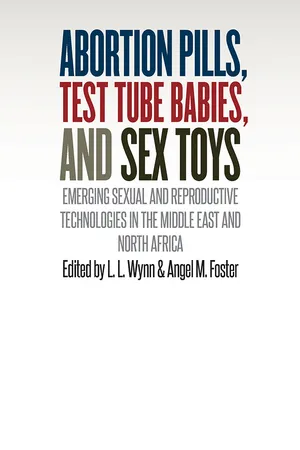
Abortion Pills, Test Tube Babies, and Sex Toys
Emerging Sexual and Reproductive Technologies in the Middle East and North Africa
- English
- ePUB (mobile friendly)
- Available on iOS & Android
eBook - ePub
Abortion Pills, Test Tube Babies, and Sex Toys
Emerging Sexual and Reproductive Technologies in the Middle East and North Africa
About this book
Information
Topic
MedicinePART I
Preventing and Terminating Pregnancy
1
Is There an Islamic IUD?
Exploring the Acceptability of a Hormone-Releasing Intrauterine Device in Egypt
Ahmed Ragaa Abdel-Hameed Ragab
The intrauterine device (IUD) is one of the most effective contraceptive methods currently available. A small device inserted into the uterus by a trained health-care provider, the copper-T IUD can provide contraceptive benefit for up to twelve years. The effectiveness of the method owes much to the fact that there is little required of the user, and thus, unlike many other contraceptive methods, user error does not figure into calculations of its effectiveness.
The copper-T IUD is extremely safe, and there are few contraindications to its use. Side effects and complications associated with the IUD include changes in bleeding patterns, device expulsion, and, rarely, uterine perforation. Once known as coils or loops, the newer generation IUDs are more effective and have fewer complications than their predecessors. However, in many contexts, the IUD is prohibitively expensive, and misinformation about this modality among both providers and potential users abounds. As a result, global IUD use is very uneven. G. Dean and E. Schwarz (2011) report that in parts of Asia more than 50 percent of contraceptive users have adopted IUDs, compared to between 6 percent and 27 percent in Europe and only 5 percent in the United States.
In this global context, Egypt’s level of IUD use is comparatively high. The results from the 2008 Egyptian Demographic and Health Survey (EDHS) indicate that 60 percent of currently married women in Egypt are using contraception, and the IUD is the most widely used method; 60 percent of contraceptive users rely on an IUD. This is the result of significant government expenditure to subsidize IUDs and promote IUD use as part of Egypt’s extensive family planning program. Yet despite the Egyptian government’s efforts, misinformation and myths about IUDs are common, particularly outside of the urban centers in the north of the country.
The copper-T IUD’s most common side effect—changes in bleeding patterns—has significant cultural implications in Egypt. The majority of the population is Muslim, and Islamic religious authorities teach that women cannot pray, fast, or engage in sexual intercourse when menstruating. As a result, many Muslim women request removal of their IUD before Ramadan, the month of fasting in the Islamic calendar.
Drawing on an extensive literature review and a series of in-depth interviews with six Egyptian health service providers and university professors who are experienced in IUD research, provision, and insertion, this chapter provides an overview of the history of the IUD in Egypt and reviews the debates over acceptability and permissibility. The chapter discusses common myths and misperceptions about IUDs, as well as cultural norms around negotiating contraceptive use within couples. The chapter then turns to a discussion of the Mirena®, a hormone-releasing IUD that was introduced recently to Egyptian women. The Mirena significantly reduces the heavy menstrual bleeding and intermenstrual spotting characteristic of inert IUDs, suggesting that it could become the contraceptive method of choice for many Egyptian women. Yet while the Mirena is available in the private sector, this new reproductive health technology is not offered by government clinics. In the private sector, physicians providing the Mirena report that they are linking its provision to costly, invasive, and unnecessary procedures. These two factors have significantly limited uptake of the method in Egypt.
A Brief History of the IUD in Egypt
Egyptian interest in methods of fertility control has been traced back to the time of the Pharaohs. Archeologists have found written contraceptive recipes dated from fifteen to eighteen centuries before the birth of Christ, in the Petri Papyrus of 1850 BC and the Ebers Papyrus of 1550 BC. Muslim conquerors of Egypt not only allowed but encouraged family planning. A sermon delivered by Amr Bin A’as, a companion of the Prophet and the first governor of Egypt, warned his listeners that a large family was one of the four causes of a decline in living standards. Amr’s exhortation assumed that his subjects knew how to keep family size within reasonable limits (Hefnawi 1982).
The concept of IUDs may have first arisen from the practice of putting stones in the uteruses of camels in order to prevent pregnancies during long journeys. This suggests a history of cultural resonance that may have shaped interest in the IUD in the modern Egyptian context. Beginning in 1959 Egypt began to receive reports of research on IUDs, and Egyptian medical scientists participated in both the development of these devices and intensive study of their side effects (Hefnawi 1982). Most family planning programs starting in the mid-1960s offered clients an intrauterine device known as the Lippes Loop. The invention of the copper IUD in the 1960s marked the introduction of the T-shaped design characteristic of most modern IUDs (Thiery 2000).
Since then Egyptian researchers have conducted extensive studies of IUD use, contraceptive failure rates, and side effects, including bleeding, pain, and spontaneous expulsion of the device from the uterus. For example, Hefnawi, Asklani, and Zaki (1974) reported that following the insertion of the IUD, menstrual blood loss increased by about 50 percent. Hefnawi and colleagues (1980) found that women experiencing high menstrual blood loss had low hemoglobin levels after twelve months of use. Hefnawi and colleagues (1982) studied the side effects of copper-T IUD use and its impact on uterine size, and El Sheikha, Hamza, and Mahmoud (1990) compared menstrual blood loss and hemoglobin levels in users of two types of copper IUDs.
Egyptian researchers focused on more than the technical and medical aspects of the IUD. Indeed, E. Hassan and colleagues describe a long history of struggle by family planning advocates in Egypt to make IUDs more acceptable and accessible (Hassan et al. 1995). In the early 1990s, this group studied the dynamics of IUD use in Egypt. They analyzed issues of IUD supply and storage; physicians’ knowledge and clinical practices; and client knowledge, attitudes, and behaviors surrounding use. A total of 449 physicians and 2,106 women were interviewed. These researchers found that the IUD was the most frequently used contraceptive method for birth spacing. Approximately 41 percent of women reported that they requested removal of the IUD because of side effects, and 33 percent stated that they requested removal because they desired a pregnancy. Researchers also found that physicians often lacked accurate knowledge about side effects and did a poor job of counseling clients.
Data on trends in the use of IUDs in Egypt come from major surveys such as the 1980 World Fertility Survey, the 1984 Egyptian Contraceptive Prevalence Survey, and a series of surveys conducted by EDHS that began in 1988 (Office of Population Research 1980).1 According to these data, use of the IUD increased dramatically over a thirty-year period. The proportion of contraceptive users who were using the IUD increased from 15.9 percent in 1980 to a peak of 63.4 percent in 2000 before declining to roughly 60 percent by 2008. Average length of time of IUD use is increasing as a result of increased training, infection control programs—including nontouch insertion techniques—and more emphasis on counseling. The average years of use of IUDs was 2.84 years in 1995 (El-Deeb 2001) and rose to 4.17 years by 2008 (El-Deeb 2011). However, according to 2008 EDHS survey, there is also a marked urban-rural divide in IUD use: urban women are more likely than their rural counterparts to adopt an IUD.
The dynamics of IUD use in Egypt over the last decade are subject to conflicting reports. According to the Ministry of Health and Population and the Family Planning Sector service statistics, the number of family planning clients increased by 39 percent between 2007 and 2011 (Said, Khaled, and Shaarawy 2013). However, the proportion of new family planning clients using the IUD decreased during this same period, from 20 percent to 12 percent, and the proportion of oral contraceptive pill (OCP) users increased from 29 percent to 47 percent. Research conducted to explain this shift attributed decreases in IUD use to women’s preference for OCPs (87 percent), lack of incentives for IUD use (50 percent), and improper training of the services providers (33 percent) (Said, Khaled, and Shaarawy 2013). Women especially liked that OCPs do not require assistance from a health care provider or a gynecological procedure, are available directly from pharmacies without a prescription, are comparatively inexpensive, are continuously available at Ministry of Health and Population clinics, and have fewer side effects than the IUD.
However, community-based data from this same period paint a different picture of IUD use in Egypt. The 2008 EDHS survey found that 36.1 percent of women were using an IUD and 11.9 percent were using OCPs, while other methods, like injectables, condoms, and implants, were used by nearly 12 percent combined. According to the 2008 EDHS survey, reliance on government facilities had increased over the previous two decades; in 2008 the majority of IUD users (67 percent) had their IUDs inserted at a publicly funded facility; 32 percent obtained their IUDs from a private physician, hospital, or clinic; and only 2 percent obtained the device from a clinic operated by a nongovernmental organization. Recognizing that the IUD was one of the most effective methods in its extensive family planning program, and in an effort to expand contraceptive coverage to socioeconomically disadvantaged and remote areas of the country, the Ministry of Health and Population designed a program using mobile clinics that are equipped with IUD insertion sets and staffed by trained health care providers. These mobile clinics are designed to reach areas ranging from urban slums to remote rural districts, and they provide services free of charge. EDHS data from 2008 indicate that 3 percent of IUD users obtained the IUD from one of these mobile facilities.
In Egypt, the type of facility at which a woman obtains an IUD can have significant implications for the cost. According to the 2008 EDHS survey, in the public sector the median cost of an IUD is 3.5 Egyptian pounds (approximately US$0.5), although there is some variation: nearly 5 percent of public sector clients obtain the device free of charge. In the private sector costs are considerably higher. In 2014 gynecologists reported charging anywhere from 100 to 1000 Egyptian pounds (approximately US$14 to US$140), depending on the type of IUD, the seniority of the health care provider, the location of the clinic, and the socioeconomic class of the client. There are no regulatory limits on the fees doctors may charge.
Finally, anecdotal evidence suggests that some women may be using the IUD for purposes beyond pregnancy prevention. When inserted in the five to seven days after underprotected or unprotected sexual intercourse, the IUD reduces the risk of pregnancy by 99 percent and provides ongoing contraception benefit (Trussell 2012). Although the effectiveness of the copper-T IUD as a method of EC is well documented, no data are available on its use for this purpose in Egypt. However, experienced obstetrics and gynecology professors interviewed for this study reported that in recent years women who have missed a period, most probably as a result of pregnancy, are also using the IUD. These informants reported that women can go to a family planning clinic, claim that they are postmenstrual, have an IUD inserted, and immediately afterward go to a different clinic and have the device removed. This anecdotal evidence suggests that women are using IUD insertion and rapid removal to induce an abortion. Because abortion is severely legally restricted in Egypt, many women do not have access to safe, legal pregnancy termination services. The degree to which this strategy is effective in terminating a pregnancy has not yet been rigorously studied.
Religious Influences on IUD Use in Egypt
In Egypt religious leaders are highly influential. Women, men, and youth rely on them for guidance on many personal and family matters. Religious leaders often share opinions about reproductive and sexual health and rights, and help their followers make important life decisions. Religious leaders also play an active role in the dissemination of both accurate information and misconceptions about many issues, including IUDs.
For religious leaders, evaluating the permissibility of any reproductive health technology requires first determining how it works. Most Islamic leaders regard birth spacing as permissible. The dominant theological interpretation of contraception in Egypt holds that a form of contraception is permissible so long as it is safe and without serious side effects, it is nonpermanent, and fertility can return after use is stopped. The mechanism of action of the IUD is debated; the best available evidence suggests that the IUD both prevents fertilization and impedes implantation if a fertilization event occurs. In some parts of the world, including Latin America and the United States, the probable postfertilization mechanism of action has led some politicians and religious leaders to claim that the IUD causes an abortion. This assertion is largely derived from the religious and moral position that human life begins at fertilization. However, the vast majority of scholars of Islamic jurisprudence agree that human life does not begin at fertilization. There are differences among theologians as to when “ensoulment” occurs, with most interpretations ranging from 40 days to 120 days after fertilization. A minority of Islamic scholars believe that ensoulment coincides with implantation. But neither medical nor religious authorities in Egypt consider an IUD to be abortifacient because there is no evidence that the IUD interrupts a pregnancy after implantation has been established.
A more significant concern about IUDs from a religious perspective revolves around bleeding. Islam regulates sexual life and holds that penile-vaginal intercourse during menstruation is not acceptable. However, other forms of sex not involving vaginal penetration are accepted during menstruation, provided that they are not against religious beliefs. Fasting and prayer are also proscribed for women during menstruation. Consequently, the heavy and prolonged menstrual bleeding (menorrhagia) and spotting that women commonly experience with copper-T IUD use is a major concern for Egyptian women.
Studies have documented the relationship between menstrual side effects of certain contraceptives and women’s discontinuation of use (Paul, Skegg, and Williams 1997). Tolley and colleagues (2005) report that in focus group discussions the majority of IUD users described an increase of several days in the length of their menstrual periods. Some also described heavier bleeding. Diary data supported these claims. Among IUD users, the number of bleeding days increased slightly once they began the method, but stabilized over time. However, more that 40 percent of those who discontinued use of their contraceptive method cited heavy or long menstruation as one of the most important reasons for stopping. In rural areas of Egypt, where parasitic diseases combine with malnutrition to cause high rates of anemia, extra blood loss can be a major public health problem. Thus IUD-associated changes in bleeding patterns can have both cultural-religious and public health implications in the Egyptian context.
I interviewed six obstetrician and gynecologists who have considerable experience with IUD insertion in Egypt and other Arab countries (mainly Saudi Arabia and the Gulf States), and all reported an increase in requests for IUD removal shortly before the fasting month of Ramadan. Islam holds that women cannot pray or fast while menstruating, and many women believe that spotting or a lengthy menstrual period will prevent them from fasting during Ramadan. In fact, the dominant theological interpretation holds that there is a difference between normal menstruation and intermenstrual spotting, and there have been attempts to disseminate this authoritative interpretation of Islam to women, but many laypeople continue to believe that any vaginal bleeding is polluting and precludes prayer, fasting, and sexual intercourse.
Sociocultural Dynamics Shaping IUD Use in Egypt
As in many other settings around the world, misinformation about IUDs is rampant in Egypt. One major obstacle to IUD use is the widespread circulation of rumors about the device. Stories about the ineffectiveness of the IUD and its ability to wander throughout the body abound. In a study by Serour, Ragab, and Mahmoud (2004), concerns about IUD migration were particularly prominent among women interviewed. As one woman explained, “A neighbor of one of my relatives inserted it [the IUD] in the morning and while she was sitting with her husband at dinner, the IUD moved and came out of her mouth and damaged the eye of her husband.” Another interviewee reported, “A woman got pregnant while she was using an IUD, and the boy was delivered holding the IUD in his hand.” These apocryphal tales that often circulate among women invariably involve the experience of a friend, neighbor, or relative. In addition, some IUD users report side effects of the IUD that have no physiological basis. For example, “Since the insertion of my IUD, I suffer from a bad odor from my mouth and my vagina.”
These rumors can be difficult to combat, and they affect women’s decisions about whether to adopt the device. Rumors about the IUD have become so pervasive that the Ministry of Hea...
Table of contents
- Cover
- Title Page
- Copyright
- Dedication
- Contents
- Acknowledgments
- Introduction: Setting the Context: Sexuality, Reproductive Health, and Medical Technologies in the Middle East and North Africa
- Part I: Preventing and Terminating Pregnancy
- Part II: Achieving Pregnancy and Parenthood
- Part III: Engaging Sex and Sexuality
- Conclusion: Individual, Community, Religion, State: Technology at the Intersection
- Acronyms and Abbreviations
- Glossary of Foreign Terms
- Bibliography
- Contributors
- Index
Trusted by 375,005 students
Access to over 1.5 million titles for a fair monthly price.
Study more efficiently using our study tools.
Frequently asked questions
Yes, you can cancel anytime from the Subscription tab in your account settings on the Perlego website. Your subscription will stay active until the end of your current billing period. Learn how to cancel your subscription
No, books cannot be downloaded as external files, such as PDFs, for use outside of Perlego. However, you can download books within the Perlego app for offline reading on mobile or tablet. Learn how to download books offline
Perlego offers two plans: Essential and Complete
- Essential is ideal for learners and professionals who enjoy exploring a wide range of subjects. Access the Essential Library with 800,000+ trusted titles and best-sellers across business, personal growth, and the humanities. Includes unlimited reading time and Standard Read Aloud voice.
- Complete: Perfect for advanced learners and researchers needing full, unrestricted access. Unlock 1.5M+ books across hundreds of subjects, including academic and specialized titles. The Complete Plan also includes advanced features like Premium Read Aloud and Research Assistant.
We are an online textbook subscription service, where you can get access to an entire online library for less than the price of a single book per month. With over 1.5 million books across 990+ topics, we’ve got you covered! Learn about our mission
Look out for the read-aloud symbol on your next book to see if you can listen to it. The read-aloud tool reads text aloud for you, highlighting the text as it is being read. You can pause it, speed it up and slow it down. Learn more about Read Aloud
Yes! You can use the Perlego app on both iOS and Android devices to read anytime, anywhere — even offline. Perfect for commutes or when you’re on the go.
Please note we cannot support devices running on iOS 13 and Android 7 or earlier. Learn more about using the app
Please note we cannot support devices running on iOS 13 and Android 7 or earlier. Learn more about using the app
Yes, you can access Abortion Pills, Test Tube Babies, and Sex Toys by L. L. Wynn, Angel M. Foster, L. L. Wynn,Angel M. Foster in PDF and/or ePUB format, as well as other popular books in Medicine & Gynecology, Obstetrics & Midwifery. We have over 1.5 million books available in our catalogue for you to explore.