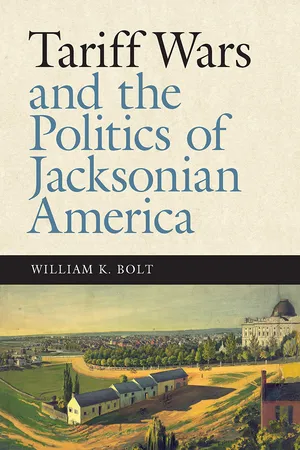
Before the Civil War, the American people did not have to worry about a federal tax collector coming to their door. The reason why was the tariff, taxing foreign goods and imports on arrival in the United States. Tariff Wars and the Politics of Jacksonian America attempts to show why the tariff was an important part of the national narrative in the antebellum period. The debates in Congress over the tariff were acrimonious, with pitched arguments between politicians, interest groups, newspapers, and a broader electorate.The spreading of democracy caused by the tariff evoked bitter sectional controversy among Americans. Northerners claimed they needed a tariff to protect their industries and also their wages. Southerners alleged the tariff forced them to buy goods at increased prices. Having lost the argument against the tariff on its merits, in the 1820s, southerners began to argue the Constitution did not allow Congress to enact a protective tariff. In this fight, we see increased tensions between northerners and southerners in the decades before the Civil War began.As Tariff Wars reveals, this struggle spawned a controversy that placed the nation on a path that would lead to the early morning hours of Charleston Harbor in April of 1861.
- English
- ePUB (mobile friendly)
- Available on iOS & Android
eBook - ePub
Tariff Wars and the Politics of Jacksonian America
About this book
Information
1
“The new system which out Hamiltons Alexander Hamilton”
DURING THE WAR OF 1812, British general Phineas Rial pondered his fate while he sat in an American prison in Berkshire, New York. As he stared out from his cell, he saw a woolens factory. One of his guards noticed how the general seemed fascinated with this factory. He began teasing the officer, but the sharp-witted Rial turned the tables on his jailor. “You may as well stop where you are, and save your money,” Rial announced. “For depend upon it, we will destroy all your manufactories as soon as peace takes place.” The young American, no doubt puzzled by this statement, resolved that he would not be outdone by an officer whom American forces had captured at the Battle of Lundy’s Lane. “Not by fire, I trust?” he snapped. “No,” responded the captive, “but a few millions sterling, more or less, will be no object to our government, to root up your manufactures in the bud.”1
The story of Rial mocking his captor, which appeared in 1817, is more than likely apocryphal. However, it reveals the apprehensions that Americans felt when they stared out onto the Atlantic Ocean and saw the puffy white sails of British mariners arriving at American ports. These ships no longer carried British soldiers to menace the American people. Instead, their cargo holds contained British manufactured goods. Americans now feared that British manufacturers would “dump” their products in American ports in an effort to destroy American manufacturers. The British might suffer a short-term loss by doing this; but by killing their competitors, they would gain control of the marketplace and could recoup their losses quickly. The cheap price of labor in Great Britain and the accessibility to raw materials from Britain’s colonial empire allowed the British to transport and sell their goods in America at a profit in spite of shipping and insurance costs. To even the playing field between American and British manufacturers, American entrepreneurs began calling for a new tariff. Congress responded with the tariff of 1816. This tariff offered protection to American industries. More importantly, the tariff of 1816 and its successor tariffs helped to spread democracy in America. Many Americans took an active interest in the tariff and began agitating for either higher tariffs or lower ones. Nobody recognized it at first, but the tariff helped to unleash a tidal wave of democracy that would reach a crescendo with Andrew Jackson’s elevation to the presidency in 1828.2
The War of 1812 represented a break from precedent for the United States. A younger generation of Americans who had not participated in the Revolution had begun to exert their influence over public policy. This younger group of leaders initiated a cultural, political, and economic revolution in America. Nationalism inspired them. They began appropriating funds for roads, turnpikes, bridges, canals, army bases, coastal fortifications, and other public works at the state and federal levels. Younger politicians embraced the march of a market-oriented economy. Their policies sought to expand this market revolution. By appropriating funds toward internal improvements, which would lower shipping costs and open new markets in the West, American entrepreneurs had more reasons to invest their capital into manufacturing.3
While most Americans cheered the ratification of the Treaty of Ghent in 1815, which ended the War of 1812, some Americans sensed potential trouble. Right after Congress declared war against Great Britain in 1812, it had passed a revenue bill known as the tariff act of 1812. This legislation stipulated that one year after the United States and Great Britain ended hostilities, it would no longer be in force. As a result, the moment the Senate approved the Treaty of Ghent, a one-year countdown commenced until the duties on imported goods entering the United States would be repealed and the country would revert to the prewar duties. If the nation went back to the prewar duties, the result would be catastrophic, or so some claimed, for Americans who made their living through the manufacturing of such goods as textiles, spirits, rope, sugar, and iron.4
Shrewd congressmen anticipated the pending problems. From 1801 through 1811, the federal government received $148 million in revenue, $134 million of which came from customs receipts. In most years, the federal government obtained close to 90 percent of its annual revenue from customs receipts. If imported goods landed at American ports with very low or no duties whatsoever, the nation would have to resort to direct taxation to sustain itself. The Republican Party, which had controlled Congress and the presidency since 1801 and which had come to power on the pledge that the party would repeal all direct taxes, did not want to go back on its promise to the American people and levy internal taxes during a time of peace. Just eight days after the final ratification of the Treaty of Ghent, John W. Eppes, chairman of the House Committee on Ways and Means, offered a motion asking “that the Secretary of the Treasury be directed to report at the next session a general tariff of duties proposed to be imposed upon imported goods, wares, and merchandise.” The entire House quickly concurred with the Virginian’s motion.5
When the second session of the Fourteenth Congress commenced in the charred capital city at the end of 1815, President James Madison reminded the members that the national debt had climbed to $127 million. The reduction of the public debt became the primary concern of most congressmen. In his next-to-last annual message to Congress, Madison recommended to Congress that it adjust the tariff. When Congress selected the branches of industry entitled to “public patronage,” those sectors of the economy that relieved the nation from foreign dependence should be given preference.6
Petitions seeking assistance for certain interests had begun arriving in Washington even before Madison discussed the tariff. Most of these had been sent by manufacturers. One newspaper editor observed: “Many of the members [of Congress] seem still to have a hankering after the flesh pots of Old England and notwithstanding the experience of the late war, do not appear to understand the connections which exists between the prosperity of our own manufactures, and the prosperity, real independence, and liberties of this country.”7 Whereas this editor perceived patriotism and the further march of democracy in these petitions, George Washington Logan detected avarice. “The love of honest fame, predominant during the revolutionary war, is changed into cupidity, disinterestedness into selfishness-and the public good is sacrificed to personal views of ambition,” Logan wrote to Thomas Jefferson.8
Americans asking their government to assist their economic interests ran counter to the principles of the Revolution. Republican orthodoxy dictated that Americans should be self-sacrificing and disinterested citizens. Having the government bestow favors on a manufacturing interest ran against the ideals of the Revolution. Those Americans not interested in manufacturing viewed the asking of favors as the ultimate betrayal of republican ideals because it resembled the practices of Great Britain. Those who placed their own interests or personal gain above the community or nation allowed for corruption and despotism. Balancing the conflicting interests of capitalism and republicanism dogged the generation of Americans who lacked firsthand knowledge of the sacrifices made by their revolutionary forefathers.9
The Old Republicans, a faction of the Republican Party comprising southern politicians who advocated rigid economy and retrenchment in expenses, found themselves on the defensive at the end of 1815 and in the beginning of 1816. It looked as if the rest of the nation had moved forward while these ideologues remained trapped in the past. Madison called for a protective tariff, and former president Thomas Jefferson announced his support for manufacturing. “We must now place the manufacturer by the side of the agriculturalist,” Jefferson mused.10 Newspapers throughout the country reprinted Jefferson’s letter. Although Jefferson never countenanced a protective tariff, his endorsement of manufacturing perhaps swayed some wavering members of his party to support the pending tariff. On February 5, 1816, with little debate, Congress extended the war tariff until June 30.11
Eight days later, Secretary of the Treasury Alexander Dallas communicated his report on a proposed tariff to the House of Representatives. “The present policy of the government is directed to protect, and not to create manufactures,” Dallas proclaimed.12 This sentence crystallizes Dallas’s conception of how a tariff should function. He did not want to use the legislative power of Congress to create a manufacturing establishment, but he sought to use the powers given to the House and Senate to assist those that already existed. He recommended three classes of duties for goods imported into the United States. The first class included manufactured items that had an extended history of being produced within the United States. Cabinets, cannons, carriages, iron castings, leather bridles, muskets, paper, and window glass fell into this category. Dallas believed that a prohibitory duty could be laid on these items since Americans produced enough of them to meet current demand. For the second class, Dallas included goods that had only recently begun to be produced in the United States. The secretary hoped that with “proper cultivation,” these goods could soon meet the demand of Americans. Axes, beer, coarse cottons, woolens, metal buttons, nails, shovels, and spades fell into the second class. Dallas placed products that Americans did not manufacture at all in the third class. These goods, such as luxury items, would have a tariff rate designed to produce revenue only. Dallas reasoned that his tariff would bring in $17 million of revenue annually.13
Dallas’s report revealed that the Republican Party had carved out a new position. As the minority party in the 1790s, the Republicans had warned about the dangers of replicating the British model of government-sponsored manufacturers. Now in power, many Republicans urged an increased role for the government over the economy. This trend had begun during the war and would continue now that it had concluded. Dallas tried to chart a middle course that might appeal to all members of the Republican coalition. His proposal sought to “protect” American manufacturers from the established British ones. This protection would also allow the government to reduce its debt. Dallas’s critics might fear the potential effects of protectionism, but he would not go as far as economic nationalists such as Hezekiah Niles and Mathew Carey, who championed prohibition of all foreign manufactured goods.14
Even though it carried the full weight and approval of the administration, Dallas’s report competed with the petitions of Americans for the attention of the House. Cotton manufacturers submitted the largest number of petitions seeking relief. If the House used the requests of the people rather than Dallas’s report to structure the tariff bill, it could have been interpreted as the will of the people triumphing over the views of a Washington leader. Conversely, if the House rejected the petitions and framed the tariff based on Dallas’s report, it could have been argued that politicians had turned their backs on the people. The House split the difference and referred the petitions to the Committee of Commerce and Manufactures and sent Dallas’s report to the Committee on Ways and Means.
On the same day as Dallas’s report arrived in Congress, Thomas Newton of Virginia, the chairman of the Committee of Commerce and Manufactures, presented a report warning about the problems of state-sponsored manufacturing. “Different sections of the nation will,” Newton began, “according to their position, the climate, the population, the habits of the people, and the nature of the soil, strike into that line of industry which is best adapted to their interest and the good of the whole.” Newton warned against enacting legislation that would force certain Americans into pursuits that their soil and geography would not sustain. Although he did not reference Adam Smith, Newton had endorsed Smith’s invisible-hand principle. Nothing came of Newton’s report, however.15
Almost one month after Newton presented the report of the Committee of Commerce and Manufactures, William Lowndes, the chairman of the Committee on Ways and Means, offered a new tariff proposal. Born in the lowcountry of South Carolina in 1782, Lowndes endured poor health throughout his entire life. In 1810, he won election to the House of Representatives. Arriving in the capital city in 1811, Lowndes found lodgings in the “War Mess” that included George M. Bibb, John C. Calhoun, Henry Clay, Felix Grundy, and Langdon Cheves. Along with his messmates, Lowndes helped to secure a declaration of war against Great Britain in the summer of 1812. By the time he drafted his tariff bill in 1816, he had risen to the upper echelons of the Republican Party. When Lowndes made known his intention to speak in the House, all recognized that his words carried the approval of the administration.16
Lowndes’s bill emerged after thorough research and investigation. In addition to manufacturers, the South Carolinian conferred with merchants, navigators, and farmers. He sought their input on the effects of the tariff on their branches of industry. While crafting the bill, and then later during the debate, Lowndes listened to the suggestions that fellow congressmen offered him, including his political enemies. Lowndes appeared willing to accept the suggestions of his fellow House members. He discussed the duties that should be levied on cotton goods with Massachusetts Federalist Timothy Pickering. The New Englander advised Lowndes that high duties hurt the shipping interests of his region: if fewer imports arrived in America, then New England mariners would lose a large portion of their business. The South Carolinian’s bill used Dallas’s plan as a model, but it included numerous alterations. The majority of the changes that Lowndes made lowered the duties proposed by Dallas. These reductions made the tariff less protective than Dallas wished. Lowndes wanted protection, but not if it threatened the main source of revenue for the nation.17
Only nine days after Lowndes presented his bill, Speaker Henry Clay offered an amendment to it. A Virginian by birth, Clay left the Old Dominion for the bluegrass of Kentucky in 1797 to advance his law career. He rose quickly in Kentucky politics, so much so that in 1806, the state legislature elected him to be one of the state’s senators, even though he had not yet turned thirty. Clay disliked the slow pace of business in the Senate and craved a change. In 1811 he entered the House, where his Republican colleagues elected him Speaker on the very first ballot. Witty, confident, intelligent, comfortable around ladies, and no stranger to the field of honor, Clay won the respect of House Republicans. Dubbed the “Star of the West,” he enjoyed the Washington nightlife and gambled frequently.18
To determine how far the House intended to go toward protecting domestic manufactures, Clay proposed to increase the duty on imported cottons from 25 to 33 percent. Samuel Smith, a Republican from Baltimore with ties to the merchant community in that city, opposed Clay’s motion, along with Lowndes. The House defeated it by a vote of fifty-one to forty-three. This rejection did not represent an auspicious beginning for the members who wanted the tariff to be highly p...
Table of contents
- Cover
- Series Page
- Title Page
- Copyright
- Dedication
- Contents
- List of Illustrations
- List of Tables
- Preface
- Acknowledgments
- Introduction
- 1. “The new system which out Hamiltons Alexander Hamilton”
- 2. “Whatever the people will, at any particular moment, must be done”
- 3. “A step between the throne and the scaffold”
- 4. Judicious and Injudicious Tariffs
- 5. Scratching an Itch
- 6. The Harrisburg Convention
- 7. “Wolves in sheep’s clothing”
- 8. “The people are generally greatly excited on the subject of the Tariff ”
- 9. “Every American must give up a little for his country”
- 10. “Repeal the Tariff or Repeal the Union”
- 11. “Our country is at an awful and momentous crisis”
- 12. The Winter of Discontent
- 13. “Democracy seeks the benefit of all at the expense of none”
- 14. “Congress should be made to see & hear that the People are in earnest”
- 15. “If you elect us, boys, the Tariff of 1842 is safe”
- 16. “Mr. Polk’s political death warrant is sealed”
- 17. “Even the tariff is not a question on which opposite political parties are united in taking opposite sides”
- 18. “Free trade and slavery are twin measures”
- Illustration Galleries
- Abbreviations
- Notes
- Bibliography
- Index
Trusted by 375,005 students
Access to over 1.5 million titles for a fair monthly price.
Study more efficiently using our study tools.
Frequently asked questions
Yes, you can cancel anytime from the Subscription tab in your account settings on the Perlego website. Your subscription will stay active until the end of your current billing period. Learn how to cancel your subscription
No, books cannot be downloaded as external files, such as PDFs, for use outside of Perlego. However, you can download books within the Perlego app for offline reading on mobile or tablet. Learn how to download books offline
Perlego offers two plans: Essential and Complete
- Essential is ideal for learners and professionals who enjoy exploring a wide range of subjects. Access the Essential Library with 800,000+ trusted titles and best-sellers across business, personal growth, and the humanities. Includes unlimited reading time and Standard Read Aloud voice.
- Complete: Perfect for advanced learners and researchers needing full, unrestricted access. Unlock 1.5M+ books across hundreds of subjects, including academic and specialized titles. The Complete Plan also includes advanced features like Premium Read Aloud and Research Assistant.
We are an online textbook subscription service, where you can get access to an entire online library for less than the price of a single book per month. With over 1.5 million books across 990+ topics, we’ve got you covered! Learn about our mission
Look out for the read-aloud symbol on your next book to see if you can listen to it. The read-aloud tool reads text aloud for you, highlighting the text as it is being read. You can pause it, speed it up and slow it down. Learn more about Read Aloud
Yes! You can use the Perlego app on both iOS and Android devices to read anytime, anywhere — even offline. Perfect for commutes or when you’re on the go.
Please note we cannot support devices running on iOS 13 and Android 7 or earlier. Learn more about using the app
Please note we cannot support devices running on iOS 13 and Android 7 or earlier. Learn more about using the app
Yes, you can access Tariff Wars and the Politics of Jacksonian America by William K. Bolt in PDF and/or ePUB format, as well as other popular books in History & North American History. We have over 1.5 million books available in our catalogue for you to explore.