Specialized public resources for survivors of intimate partner violence (IPV) are increasingly common and diverse--from protection order courts and dedicated domestic violence units in police precincts to a vast network of community-based emergency shelters and counseling services. Yet little consensus exists regarding which resources actually work to reduce violence and help survivors lead the lives they would like to live. This book is an account of these resources and IPV survivors' experiences with them in three communities in the United States.Through detailed observations of services such as court procedures, public benefits processes, and community-based IPV programs as well as in-depth interviews with dozens of IPV survivors and practitioners, Shoener describes how our current institutional response to IPV is often not useful--and sometimes quite harmful--for IPV survivors with the least material, social, and cultural capital to spare. For these women, as the interviews vividly record, IPV has long-term economic and social consequences, disrupting career paths and creating social isolation.
eBook - ePub
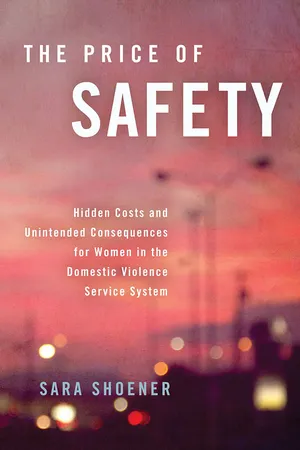
The Price of Safety
Hidden Costs and Unintended Consequences for Women in the Domestic Violence Service System
- English
- ePUB (mobile friendly)
- Available on iOS & Android
eBook - ePub
The Price of Safety
Hidden Costs and Unintended Consequences for Women in the Domestic Violence Service System
About this book
Information
1
“I was crazy and in court all the time”
The Economic Ripple Effect of Intimate Partner Violence
WHEN I MET SOPHIE, I could immediately relate to her. Spring was just beginning, and we both celebrated by coming to the interview in floral dresses and orange toenail polish. We started our conversation by talking about the music festivals we both attended—one of which was where she had met her ex-husband, Henry. She was immediately smitten by his good sense of style, his taste for sushi, and his awareness of the magic of rooftop picnics. When Henry told Sophie that he had had a vasectomy, she believed him. However, three months into their relationship, she learned that she was pregnant.
Even though she was stably employed, when Sophie found out they were going to have a baby, she accepted Henry’s invitation to move in. She explained, “I didn’t want to be a single mom. I lived in a crappy apartment, I had black mold. He seemed sincere.”
The day Sophie moved into Henry’s apartment, the abuse started. According to Sophie, Henry forced her to quit her job at an insurance agency, refused to give her access to his car, and began telling her church and family that she was addicted to drugs. Years later, while pregnant with their second child, Sophie filed for a civil protection order after Henry attempted to push her down their apartment’s stairs. When the protection order was issued, Henry came to their home with professional movers, emptied the entire apartment, turned off the utilities, cancelled the lease (which was only in his name), and moved to another state. “So there I was,” she said, “in an empty apartment, eight months pregnant, with a toddler, with no job.”
Soon Henry began filing harassment charges against Sophie, requiring her to travel across state lines to appear in court. Each time one set of charges against Sophie was dismissed, Henry would file more. In the meantime, Sophie’s economic stability was crumbling. She explained, “I couldn’t keep a job. I’d try to get a job and I’d lose it because I couldn’t handle myself at work. . . . I had no money, I had no food, I had no brain, I had no time, I had no mom, I had no friends, I had no church.” Soon after, Henry sought full legal and physical custody of their two children and won. He also falsified their children’s school bills to inflate the amount of money he was spending on parenting and was granted an $800 monthly child support order.
Sophie moved to Henry’s neighborhood to be closer to her children and tried to fight the child support order in a civil court hearing. She said that after missing ten days of work in five months, she was fired from her job at a medical center. After that, she was fired from a financial company for coming to work emotionally distressed. “I wasn’t doing good,” she recalled. “I would break down crying. I wasn’t too with it. I was a supervisor and making really good money. But I was crazy and in court all the time.”
Sophie did eventually win partial custody of her children, which now required her to maintain routine contact with Henry and with the custody court system to settle disputes and make changes to their order. According to Sophie, “The judge has us in court every thirty to ninety days. And usually in between that time, something happens where we need to go to court for an emergency for some reason.” She won’t consider seeking full custody of her children, because she doesn’t have the time to parent, maintain a sustainable job, and attend to Henry’s harassment through the court system:
I’m pretty much self-supporting now except for every time I lose my job, because I have to go to court. And the way I look at it is, that’s what the government is allowing me right now. This is what the government says Sophie is allowed to do: Sophie is allowed to work. Sophie is allowed to collect food stamps. Sophie is allowed to collect unemployment. Sophie has to go to court. And Sophie has to listen to what the judge says. . . . If that’s the way the system wants it right now, then I will continue to suck off the government and they will continue to allow Henry to harass me, and my kids will continue to get family services. And that’s the broken system.
IPV researchers and practitioners have become particularly attuned to the economic abuse survivors experience at the hands of their intimate partners. We regularly point to tactics such as hiding car keys on the morning of a job interview, denying access to money for household necessities, or coercing a partner to write fraudulent checks. This heightened awareness is merited: a seminal 2008 study by A. E. Adams and colleagues, which was one of the first to measure the prevalence of economic abuse, found that an overwhelming 99 percent of IPV survivors reported some kind of economic violence during the abusive relationship.
While current literature has detailed IPV perpetrators’ deliberate actions to sabotage survivors’ economic security during abusive relationships, the negative economic impacts of IPV last far beyond the relationship itself. Economic violence typically has been framed as a series of isolated and decontextualized incidents directly perpetrated by batterers to achieve greater economic control over their partners. However, the economic effects of IPV that I observed were cumulative, durable, and perhaps most importantly, exacerbated at times by the social service systems women were expected to navigate. Well after new incidents of abuse had ceased to occur, the interpersonal, physical, and psychological effects of domestic violence created significant obstacles to women’s long-term economic security. In turn, survivors’ economic instability often increased their vulnerability to future abuse, both within and outside of battering relationships. Survivors’ experiences of abuse and economic hardship were inextricably linked, mutually reinforcing, and shaped by the institutions they had to navigate.
Henry’s abuse continued to contribute to Sophie’s financial problems long after their intimate relationship ended. Her economic hardship and vulnerability to IPV fueled one another. After moving in with Henry, Sophie reported, she was pushed to give up her independent source of income. Information about household finances, such as details about the lease, utilities, credit cards, and routine expenses, was hidden from her. Henry orchestrated Sophie’s financial dependence, leaving her with few options for securing stable housing and maintaining an income. When she did not have the financial resources to defend herself in another state’s courts, Henry exploited this vulnerability, adding even more economic costs. Sophie’s economic trajectory had been permanently changed. She continued to operate at an economic disadvantage not just because she was in an abusive relationship, but because she had left it.
A Taxonomy of IPV’s Economic Harms
I have categorized the ways in which IPV created long-term economic costs into five categories: psychological costs, physical harm, professional harm, opportunity costs, and financial costs. This organization is certainly not the only way to conceptualize the economic damage caused by IPV. Though each cost will be discussed separately, in reality these facets overlapped and interacted in women’s daily lives.
Psychological Costs
In addition to generating mental health care costs, the psychological consequences of IPV created financial harm by constraining IPV survivors’ ability to seek and maintain resources. Like Sophie, some IPV survivors’ poor mental health outcomes contributed to job losses. Survivors reported crying at work frequently, becoming more easily angered, and struggling to remain focused on tasks. Others never found employment because they feared leaving the house, experienced reduced feelings of self-worth, or were institutionalized in a mental health facility.
When I met Greta, she mentioned how much she liked the photographs that hung on the office walls where we met and apologized for the paint under her nails: she had been working on a portrait in oil paint the night before. She told me that when she had started dating David, the father of her two daughters, almost a decade before, she was assisting at an art gallery on the weekends in addition to her full-time job as a bank teller. Soon after she and David moved in together, he became severely sexually abusive. She explained:
I didn’t realize that when you are in a relationship with somebody, if they forced you into having sex with them it was still considered rape. Because I kind of feel like it was my fault. Because when I was pregnant with [my first child], he did that to me and I just let it go. . . . But now I know, even if you are in a relationship, you don’t have to. Even if you’re married. Which I, I don’t know why, I guess I just wasn’t thinking. And he knows more about the law than I do too. But it’s a scary situation too, because you’ve got somebody saying that if you say anything, they’ll kill you and your family.
Within a year of moving in with David, Greta started having debilitating panic attacks at the bank. She described feeling as though her throat was closing, her heart was going to explode, and she would die at any minute. At first these anxiety attacks appeared irregularly when Greta was around large groups of people, but they increased in frequency as David’s sexual violence grew more severe. Her anxiety became so debilitating in social situations that she eventually quit her job.
After an incident during which David beat Greta with a phone until it broke in half and both her eyes were swollen shut, Greta decided to leave him. Without David’s income to help pay the rent, Greta tried to find a new job after her injuries healed. She landed a job as an assistant to a portrait photographer in a department store, which felt like a promising start to a career in the visual arts. However, as school picture season ramped up, Greta began suffering anxiety attacks again. “It doesn’t make sense to me,” she said. “I was doing so good. It came out of nowhere. But I guess they said stress and all that doesn’t help.”
Greta desperately wanted to address the roots of her anxiety, but had no access to affordable mental health care. Her family doctor gave her a prescription for Xanax to keep her panic attacks under control, but she could not take it when she needed to work. She explained, “They had me on it like three times a day. And then I’m always tired. But I can’t take a nap during the day. So I weaned myself off it. I take it once a day and then I’ll take it again if I absolutely need it.”
As Greta navigated between panic and fatigue, her work at the department store suffered, and she was eventually fired. After that she resigned herself to seeking employment in which she did not have to interact with other people. “I’ve had a couple jobs since then but it’s been with not so many people,” Greta explained, “and it’s hard to find jobs like that.”
When I asked Greta what she hoped for herself for the future, she rested her eyes on one of the pictures hanging behind my head and described a life filled with art and the financial stability to care for her two little girls. She hoped to gradually desensitize herself to crowds in order to pursue these goals:
I’m hoping if I get out, and the more people I get around, maybe the better I can get being around people and finding a better job. Because I want to work. I could be on disability for my anxiety, but if I can overcome it I’d love to. Because I want to be out there and I want to support my kids. Give them what they need. . . . I have done quarry work and stuff like that, but I want something more. You know what I mean? I love photography. I’d love to do something with that. But I’m willing to start back out small and work my way up. So I’m hoping I can overcome my anxiety and find something.
For other survivors, their experiences of traumatic abuse decreased their mental focus and comprehension. This created additional barriers to accessing resources that required complicated or protracted processes. Sophie’s trauma history was a significant obstacle in her efforts to secure public benefits for herself and her children. Her inability to focus or motivate herself made navigating the necessary bureaucracies an impossible task. She explained: “I remember I couldn’t process information. I remember times when I couldn’t read a form without just crumbling. I didn’t know how to read a form. I didn’t know how to make a phone call. I would sit in piles of phone calls and work and I would just stare at it because I couldn’t wrap my mind around anything else.” For Sophie and others, the psychological harm from IPV-generated trauma undermined their ability to lead productive lives.
Physical Costs
Some survivors’ most visible barriers to economic security were their lasting physical injuries. During interviews, some women spoke of broken teeth that affected their personal appearance, permanent back injuries that hampered their mobility, and chemical-burned eyes that could no longer see clearly. Some injuries were permanent and untreatable, while others could have been treated if the victims had access to the necessary health care. Regardless, many survivors of severe physical abuse contended with persistent physical harm that they said narrowed their employment possibilities.
Despite the common conception that physical violence is the central component of IPV, only a small subset of the interviewed survivors suffered from chronic injuries resulting from the abuse. Most of these cases occurred in the rural setting of South Falls. In the larger, more urban sites of North Point and Centre City, many of the survivors experienced physical violence infrequently and made full recoveries. Their batterers often used the threat of physical assaults to maintain fear and control in the home, but relied on more invisible tactics of abuse that did not fit neatly into any legal definitions of prosecutable crimes. The cause of this difference between sites is unclear. One possible explanation is that the cultural disapproval of domestic violence in the two larger sites was more powerful, compelling batterers to hide the visible effects of their violence. Another possibility is that the women in North Point and Centre City had greater access to health care that allowed them to treat physical injuries such as lost teeth, broken bones, and torn ligaments before they became permanent problems.
My conversations with Daisy often ended in long, joy-filled discussions about our dogs. She had just adopted a Rottweiler puppy, Buttercup, who had “two little blonde eyebrows, which is the most adorable thing.” Daisy added, “She loves to kiss.” Buttercup was the new sister of Daisy’s husky, Blue, who hated the cold and rain. Through laughter, she told me, “He’ll stand there in the door shivering, and then you put a sweater on him and he trots out in the snow. I tell him, ‘Huskies all over the world are hiding their heads.’” Dogs have always helped her sleep at night: “Blue wouldn’t let too much happen in front of him. At one point when my ex charged across the room at my daughter, Blue was sound asleep laying on the couch by her. By the time [my ex] got there with his arm out, the dog was hanging off him. And letting him know, ‘I will sink deeper. Back off.’ And I mean, Blue’s just a little runt thingy.”
When I met Daisy, she was trying to raise four hundred dollars to get her car fixed and drive a few states away to live with family. She lived in South Falls and had always earned her income in the local quarry. She told me that she was toothless because her ex-husband “beat them out of my face,” and she never had the money to get them fixed. As a result, she was ashamed to talk to people and pursued a career in manual labor. However, she had recently left her job due to persistent back pain. She explained:
From the constant punches and kicks in the back I have little spurs and bumps all through my spine and neck. And they decide to grab and lock and they hurt. It was fun to maneuver that way to scrub the floor. You could eat off the floor it was so clean, but there is one little speck of dirt in the corner and my ex would come out, “You filthy slut. You pig. Why don’t you just stop breathing already.”
Even though Daisy’s husband had died years earlier, his abuse continued to have repercussions for Daisy’s economic stability.
Though poverty prevented some survivors from treating their injuries, the physical costs of IPV were not limited to women without access to health care. For example, one evening after returning home from her job as a dentist, Susan was interrogated by her husband, Will, regarding her late arrival. According to Susan, Will’s rage escalated, and he attacked her with a knife in their kitchen. As she held her hand up to protect her face, he severed nerves in both her hands, rendering four of Susan’s fingers immobile. Susan never regained full control of her hands, so she abandoned her practice as a dentist. When I met Susan a few months later, she was searching for jobs that would allow her to be financially stable and support her two children, but did not require the use of her hands. As a result, she was living in a domestic violence shelter. Throughout our time together, her eyes were exhausted and always almost closed. Her anxiety over her finances was keeping her awake at night, which compounded the fatigue she already felt from the painkillers she was taking for her hands. Though Will’s immediate intent probably was not to cause lasting financial harm, such harm as an indirect and permanent effect of the physical punishment that resulted from Susan’s late return home that night.
Professional Costs
June was enjoying a career as a nurse until her ex-boyfriend started harassing her at the hospital where she worked. He would call to threaten her or show up at the hospital unannounced. Her supervisor grew impatient with the disruptions and reported June to the hospital’s administrators. She recalled that th...
Table of contents
- Cover
- Title Page
- Copyright
- Dedication
- Contents
- Acknowledgments
- Introduction
- 1. “I was crazy and in court all the time”: The Economic Ripple Effect of Intimate Partner Violence
- 2. “They just focus on the fact that I’m screaming”: The Enduring Strain on Social Support
- 3. “Men get bonus points just for walking in the door”: The Prioritization of Two-Parent Families
- 4. “I’m not so sure what they think I’m going to invest”: Unaffordable Safety
- 5. “They treat you like they’re family”: The Value of Supportive Relationships
- 6. Lowering the Price of Safety: Toward Structural Solutions to Intimate Partner Violence
- References
- Index
Trusted by 375,005 students
Access to over 1.5 million titles for a fair monthly price.
Study more efficiently using our study tools.
Frequently asked questions
Yes, you can cancel anytime from the Subscription tab in your account settings on the Perlego website. Your subscription will stay active until the end of your current billing period. Learn how to cancel your subscription
No, books cannot be downloaded as external files, such as PDFs, for use outside of Perlego. However, you can download books within the Perlego app for offline reading on mobile or tablet. Learn how to download books offline
Perlego offers two plans: Essential and Complete
- Essential is ideal for learners and professionals who enjoy exploring a wide range of subjects. Access the Essential Library with 800,000+ trusted titles and best-sellers across business, personal growth, and the humanities. Includes unlimited reading time and Standard Read Aloud voice.
- Complete: Perfect for advanced learners and researchers needing full, unrestricted access. Unlock 1.5M+ books across hundreds of subjects, including academic and specialized titles. The Complete Plan also includes advanced features like Premium Read Aloud and Research Assistant.
We are an online textbook subscription service, where you can get access to an entire online library for less than the price of a single book per month. With over 1.5 million books across 990+ topics, we’ve got you covered! Learn about our mission
Look out for the read-aloud symbol on your next book to see if you can listen to it. The read-aloud tool reads text aloud for you, highlighting the text as it is being read. You can pause it, speed it up and slow it down. Learn more about Read Aloud
Yes! You can use the Perlego app on both iOS and Android devices to read anytime, anywhere — even offline. Perfect for commutes or when you’re on the go.
Please note we cannot support devices running on iOS 13 and Android 7 or earlier. Learn more about using the app
Please note we cannot support devices running on iOS 13 and Android 7 or earlier. Learn more about using the app
Yes, you can access The Price of Safety by Sara Shoener in PDF and/or ePUB format, as well as other popular books in Politics & International Relations & Social Policy. We have over 1.5 million books available in our catalogue for you to explore.