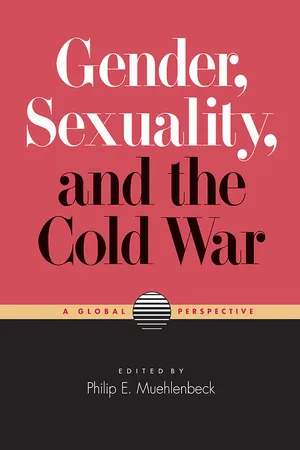
As Marko Duman?i? writes in his introduction to Gender, Sexuality, and the Cold War, "despite the centrality of gender and sexuality in human relations, their scholarly study has played a secondary role in the history of the Cold War.... It is not an exaggeration to say that few were left unaffected by Cold War gender politics; even those who were in charge of producing, disseminating, and enforcing cultural norms were called on to live by the gender and sexuality models into which they breathed life." This underscores the importance of this volume, as here scholars tackle issues ranging from depictions of masculinity during the all-consuming space race, to the vibrant activism of Indian peasant women during this period, to the policing of sexuality inside the militaries of the world. Gender, Sexuality, and the Cold War brings together a diverse group of scholars whose combined research spans fifteen countries across five continents, claiming a place as the first volume to examine how issues of gender and sexuality impacted both the domestic and foreign policies of states, far beyond the borders of the United States, during the tumult of the Cold War.
- English
- ePUB (mobile friendly)
- Available on iOS & Android
eBook - ePub
About this book
Information
PART I
Sexuality
CHAPTER 1
Faceless and Stateless
French Occupation Policy toward Women and Children in Postwar Germany (1945–1949)
Katherine Rossy
By the spring of 1945, Germany was partitioned into four occupation zones. In the German states of Hessen, Bavaria, and north Baden-Württemberg, the Americans structured their German program around the “Four D’s” of the Potsdam Agreement—demilitarization, denazification, democratization, and decentralization—while countering the threat of communist expansion in the East.1 In Thuringia, Saxony, Brandenburg, and Mecklenburg-Vorpommern, the Russians established a new empire in which communism would triumph over Nazism and capitalism while attempting to exploit as many German resources and technologies as possible, all the while “liberating” those under their control through a systematic propaganda apparatus.2 In Hamburg, Hanover, Schleswig-Holstein, Lower Saxony, and North Rhine-Westphalia, the British sought to reconstruct German society through an intensive re-education program in the hopes of reviving economic cooperation and preserving the balance of power on the continent, all the while buffering Western Europe from Soviet expansion.3 In Baden, Württemberg, Pfalz, and the Saar, the French exploited German economic resources while exercising zealous cultural and immigration policies designed to engender French “grandeur,” a vision in which France would surpass the rest of Europe and once again take its place alongside the world’s great powers.4
As the occupation took shape, it quickly became evident that postwar reconstruction was not just a matter of repairing shattered infrastructure and denazifying a people influenced by twelve years of fanatical Nazi ideology. Wartime atrocities had ushered in droves of refugees and displaced persons. Among these people were tens of thousands of displaced, orphaned, stolen, and abandoned children who created part of what Tony Judt has called the “human flotsam of war.”5 While some children were happily reunited with their families after the war, some had no surviving relatives to claim them. Others were too young or traumatized to recall who they were, and many of these children did not have any identity documents or papers in their possession. Some children were the unanticipated consequence of rape or sexual relations between prisoners of war, forced laborers, civilians, and occupation soldiers, while others had been brought to Germany against their will to be put to work or exterminated in concentration camps. These are but several of the possible scenarios that led children to overcrowded cellars and bombed-out buildings, institutions and hospitals, refugee camps, children’s homes, transit centers, and repatriation convoys after the war.
As Tara Zahra has argued, “Children were central objects of population politics, nation building projects, and new forms of humanitarian intervention in the twentieth century, as they represented the biological and political future of national communities.”6 For many nations, recovering missing children was the penultimate step toward postwar reconstruction. But theory differed greatly from practice, and locating children in Germany would quickly prove to be one of the most challenging reconstruction policies of the postwar period.
No nation was more concerned with recuperating its missing children than France. To French military authorities and policy makers, recovering and repatriating children who were presumed to be of French origin was a means both of transcending the “dark years” of Vichy collaboration and of solving a decades-long demographic anxiety. The repatriation of French children, furthermore, also symbolized a fundamental element of France’s new role on the postwar stage. But finding these children proved to be a most challenging task, as it required the careful cooperation of the military authorities and humanitarian agencies that operated in the French Zone. Under its agreement with the Supreme Headquarters Allied Expeditionary Force in October 1944, the United Nations Relief and Rehabilitation Administration (UNRRA) would act as the principal humanitarian organization during the postmilitary period.7 Established by U. S. President Franklin D. Roosevelt in Atlantic City in 1943, UNRRA was responsible for coordinating the health, welfare, registration, administration, and repatriation of all United Nations refugees and displaced persons found in enemy or ex-enemy territory between May 1945 and July 1947.8 The International Refugee Organization (IRO) then resumed UNRRA’s activities after its mandate formally ended in July 1947.9 Unlike the United States and the United Kingdom, France was the only Western occupation authority to exclude UNRRA and the IRO from child search and repatriation efforts. The French chose instead to operate their own child search program through the Tracing Bureau of its Displaced Persons and Prisoners of War branch, whose activities were carried out by the French Red Cross as of December 1945.10 By choosing to operate outside the international channels championed by the Americans and the British, the French placed the child question within the broader context of the occupation of Germany as a means of furthering concerns about demography, immigration, and the nuclear family across the Rhine. Wedged between two emerging superpowers, the United States and the Soviet Union, French policy toward unaccompanied children marked an attempt to legitimize France as a major power player on the postwar stage as the Iron Curtain began its rapid descent through Eastern Europe.
The “Big Three” and France
When the Nazis unconditionally surrendered on May 8, 1945, the Allies stood at the tail end of a long and bloody succession of wars and occupations against Germany. But the circumstances of defeat had changed, and defeat was now total. The German people were both active and passive perpetrators of some of the most harrowing crimes against humanity that humankind had ever known. Cities were reduced to piles of rubble, and villages were wiped off the map. Entire populations were rendered stateless and driven from their homes, and millions of Jews were systematically exterminated. After Auschwitz, Belzec, Birkenau, and Buchenwald, guilt and denial became deeply engrained in the German collective conscience.11 In this light, it was not Germany that menaced the Allies after capitulation but a new nemesis in the East, the Soviet Union, an emerging superpower against whom the United States and Britain would square off, leaving France to question the place it was to occupy in a new Cold War order.
It was the French, however, and not the Soviets, who were the outliers during the first phase of the occupation of Germany in 1945. Tensions mounted between the “Big Three” and France during the signing of the German Act of Capitulation in Berlin on May 8, 1945, in Marshal Georgy Zhukov’s headquarters in Karlshorst, an episode during which Jean de Lattre de Tassigny, the French signatory, noticed that the French flag was missing:
I required that France should be represented at this ceremony with her flag in a place of equality with those of her Allies . . . and in fact it was a business! A diplomatic affair to start with, for everyone was not in agreement. A Brigadier-General, learning of my request, had even cried out “And why not China!” It was a practical matter above all, for a French flag could nowhere be found. The Russians decided to make one, with a piece of red stuff taken from a former Hitlerite banner, a white sheet and a piece of blue serge cut out of an engineer’s overalls. . . . At last, at 20.00, our national emblem was placed between those of Great Britain and the United States in a cluster surmounted by the Soviet flag.12
Charles de Gaulle recalls that even Wilhelm Keitel, Hitler’s war minister, was resentful of France’s participation in Germany’s unconditional surrender, exclaiming, “What? The French too!”13 Vichy collaboration had made the “Big Three” deeply skeptical of France’s participation in the occupation of Germany, especially since Vichy collaborators had fought against the Allies in North Africa in November 1942.14 Although the Allies did not formally declare war on the Vichy government, they imposed an economic blockade on Vichy France and its colonies.15 Joseph Stalin had remarked that it was Henri-Philippe Pétain, and not de Gaulle, who symbolized “the real physical France.”16 At Yalta, he told Roosevelt that the “Big Three” was an “exclusive club . . . restricted to a membership of nations with five million soldiers,” and had insisted that France had no place as an occupier since “she had not done much fighting in the war.”17 It was Winston Churchill who defended French interests in Germany. Churchill and Roosevelt supported different French émigré governments during the war; Roosevelt backed Henri Giraud, who controlled French North Africa and claimed to have no political aims, while Churchill supported de Gaulle, who controlled French Equatorial Africa and Oceania from his headquarters in London.18 As Britain grew more anxious about Soviet expansion by the spring of 1945, Churchill recognized that the key to Britain’s survival as a great power lay in a shared occupation effort with France. The need to stabilize a shifting postwar dynamic meant that “Britain had a strong interest in bolstering French power on the Continent as a counterweight to a revived Germany, but more realistically, to the spectre of Soviet communism.”19 Fearful that rapidly expanding Soviet influence would tilt the balance of power in Germany, Churchill telegraphed Roosevelt in November 1944: “How will it be possible to hold down Western Germany beyond the present Russian occupation line? . . . All would therefore rapidly disintegrate as it did last time. . . . I hope however that my fears are groundless. I put my faith in you.”20 Roosevelt was wary of France’s ability to sustain the burden of occupation, informing Churchill in February 1944 that he was “absolutely unwilling to police France” and that “France is [Churchill’s] baby and will take a lot of nursing in order to bring it to the point of walking alone.”21 But since Roosevelt had initially planned for US troops to occupy Germany for only a two-year period, a plan that was quickly abandoned following the rapid breakdown of American-Soviet relations in 1947, Churchill convinced Roosevelt and Stalin to authorize the creation of a French Zone of Occupation, an hourglass-shaped territory bordering the Rhine created jointly by carved-out portions of the American and British Zones.22
For the French, participating in the shared occupation of Germany was as much a means of avenging its long-time enemi héréditaire (hereditary enemy) as it was a race to establish hegemony in a new Cold War order. Following Liberation in 1944 and the establishment of the Provisional Government under de Gaulle’s leadership, the purge of those considered traitors and collaborators raised many questions about France’s rightful place as a victor, ally, and world power. Occupying Germany would provide the French with an opportunity to practice une grande politique européenne (grand European policy) through a doctrine known as the “French Thesis.”23 First discussed by Georges Bidault, the French foreign minister, at the London Conference in September 1945, the French Thesis was, in many ways, an intensification of Rhineland policy after the First World War. As Alistair Cole points out, the legacies of the Versailles peace treaty had given way to two lines of reasoning in 1945: the hard-line “Poincaré approach,” which sought to punish Germany by imposing a Carthaginian peace with hefty war indemnities, and the more lenient “Briand approach,” which sought reconciliation with its former enemy in order to foster European cooperation.24 The French Thesis was acutely poincarien at the beginning of the occupation, in that it was intended to safeguard France from future German aggression by securing Fr...
Table of contents
- Cover
- Title Page
- Copyright
- Contents
- Preface
- Introduction: Hidden in Plain Sight: The Histories of Gender and Sexuality during the Cold War
- Part I: Sexuality
- Part II: Femininities
- Part III: Masculinities
- Contributors
- Index
Trusted by 375,005 students
Access to over 1.5 million titles for a fair monthly price.
Study more efficiently using our study tools.
Frequently asked questions
Yes, you can cancel anytime from the Subscription tab in your account settings on the Perlego website. Your subscription will stay active until the end of your current billing period. Learn how to cancel your subscription
No, books cannot be downloaded as external files, such as PDFs, for use outside of Perlego. However, you can download books within the Perlego app for offline reading on mobile or tablet. Learn how to download books offline
Perlego offers two plans: Essential and Complete
- Essential is ideal for learners and professionals who enjoy exploring a wide range of subjects. Access the Essential Library with 800,000+ trusted titles and best-sellers across business, personal growth, and the humanities. Includes unlimited reading time and Standard Read Aloud voice.
- Complete: Perfect for advanced learners and researchers needing full, unrestricted access. Unlock 1.5M+ books across hundreds of subjects, including academic and specialized titles. The Complete Plan also includes advanced features like Premium Read Aloud and Research Assistant.
We are an online textbook subscription service, where you can get access to an entire online library for less than the price of a single book per month. With over 1.5 million books across 990+ topics, we’ve got you covered! Learn about our mission
Look out for the read-aloud symbol on your next book to see if you can listen to it. The read-aloud tool reads text aloud for you, highlighting the text as it is being read. You can pause it, speed it up and slow it down. Learn more about Read Aloud
Yes! You can use the Perlego app on both iOS and Android devices to read anytime, anywhere — even offline. Perfect for commutes or when you’re on the go.
Please note we cannot support devices running on iOS 13 and Android 7 or earlier. Learn more about using the app
Please note we cannot support devices running on iOS 13 and Android 7 or earlier. Learn more about using the app
Yes, you can access Gender, Sexuality, and the Cold War by Philip E. Muehlenbeck in PDF and/or ePUB format, as well as other popular books in History & 20th Century History. We have over 1.5 million books available in our catalogue for you to explore.