Since the Constitution's ratification, members of Congress, following Article V, have proposed approximately twelve thousand amendments, and states have filed several hundred petitions with Congress for the convening of a constitutional convention. Only twenty-seven amendments have been approved in 225 years. Why do members of Congress continue to introduce amendments at a pace of almost two hundred a year?This book is a demonstration of how social reformers and politicians have used the amendment process to achieve favorable political results even as their proposed amendments have failed to be adopted. For example, the ERA "failed" in the sense that it was never ratified, but the mobilization to ratify the ERA helped build the feminist movement (and also sparked a countermobilization). Similarly, the Supreme Court's ban on compulsory school prayer led to a barrage of proposed amendments to reverse the Court. They failed to achieve the requisite two-thirds support from Congress, but nevertheless had an impact on the political landscape. The definition of the relationship between Congress and the President in the conduct of foreign policy can also be traced directly to failed efforts to amend the Constitution during the Cold War.Roger Hartley examines familiar examples like the ERA, balanced budget amendment proposals, and pro-life attempts to overturn Roe v. Wade, but also takes the reader on a three-century tour of lesser-known amendments. He explains how often the mere threat of calling a constitutional convention (at which anything could happen) effected political change.
eBook - ePub
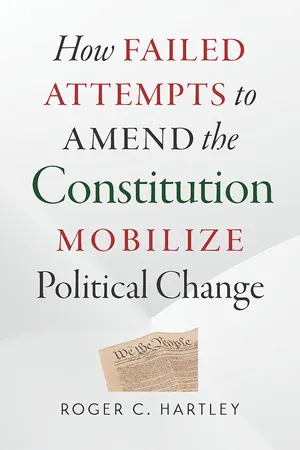
How Failed Attempts to Amend the Constitution Mobilize Political Change
- English
- ePUB (mobile friendly)
- Available on iOS & Android
eBook - ePub
How Failed Attempts to Amend the Constitution Mobilize Political Change
About this book
Information
PART I
Lessons from the ERA
1
Amendment Efforts as a Movement-Building Resource
By the 1970s, the effort to add the Equal Rights Amendment (ERA) to the Constitution had attracted large numbers of engaged partisans on both sides. Few Americans were unaware of this amendment proposal. The ERA’s substantive provision stated: “Equality of rights under the law shall not be denied or abridged by the United States or by any State on account of sex.” Congress approved the ERA and sent it to the states for ratification in March 1972. The original seven-year expiration date for ratification was extended to June 30, 1982. By that date, the ERA had secured thirty-five state ratifications, three short of the required three-fourths of the states.
The ERA is an example of an unsuccessful constitutional amendment effort that nevertheless influenced a broad swath of US politics. Isolating the pathways through which political actors used the ERA as a resource to achieve a variety of political objectives opens opportunities for clarifying how other “failed” constitutional amendment efforts have provided amendment proponents similar political opportunities. The ERA was unique in the sense that it impacted US politics in several dimensions. One was using the ERA as a resource to help mobilize supporters favoring legal equality for women in general and building the feminist movement in particular.
Mass mobilization is normally necessary for generating the broad-based engagement, intense debate, and political agitation needed to stimulate significant political and social change. But such mobilization will seldom develop spontaneously. During times of “normal politics,” people go about their business, remain relatively uninvolved in Washington, DC, politics, and only tangentially participate in political discourse.1 To stimulate political agitation, a committed cadre must design a strategy that can first activate support from a small cohort of concerned citizens and then organize partisans into an effective social movement.2 Existing scholarship demonstrates how asserting legal rights through litigation can serve as a resource for building a social movement. The “failed” ERA demonstrates that proposing a constitutional amendment similarly can and did operate as a resource for movement building—in the case of the ERA, serving as a catalyst for building the modern feminist movement and then creating a backlash countermovement.
Claiming Rights through Litigation as a Resource for Movement Building
Forty years ago Stuart Scheingold wrote the first edition of his important book The Politics of Rights. It describes how claiming legal rights through litigation can initiate and nurture political mobilization.3 Scheingold was initially struck by the apparent paradox of American faith in law coexisting with the reality on the ground that law is often a feckless agent for effecting social change.4 Americans are wedded to the idea that a legal right is an entitlement that courts will safeguard. But Scheingold’s research, as well as research produced by later generations of scholars, confirms the existence of structural forces causing a disconnect between the law as extolled by judicial decisions and the law as it actually impacts individuals.5 Scheingold coined the phrase “myth of rights” to describe this faith in law coexisting with a gap between the promise and the reality of law.
Scheingold’s groundbreaking book advanced a second, even more powerful, insight. Since it is illusory to view judicially affirmed rights as self-implementing vehicles for achieving social justice, it is far more sensible to think of claims of legal rights not as ends in themselves but as a means to achieve the political mobilization that makes social justice achievable. Social movement organizers can exploit the “myth of rights”—the widely held perceptions that legal rights are entitlements that courts will enforce—both to initiate political mobilization (activation) and then nurture a fledgling rights-claiming campaign into an effective social movement (organizing). Scheingold called the power of rights claiming to catalyze social movement mobilization the “politics of rights.”6
Activation
For political mobilization to commence, discontented people must cease thinking of their discontent as an individual problem and instead begin to perceive the injustices they see as social problems requiring a political solution.7 For this to occur, individuals and groups must have their expectations altered to the point that they are able to conclude their grievance represents an indefensible deprivation and that redress through collective action is realistically possible.8 A powerful way for social activists to alter expectations this way is through rights claiming—demanding official redress of grievances. Through reform strategies that demand official vindication of rights, social activists are able to accord grievances a measure of political legitimacy, which has the effect of raising expectations and activating individuals’ and groups’ political consciousness.9 By providing a grievance the imprimatur of official acknowledgment and a measure of political legitimacy, rights claiming moves individuals from the view that they are isolated, atomized individuals with grievances to the view that it is politically legitimate and sensible to insist on official redress of grievances through mobilization for collective action.10
Scheingold, and subsequently others, have thus demonstrated that rights claiming might not succeed in effecting social change through judicial enforcement of the asserted right, but the process of rights claiming can become a resource for recruiting support for a social movement, and the resulting social movement may be successful in obtaining the desired social change through other political processes.
It is of critical importance to the present project of applying the politics-of-rights principles to efforts to amend the Constitution that subsequent research has demonstrated that Scheingold’s politics-of-rights principles apply even to rights not yet formally recognized or enforced.11 In other words, legal strategies centered on the contention that certain claimed rights should be acknowledged and respected can catalyze political mobilization.12 And, of course, proposing a constitutional amendment is grounded in the assertion that a right not yet recognized should be acknowledged through a proposed amendment’s ratification. Anything that validates a rights claim can activate rights consciousness. Even some relatively small departure from existing practice can serve to legitimatize a claim of rights and thus create connotations of entitlement.13
Organizing
Activation of political consciousness among the discontented is a necessary, yet insufficient, prerequisite for building an effective social movement. Rights claiming will not gain enough traction to influence changes in public policy absent effective political organizations that can maintain the momentum needed to press rights claims. Rights claiming can nurture a nascent social movement and assist in its development in several different ways.
First, rights claiming can promote movement growth by providing opportunities for movement organizers to develop a plausible legal logic for how change can occur. In order to take root and become effective, an incipient social movement and its members must be taken seriously. Only then can they expect to attract new members and powerful institutional allies and eventually gain sufficient influence to effect a favorable change in public opinion. When a social movement advocates a plausible legal logic for how change can occur, it is more likely to be taken seriously and inspire confidence among potential supporters that the organization has the capacity to become an effective change agent. That confidence facilitates the movement’s effort to recruit new members and institutional allies.14
In addition, rights claiming permits an organization to benefit from a process known as “framing and naming.” The social movement frames its goals as an effort to obtain official vindication of rights and names the right asserted in terms of some legally recognizable category. It makes a difference, for example, whether an asserted “right” is framed in terms of the right to life or a women’s right to choose. In school prayer disputes, one might support the return of God to the classroom (connoting something has been taken away) versus an opponent’s claim for respect for an individual’s right to freedom of religion or separation of church and state. In desegregation and busing disputes, naming permits one to be associated with either the right to choose neighborhood schools versus the right to a racially integrated public education. By further example, in affirmative action disputes it makes a difference if the debate is framed within the ideological framework of eliminating effects of past racial injustice or in terms of white victimization resulting from a violation of the Equal Protection Clause’s demand for color-blindness.15 The point is that framing helps give social meaning to a discontent and empowers members by providing a conceptual context for making sense of the perceived injustice they feel. Naming helps sustain hope and confidence that change is possible because an individual’s or a group’s discontent can now be understood as a deprivation of a right described within a recognized legal category. Naming also provides groups the ability to coalesce around a mutually shared understanding of some perceived injustice and promotes cohesion by separating “us” (who all claim a discernible right) from “them” (who seek to deny “us” the right). And naming creates an easily administered litmus test for determining allies and opponents.16 In short, rights claiming provides movement organizers creative opportunities to design a plausible legal strategy for how change can occur that frames its objective as insistence on official vindication of a right and names the claimed right in terms of a recognized legal category. Such framing and naming promotes cohesion among existing supporters and assists in recruiting new members and institutional allies.
Additionally, rights claiming can promote movement growth by providing media coverage. A nascent political movement gains organizational strength by aligning itself with affinity groups and elite activists in government, community groups, and the public at large.17 A movement achieves leverage in its efforts to form such alliances when its agenda attains national prominence. This requires that a fledgling movement secure national publicity through media coverage. In addition to promoting favorable alliances, media coverage also educates the public, dramatizes the issues at stake, and can “awaken the ‘sleeping giant’ of protest” against a targeted perceived injustice.18
A rights-claiming strategy can provide a movement with valuable opportunities to generate national publicity. Preliminary litigation success, for example, has been shown to provide political legitimacy to a rights claim and concomitant mainstream media attention.19 In a similar vein, proposing a constitutional amendment as a means to secure official redress of grievances is a dramatic political gesture that attracts media attention. The national media inevitably provides extensive coverage, particularly if congressional hearings are scheduled on the proposed amendment. This occurred in the spring of 2014, for example, when the Senate Judiciary Committee held hearings on a proposed constitutional amendment to authorize Congress and the states to regulate the raising and spending of money for political campaigns. These hearings received nationwide attention from both mainstream media and the internet.20 Just writing a book proposing adoption of a constitutional amendment can land the amendment proposal on the editorial page of a major newspaper—at least if the author is a celebrated public figure.21 Many examples of the media’s attraction to amendment efforts can be seen in the history of the ERA, Prohibition, the proposed school prayer constitutional amendments, amendment proposals to ban f...
Table of contents
- Cover
- Title Page
- Copyright
- Dedication
- Contents
- Acknowledgments
- Introduction: The Problem
- Part I. Lessons from the ERA
- Part II. Impact of Failed Amendment Efforts on Congressional Politics
- Part III. Impact of Failed Amendment Efforts on Federal Executive Policy
- Conclusion
- Cases Cited
- Notes
- Bibliography
- Index
Trusted by 375,005 students
Access to over 1.5 million titles for a fair monthly price.
Study more efficiently using our study tools.
Frequently asked questions
Yes, you can cancel anytime from the Subscription tab in your account settings on the Perlego website. Your subscription will stay active until the end of your current billing period. Learn how to cancel your subscription
No, books cannot be downloaded as external files, such as PDFs, for use outside of Perlego. However, you can download books within the Perlego app for offline reading on mobile or tablet. Learn how to download books offline
Perlego offers two plans: Essential and Complete
- Essential is ideal for learners and professionals who enjoy exploring a wide range of subjects. Access the Essential Library with 800,000+ trusted titles and best-sellers across business, personal growth, and the humanities. Includes unlimited reading time and Standard Read Aloud voice.
- Complete: Perfect for advanced learners and researchers needing full, unrestricted access. Unlock 1.5M+ books across hundreds of subjects, including academic and specialized titles. The Complete Plan also includes advanced features like Premium Read Aloud and Research Assistant.
We are an online textbook subscription service, where you can get access to an entire online library for less than the price of a single book per month. With over 1.5 million books across 990+ topics, we’ve got you covered! Learn about our mission
Look out for the read-aloud symbol on your next book to see if you can listen to it. The read-aloud tool reads text aloud for you, highlighting the text as it is being read. You can pause it, speed it up and slow it down. Learn more about Read Aloud
Yes! You can use the Perlego app on both iOS and Android devices to read anytime, anywhere — even offline. Perfect for commutes or when you’re on the go.
Please note we cannot support devices running on iOS 13 and Android 7 or earlier. Learn more about using the app
Please note we cannot support devices running on iOS 13 and Android 7 or earlier. Learn more about using the app
Yes, you can access How Failed Attempts to Amend the Constitution Mobilize Political Change by Roger C. Hartley in PDF and/or ePUB format, as well as other popular books in Law & North American History. We have over 1.5 million books available in our catalogue for you to explore.