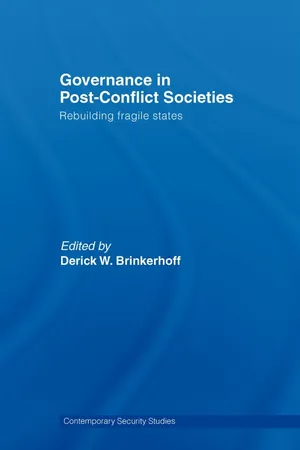
Foreword Frederick D. Barton Preface Derick W. Brinkerhoff 1. Governance Challenges in Fragile States: Re-Establishing Security, Rebuilding Effectiveness, and Reconstituting Legitimacy Derick W. Brinkerhoff Part 1. Governance and Post-conflict: Perspectives on Core Issues 2. Does Nation Building Work? Reviewing the Record Arthur A. Goldsmith 3. Constitutional Design, Identity and Legitimacy in Post-Conflict Reconstruction Aliza Belman Inbal and Hanna Lerner 4. Election Systems and Political Parties in Post-Conflict and Fragile States Eric Bjornland, Glenn Cowan, and William Gallery 5. Democratic Governance and the Security Sector in Conflict-affected Countries Nicole Ball Part 2. Actors in Governance Reconstruction: Old, New, and Evolving Roles 6. From Bullets to Ballots: The U.S. Army Role in Stability and Reconstruction Operations Tammy S. Schultz and Susan Merrill 7. The Private Sector and Governance in Post-Conflict Societies Virginia Haufler 8. Rebuilding and Reforming Civil Services in Post-Conflict Societies Harry Blair 9. Contributions of Digital Diasporas to Governance Reconstruction in Fragile States: Potential and Promise Jennifer M. Brinkerhoff Part 3. Reforming and Rebuilding Governance: Focus on the Local 10. Decentralization, Local Governance, and Conflict Mitigation in Latin America Gary Bland 11. Subnationalism and Post-conflict Governance: Lessons from Africa Joshua B. Forrest 12. Subnational Administration and State Building: Lessons from Afghanistan Sarah Lister and Andrew Wilder About the Contributors Index
- 288 pages
- English
- ePUB (mobile friendly)
- Available on iOS & Android
eBook - ePub
1
INTRODUCTION – GOVERNANCE CHALLENGES IN FRAGILE STATES
Re-establishing security, rebuilding effectiveness, and reconstituting legitimacy
Derick W. Brinkerhoff
It has become commonplace to observe that we live in a globalized world. Issues, problems, and people that once seemed remote now appear on our doorstep, both the virtual one created by today’s instant communication and the physical, territorial one. Global and local dynamics interconnect, creating a world characterized by what Rosenau (2003) terms “distant proximities.” Globalizing forces penetrate down to the local level through a variety of pathways, and local forces diffuse upward to the global level. For instance, lack of access to economic opportunities leads individuals in poor local communities to migrate to other countries in search of a better life; the aggregation of these individuals into vast transnational flows of people has global impacts. Localized political instability can engender social tensions, ethnic conflict, and dislocation. In some cases, these pressures in weak and fragile states lead to collapse, creating negative spill-overs for their immediate neighbors, and opening up a haven for illicit activities, such as the drug and arms trade or terrorism, which affect nations and people who are geographically removed from those troubled localities.
The problem of fragile states that fail, leading to conflict and war, and how to rebuild them in the post-conflict period, is the topic addressed by the contributors to this volume. Fragile states are not a new problem: most countries classed as poor or developing fall into the category of fragile states, and they have long been the target of international development and humanitarian assistance. In today’s world of distant proximities, however, fragile states are no longer solely the concern of international assistance actors. There is a new and growing intersection among the policy, research, and programmatic agendas of the international development and humanitarian, security, and diplomatic communities that is focusing on fragile and failed states (see e.g. Carment 2003; Rice 2003; Koppell with Sharma 2003; Dombrowski 2005; Francois and Sud 2006). Particularly with the current concern over transnational terrorism, such states have been referred to as a “sleeping giant” threat that requires concerted and integrated attention (CGD 2004).
A focus on governance constitutes the integrative theme of the book. Governance concerns the rules, institutions, and processes that form the nexus of state–society relations where government and citizens interact. This domain combines public administration and state structures, politics and the exercise of power and authority, and policy-making and implementation. The quality of governance is widely acknowledged as affecting the performance of economic, social, and rights-based functions. In fragile and failed states, weak governance is recognized as a contributor to conflict and civil war, and has highlighted the importance of reformed governance in establishing peace, pursuing state reconstruction, and avoiding a descent into conflict in the first place (Brinkerhoff and Brinkerhoff 2002; Milliken and Krause 2002).
Rebuilding governance in fragile and failed states, which includes promoting more democratic forms of governance, is situated at the core of the policy and programmatic convergence mentioned above. Governance reform is inextricably entangled with the political and military objectives of the intervening countries. In the United States, these policy connections are becoming institutionalized as the actors that previously operated relatively autonomously – the State Department, the U.S. Agency for International Development (USAID), and the Department of Defense – are in the process of developing increased bureaucratic, operational, and procedural linkages.
These are turbulent times in the foreign policy community in the U.S.A. and Europe. The lessons and implications of this fusion are beginning to be explored, and feed into the current policy debates, programmatic reassessments, and bureaucratic and political realignments (see e.g. Carothers 2006; Fukuyama 2006). The contributors to this volume add their analyses and observations to this collective reflection and exchange. This first chapter reviews key terminology, presents a framework for considering post-conflict governance reconstruction, introduces the contents of the various chapters, and identifies a number of common themes that emerge from the contributions to the book.
State failure, fragility, and post-conflict
The terminology applied to failed/fragile states, conflict, and post-conflict is often imprecise.1 In general, a failed state is characterized by: (1) breakdown of law and order where state institutions lose their monopoly on the legitimate use of force and are unable to protect their citizens, or those institutions are used to oppress and terrorize citizens; (2) weak or disintegrated capacity to respond to citizens’ needs and desires, provide basic public services, assure citizens’ welfare, or support normal economic activity; and, at the international level, (3) lack of a credible entity that represents the state beyond its borders (see Thurer 1999; Rotberg 2002; Francois and Sud 2006).2
One key issue, then, is the degree to which a given state exhibits these characteristics. The label, failed state, has been employed to describe extreme cases of collapse, such as Somalia, where civil and social authority have disintegrated. Many more countries, though, confront less drastic situations, and vary in the extent to which they have failed or risk failing to provide for the welfare of their citizens, supply basic security, or facilitate equitable economic growth. At this less extreme, opposite end of the spectrum, the state is more fragile than failed, and becomes nearly indistinguishable from the status of many, if not most, poor countries, which suffer from institutional weaknesses and capacity gaps.
No state’s degree of fragility or failure is static; so another issue has to do with the trajectory that characterizes the direction and degree of change taking place. Is the state on a downward slide into a serious crisis, which could provoke collapse and the outbreak of conflict; or is it weak but recovering, with an upward trajectory toward an improved situation? Given the long time horizon for state reconstruction and for putting in place the foundations for sustainable development, anticipating and planning for ups and downs along that path is important. The record shows that countries which have experienced violent conflict face a 40 percent risk of renewed conflict within five years (Collier et al. 2003).
Similarly, conflict and post-conflict are relative terms as well, and subject to nuance. Post-conflict rarely means that violence and strife have ceased at a given moment in all corners of a country’s territory. In practice, most post-conflict reconstruction efforts take place in situations where conflict has subsided to a greater or lesser degree, but is ongoing or recurring in some parts of the country. As Doyle and Sambanis observe, “no peace is perfect. Public violence . . . never gets completely eliminated. . . . We should thus consider peace to be a spectrum ranging from insecure to secure” (1999: 1). The peace-building literature has evolved a more nuanced perspective on conflict, moving away from a linear conception, similar to the recognition of the artificiality of the relief-to-development continuum (see Jeong 2005). Greater understanding of conflict dynamics has led in turn to intervention designs that recognize this complexity. For example, Leatherman et al. (1999: 8) argue that conflict interventions need “a rehabilitative dimension oriented to the past, a resolutive dimension oriented to the present, and a preventive dimension oriented to both the present and future.”
Governance definitions
Governance, as noted above, extends beyond the role and actions of public sector institutions, structures, and processes to refer to broad conceptions of how societies organize to pursue collective goals and interests. For example, Keohane and Nye (2000: 12) define governance as “the processes and institutions, both formal and informal, that guide and restrain the collective activities of a group.” Some of these processes and institutions may be governmental, others may not. International donor agency definitions, while acknowledging a realm outside of government, concentrate on technical government functions and how they are administered. For example, the World Bank (2000) views governance as economic policy-making and implementation, service delivery, and accountable use of public resources and of regulatory power. The link to society comes through public participation on the policy side, such as civil society engagement in planning exercises, and public–private partnerships on the service delivery side.
Other definitions focus on state–society linkages, and address how government connects with other sectors and with citizens. USAID considers governance to “pertain to the ability of government to develop an efficient, effective, and accountable public management process that is open to citizen participation and that strengthens rather than weakens a democratic system of government.”3 DFID describes it as “how institutions, rules and systems of the state – executive, legislature, judiciary, and military – operate at central and local level and how the state relates to individual citizens, civil society and the private sector” (2001:11). The latter definitions explicitly connect the sociopolitical dimensions of governance to the more technocratic elements of macroeconomic management and public administration operational capacity, and are reflected in how governance is addressed in failed states.
A framework for rebuilding governance
In any society, the governance system fulfills a set of core functions: assuring security, achieving effectiveness, and generating legitimacy. States vary in terms of how well or how poorly their governance system fulfills these functions. The governance system may be divided into highly interconnected sub-systems that address the three functions:
- Security governance upholds the social contract between state and citizen,4 protects people and property, and deals with crime and illegal activity while exercising oversight of security forces to ensure legitimate application of coercive force, curbing of abuses and maintenance of the rule of law.
- Administrative-economic governance achieves effective provision of basic services and economic opportunity through rules-driven and transparent policy-making, regulation, fiscal arrangements, partnerships, and civil service systems.
- Political governance guides societal decision-making and public policy, and generates legitimacy through separation of powers, responsive and accountable government, representation and inclusiveness, and protection of basic rights for all citizens.
Failed/fragile states generally face deficits in fulfilling all three of these functions. The design and implementation of governance reconstruction in post-conflict states can usefully be conceptualized as targeting the governance subsystems associated with the three: (1) re-establishing security, (2) rebuilding effectiveness, and (3) reconstituting legitimacy.
Re-establishing security
Clearly, a high-priority activity in fragile and post-conflict societies is coping with the lack of security. Without security, the other governance functions cannot be fulfilled. In post-conflict countries a key focus of establishing security is dealing with ex-combatants; this involves the classic trio of disarmament, demobilization, and reintegration. DDR connects to rebuilding effectiveness in that, without capacity to restart the economy and generate employment opportunities, reintegration will suffer, raising the possibility of crime, banditry, and re-emergence of conflict. Re-establishing security also means peacekeeping operations, often coupled with humanitarian and emergency relief, since many post-war countries have large numbers of internally displaced persons, wrecked infrastructure, and disrupted economic activity. Security is a necessary precursor to stabilization and progress toward a return to something approaching “normal” economic and political activity.
Security governance is conditioned by the status, capacity, and actions of security forces. Re-establishing security requires dealing with the police, military, and paramilitary units, and private militias through a mix of rebuilding, professionalizing, reforming, and dissolving. In the medium and long term, this governance area links closely to reconstituting legitimacy. For most post-conflict societies, civilian oversight of security forces is weak or non-existent. In addition, civil rights, judicial systems, and the operation of the courts need attention. Unaccountable, corrupt, and/or subversive security forces are major barriers to state legitimacy, impede the restoration of basic services, and often contribute to reigniting conflict (see Koppell with Sharma 2003).
Rebuilding effectiveness
Conflict and wars destroy basic infrastructure, disrupt the delivery of core services (e.g. health, education, electricity, water, sanitation), and impede the day-to-day routines associated with making a living. In the worst-case scenarios, they lead to widespread suffering, massive population dislocation, humanitarian crises, and epidemics, which overwhelm the already inadequate effectiveness of failed-state governments. The inability of fragile and post-conflict states to provide fundamental public goods and services has impacts on both the immediate prospects for tending to citizens’ basic needs and restarting economic activity, and long-term prospects for assuring welfare, reducing poverty, and facilitating socioeconomic growth. Restoring (or in some cases creating) service delivery capacity and initiating economic recovery are central to governance reconstruction agendas (see e.g. UNDP 2000).
Rebuilding effectiveness has to do, first and foremost, with the functions and capacity of the public sector. Good governance in this area means, for example, a functioning civil service, basic management systems, control of corruption, adequate municipal infrastructure, widely available health care and schooling, provision of roads and transportation networks, and attention to social safety nets. Since, in most countries, effective basic services depend on more than government, the functions and capacity of the private sector and civil society are also critical.
Beyond service provision, effective economic governance is included here. Good practices involve sound macroeconomic and fiscal policy-making, efficient budget management, promotion of equitably distributed wealth-creating investment opportunities, and an adequate regulatory framework. Failing and failed states generally exhibit the opposite: policies that favor powerful elites, few budget controls and rampant corruption, cronyism and patronage arrangements that limit opportunity and siphon off public assets for private gain, and usually a combination of a punitive use of existing regulations and exemptions to benefit the favored few.
Service delivery and economic development effectiveness relate to legitimacy in that citizens tend to withdraw support from governments that cannot or will not provide basic services, limit corrupt practices, and generate some level of economic opportunity. Particularly when coupled with ethnic tensions, weak states’ inability/unwillingness to do so can be an important contributing factor to state failure and the eruption of renewed conflict. This area of governance also connects to security in that if youth are in school, job opportunities are available, and families have hopes that their well-being will improve, and citizens (including demobilized combatants) are less likely to engage in crime or be recruited into insurgency.
Debates regarding rebuilding effectiveness in post-conflict states concern starting points, sequencing, and comprehensiveness; all these issues are interconnected. Where to start in helping new and weak post-conflict governments to get service delivery going, as well as which tasks should follow one another or be taken on simultaneously, are rarely clear choices. Often, donors and humanitarian NGOs take the lead in providing essential services, and responding to the immediate needs of the population trumps moving toward actions that will build government capacity to assume lead responsibility (Brinkerhoff and Brinkerhoff 2002). Yet quick-fix approaches that ignore existing local capacity and/or put off attention to institution-building are accused of creating dependency, reducing the chances for sustainability, and squandering opportunities for nascent governments to establish their legitimacy through providing services to citizens. Another starting point/sequencing issue is the choice between rebuilding/creating central-level institutions or focusing on those at subnational and local levels (see e.g. Romeo 2002).
Regarding comprehensiveness, the debate centers around the ambitiousness and appropriateness of donor models and plans for reconstructing effectiveness in weak and post-conflict states. In essence, the question here is: What constitutes “good enough” governance?5 In many cases, the governance reform agenda advocated by the international donor community constitutes an overwhelming menu of changes deemed necessary to assure governance effectiveness (Brinkerhoff and Goldsmith 2005).
Reconstituting legitimacy
Legitimacy refers to acceptance of a governing regime as correct, appropriate, and/or right. Without a minimum degree of legitimacy, states have difficulty functioning; and loss of legitimacy in the eyes of some segment of the population is an important contributor to state failure. Reconstituting legitimacy in post-conf...
Table of contents
- COVER PAGE
- TITLE PAGE
- COPYRIGHT PAGE
- ILLUSTRATIONS
- CONTRIBUTORS
- FOREWORD
- PREFACE
- ACKNOWLEDGMENTS
- 1: INTRODUCTION – GOVERNANCE CHALLENGES IN FRAGILE STATES: Re-establishing security, rebuilding effectiveness, and reconstituting legitimacy
- Part I: GOVERNANCE AND POST-CONFLICT: Perspectives on core issues
- Part II: ACTORS IN GOVERNANCE RECONSTRUCTION: Old, new, and evolving roles
- Part III: REFORMING AND REBUILDING GOVERNANCE: Focus on the local
Trusted by 375,005 students
Access to over 1.5 million titles for a fair monthly price.
Study more efficiently using our study tools.
Frequently asked questions
Yes, you can cancel anytime from the Subscription tab in your account settings on the Perlego website. Your subscription will stay active until the end of your current billing period. Learn how to cancel your subscription
No, books cannot be downloaded as external files, such as PDFs, for use outside of Perlego. However, you can download books within the Perlego app for offline reading on mobile or tablet. Learn how to download books offline
Perlego offers two plans: Essential and Complete
- Essential is ideal for learners and professionals who enjoy exploring a wide range of subjects. Access the Essential Library with 800,000+ trusted titles and best-sellers across business, personal growth, and the humanities. Includes unlimited reading time and Standard Read Aloud voice.
- Complete: Perfect for advanced learners and researchers needing full, unrestricted access. Unlock 1.5M+ books across hundreds of subjects, including academic and specialized titles. The Complete Plan also includes advanced features like Premium Read Aloud and Research Assistant.
We are an online textbook subscription service, where you can get access to an entire online library for less than the price of a single book per month. With over 1.5 million books across 990+ topics, we’ve got you covered! Learn about our mission
Look out for the read-aloud symbol on your next book to see if you can listen to it. The read-aloud tool reads text aloud for you, highlighting the text as it is being read. You can pause it, speed it up and slow it down. Learn more about Read Aloud
Yes! You can use the Perlego app on both iOS and Android devices to read anytime, anywhere — even offline. Perfect for commutes or when you’re on the go.
Please note we cannot support devices running on iOS 13 and Android 7 or earlier. Learn more about using the app
Please note we cannot support devices running on iOS 13 and Android 7 or earlier. Learn more about using the app
Yes, you can access Governance in Post-Conflict Societies by Derick W. Brinkerhoff in PDF and/or ePUB format, as well as other popular books in History & Military & Maritime History. We have over 1.5 million books available in our catalogue for you to explore.