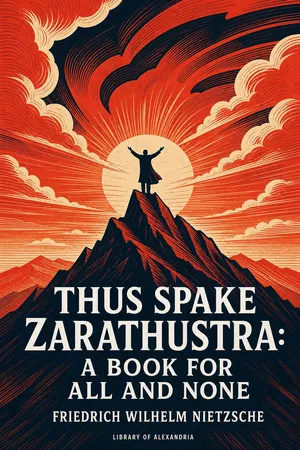
What happens when inherited beliefs no longer tell us how to live? Nietzsche turns that question into a poetic journey through the dangers and possibilities of creating our own values.
In Thus Spake Zarathustra: A Book for All and None, the solitary prophet Zarathustra leaves his mountain retreat to speak to humanity. His teachings challenge conventional morality, religious authority, and the comfort of following the crowd. Yet this is no orderly philosophical treatise: its ideas unfold through speeches, encounters, songs, and parables, giving abstract questions the force of a personal drama.
At the heart of the work is self-overcoming-the demand to confront and transform what we have become. The Übermensch, the will to power, and eternal recurrence emerge as provocative ways of thinking about human possibility, creativity, and the affirmation of life. Nietzsche's vivid imagery and unsettling questions have helped the work endure across philosophy and literature, inviting readers to examine not just what they believe but how they choose to live.
What readers find inside:
- Zarathustra's journey - A prophet's movement between solitude and society gives the philosophical questions a human setting.
- Self-overcoming - The work explores the struggle to move beyond inherited habits and personal limitations.
- The Übermensch - Nietzsche presents a challenging ideal of humanity capable of creating new values.
- Eternal recurrence - The prospect of life repeating tests what it might mean to affirm existence.
- Poetry and parable - Symbolic transformations and forceful images make the argument as imaginative as it is confrontational.
This work will appeal to readers of classic philosophy, lovers of poetic and allegorical writing, and anyone examining the relationship between morality and personal meaning. It rewards patient reading and a willingness to wrestle with ideas rather than accept ready-made answers.
Follow Zarathustra down from the mountain and encounter a searching challenge to the values that shape a life.