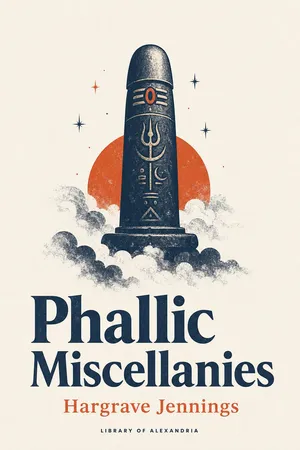
How did the power to create life become a symbol of the divine? Ancient fertility rites and sacred images open a provocative window onto the history of belief.
In Phallic Miscellanies, Hargrave Jennings examines the place of sexual and generative symbolism in religion and mythology. Drawing connections among rites, artifacts, language, and allegory, he explores how the procreative force could be understood not simply as a biological fact, but as a spiritual and cosmic principle. His subjects range across ancient cultures, including Egypt, India, and the Greco-Roman world.
This is a nineteenth-century approach to comparative religion, shaped by Jennings' interest in mysticism and esoteric interpretation. Its appeal lies both in the questions it raises about sacred imagery and in the historical perspective it preserves. Read as an interpretation rather than a statement of present-day scholarly consensus, the work invites readers to consider how symbols acquire religious meaning-and how later observers seek patterns across different traditions.
What readers find inside:
- Fertility and creation - Generative power becomes a lens for examining ancient ideas about life and the divine.
- Sacred sexuality - Jennings considers the relationship between bodily experience and spiritual belief.
- Cross-cultural comparisons - Religious imagery and practices from different societies are brought into conversation.
- Myth and allegory - Stories, language, and sacred representations are examined for their symbolic meanings.
- Esoteric interpretation - The study reveals a nineteenth-century search for shared principles beneath diverse religious forms.
For readers of comparative mythology, the history of religion, and esoteric thought, this work offers an opportunity to explore an enduring subject through the distinctive assumptions and interests of an earlier age.
Begin an inquiry into the symbols through which humanity has imagined creation, renewal, and sacred power.