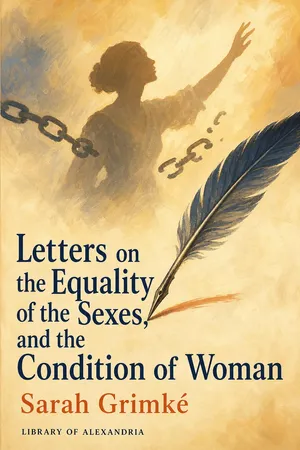
Who has the right to decide what women may learn, say, or become? Sarah Grimké confronts the beliefs and institutions that made subordination seem natural.
Published in 1838, Letters on the Equality of the Sexes, and the Condition of Woman presents an early American argument for women's equal moral standing and intellectual capacities. Writing in letter form, Grimké examines biblical interpretation, education, marriage, and the laws and customs that restrict women's lives. She challenges not only particular injustices but also the assumption that men are entitled to determine women's duties.
Grimké's work grew from a world in which women's public speech could itself provoke condemnation. As an abolitionist and advocate for women's rights, she brought questions of conscience and moral responsibility into direct conflict with established authority. Her letters remain compelling because they ask readers to distinguish religious conviction from inherited prejudice, and genuine moral obligation from obedience to social expectations.
What readers find inside:
- Religious arguments - Grimké disputes interpretations of scripture used to justify female inferiority.
- Education and opportunity - The letters examine how restricted learning and narrow expectations limit women's possibilities.
- Marriage and law - Grimké considers the unequal power embedded in domestic life and legal institutions.
- Moral independence - She argues that women must answer to conscience rather than accept a subordinate role assigned by men.
- Reform in America - Her writing connects the struggle against slavery with the emerging demand for women's rights.
This work will appeal to readers of feminist philosophy, students of American reform movements, and anyone interested in the relationship between religion and social change.
Begin these letters to encounter a searching challenge to inequality at the roots of American feminist thought.