- 242 pages
- English
- ePUB (mobile friendly)
- Available on iOS & Android
eBook - ePub
About this book
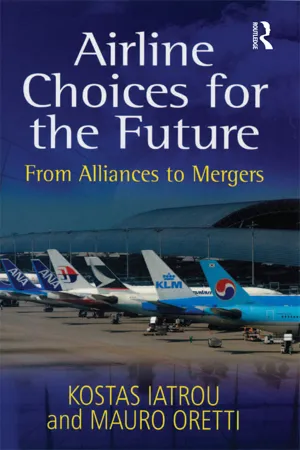
Airline Choices for the Future: From Alliances to Mergers offers an up-to-date assessment of the industry as it stands today, delivering a comprehensive insight into how the world of airline alliances is changing, and how the merger phenomenon is likely to fit into the new scenario. The purpose of this book is twofold. Firstly, it outlines the evolution and the reasons behind alliances between international air carriers, the alliances' track records and the way they have affected airlines and the air transport industry. Secondly, drawing on past and more recent developments in the industry, it examines the experiences airlines involved in cross-border mergers have gone through and the advantages and difficulties they have come across. Alliances and mergers are presented from both the airline and the consumer perspective. The book provides a balanced account of where mergers and alliances have taken the industry to date, bridging the gap between merger theory and implemented practices and strategies. It also identifies the challenges alliances and cross-border mergers have faced and highlights the key forces affecting airline development. Theoretical evidence is supplemented by data collected via surveys and interviews with airline executives, aviation experts, consultants and regulatory bodies.
Information
Chapter 1
Once Rivals, Now Partners: Why?
Since the 1980s the international airline business, an inherently global industry, has been a mixture of competition and collaboration, with virtually every major international airline regularly forming cooperative agreements with other airlines.
These agreements have in essence been a response by airlines to two external stimuli: globalisation and liberalisation/deregulation. The two phenomena have radically changed the air transport market and the rules it follows, generally upsetting the status quo. Airlines have had to develop innovative strategies to adapt to market change, growth and the demands of competition. They have met these challenges with the help of alliances.
The advent of globalisation forced the air transport sector, like other industries, to cater for the needs of a global market, that is, to operate across national boundaries. For airlines this meant offering convenient service to virtually every destination in the world, at a price passengers were willing to pay and with costs sufficiently below that price to be able to make a profit. But unlike other service industries, air transport is a capital and labour-intensive business which is dependent on technology and subject to high operating costs that lie mainly beyond the airlines’ control, a prime example being the price of fuel. A business in which fixed costs have a higher incidence than in other trades. The resources required to build an extensive network are enormous, so that cooperative agreements with competitors offering complementary services remain the best available way to deliver a worldwide network quickly, safely and inexpensively and to access new markets. At the same time, the air transport industry is by its very nature more cyclical than most industries, which means it is extremely vulnerable to the instabilities and uncertainties of the international economy. Because the growth in demand for air transport is proportional to growth in GDP, the sector is substantially affected by any change in the global economy. In times of recession, when demand decreases, potential customers become more price sensitive, while economic upturns make customers more service sensitive. This means that the competitive environment encourages different qualities in airlines during an economic upswing. In the age of globalisation the world’s airlines are therefore under added pressure to offer both seamless global service and the flexibility and readiness to adapt quickly to the economic environment and changing customer needs. Alliances, which have fundamentally changed the structure of the industry, have enabled airlines to cope with the inherent instability of the sector and reap as many benefits as possible.
Domestic deregulation and regional liberalisation were launched because both governments and the industry itself were convinced that with fewer regulations and more open domestic and international aviation markets, the enhanced economic development, consumer welfare and competition that followed would improve the way such markets operated. This in turn would lead to even greater competitiveness and therefore higher productivity, more efficiency and lower prices overall.
Airlines, like other firms in other sectors, have resorted to alliances because an alliance is a flexible organisational form offering rapid growth potential. It is the modern engine for growth, and for airlines growth takes the form of increased network coverage and entrance to new markets. Because of the peculiarities of the air transport industry and the regulatory framework governing it, which strictly prohibits cross-border mergers, alliances represented the only business arrangement that would allow airlines from different countries to serve the global market together.
Airline Alliance Definition
Attempts have been made by regulatory authorities and in air transport industry literature to define just what exactly an airline alliance is and to pinpoint the features which transform the nature of competition. In the Glossary of ‘most commonly used air passenger terms’, included in IATA’s ‘Recommended practice 1008’, the following definition is provided:
Three or more airlines participating in commercial relationship or joint venture, where i) a joint and commonly identifiable product is marketed under a single commercial name or brand; and ii) this commercial name or brand is promoted to the public through the airlines participating in the alliance and its agents; and iii) the commercial name or brand is used to identify the alliance services at airports and other service delivery points in situations where bilateral agreements exist, for example code share agreements.
By contrast, ICAO does not offer any formal definition of alliances because, as its Air Transport Director put it, ‘the nature and scope of alliances vary so widely’.
Reference material on airline alliances abounds in definitions. According to one such definition:
A strategic airline alliance is a long term partnership of two or more firms who attempt to enhance advantages collectively vis-à-vis their competitors by sharing scarce resources including brand assets and market access capability, enhancing service quality, and thereby improving profitability (…) A strategic alliance is one involving strategic commitment by top management to link up a substantial part of their respective route networks as well as collaborating on some key areas of airline business (Oum et al., 2000).
Another definition focuses mainly on commercial and operational cooperation and states that an airline alliance is formed when two or more airlines agree to cooperate in a number of fields such as scheduling, marketing, purchasing, administration, maintenance and frequent flyer programmes (PricewaterhouseCoopers, 1998).
The definition used in research carried out by the Institute of Air Transport focuses mainly on the global nature of alliances. This description states that the essential characteristics of alliances are global ambition, that is the aim to grow in the world market; their multinational aspects and the linking of intercontinental routes. In many cases, alliances have evolved around already existing cooperating airline pairs, as in the case of the Star Alliance, which unites Lufthansa-United Airlines and Lufthansa-SAS (Naveau, 2001).
Finally, the European Competition Authorities (ECA) define alliances as cooperation agreements by which airlines integrate their networks and services and operate as though they were a single entity (but without the implied irreversibility of a concentration) while retaining their separate corporate identities and control.
All these definitions stress the multinational character of alliances – a logical consequence of the need of many partners in order to achieve global coverage – the linking of networks and the fact that the partners, or allies, maintain their independence. Alliances among carriers are focused around the size and shape of their combined web of routes, in an effort to create the largest network possible and thereby be as efficient as possible in a global marketplace.
Alliances can be classified into two types: complementary and parallel. Complementary alliances refer to alliances where firms link up their networks to feed traffic to one other. In parallel alliances, firms have overlapping, competing routes before the alliance. Most alliances have aspects of both but can be characterised as predominantly complementary or predominantly parallel.
Reasons Leading to the Formation of Airline Alliances
The propelling forces behind alliances have been the need to acquire global access, provide customers with global coverage and service the global village.
The winner is the alliance that can get its passengers to the most destinations in the most ways (Airline Business, 2002).
The prime objective for any airline wishing to become a global player is to expand the geographic scope of its network without undertaking sizeable capital investment. A survey by the Association for Corporate Growth (2000) indicated that 67% of the sampled US and European airlines recorded global reach as a prime reason for forming alliances (Alamdari, 2001). The allied airlines participating in another survey, in 2004, agreed that the aim of an alliance was the creation of a global network serving many destinations without incurring extra cost for the airlines involved. Or, in their own words, alliances ‘satisfy customer demand with more global demands’ and achieve ‘global presence without global cost structure’ (Iatrou, 2004).
Growth in the 1990s meant that airlines were expected to access new transatlantic and transpacific markets, thus they needed to start building an international route structure. Even mega-carriers cannot achieve access to all destinations solely on their own steam; entering new markets would not only be too expensive, time-consuming and risky to attempt with their own aircraft, but would also be hampered by bilateral aviation agreements with other nations. In order to set up efficient global networks, therefore, partners were needed, and international marketing agreements seemed the perfect way to kill two birds with one stone. By connecting their respective networks, alliance partners were able to expand their routes beyond their respective territories, access new markets and provide optimal customer services, all without any new financial investment. This linking of networks has produced increased traffic volumes and revenues as well as improved service levels via the introduction of ‘seamless’ travel initiatives – all of which have helped the allied airlines improve their efficiency and reduce costs.
This has been positive, but several other benefits and competitive advantages may also be accrued from larger networks and better geographical spread. Through the development of a joint network, alliances enable airlines to stimulate new traffic and save on costs, in addition to generating strategic advantages and securing long-term growth potential and market orientated, cost efficient operations. But the need for standardisation and new systems to provide better service, the need to share costs and risks, the need to create the critical mass necessary to enable airlines to strike better deals with their suppliers, and even the need to enhance knowledge, have all come into play. Below are just some of the factors which have helped convince airlines to form alliances:
• By successfully linking the members’ networks, alliances secure additional traffic as each partner feeds traffic to the other and more passengers fill the respective airplanes, thereby increasing load factor and revenues. By increasing the number of frequencies or destinations served, each partner is likely to attract more passengers to the network, and this without actually increasing its own aircraft deployment. This effect is multiplied in terms of traffic volume and market access, in much the same way as when an airline adds a new destination to its hub-and-spoke structure. Network expansion and mutual traffic feed allow partners to make more efficient use of capacity and achieve higher traffic density, which very simply means that by increasing frequencies and using larger aircraft on a route, they can reduce unit costs. In other words, economies of traffic density are achieved by securing more traffic per unit of capital. This in turn is reflected in the improved productivity of the fleet and other assets, achieved also through the use of larger, more efficient aircraft.
• Alliances allow partners to increase their efficiency, improving their use of capacity or reducing expenses by weeding out redundant operations and cutting back on fixed costs. By coordinating schedules and aircraft, partners can reduce their fleet requirements or take more effective advantage of the capacity available, as having a larger aircraft fleet makes it easier to match the aircraft size with the demand of a specific route. Shared or consolidated use of airport facilities and ground handling arrangements and staff (alliance partners often use the same ground handler at each of the alliance’s hubs), cooperative advertising and promotional campaigns, joint procurement of fuel and amenities, combined development of computer systems and software, and mutual handling of baggage transfers and passenger check-in are some of the ways alliances help foster economies of scale.
• Alliances enable carriers to enhance the marketability and quality of their services to passengers by offering more convenient flight schedules, greater flight frequency, a larger network and more on-line connections. Partners in an alliance coordinate flight schedules to minimise waiting time for connecting passengers and ease connections by locating arrival and departure gates close to each other, thus offering ‘seamless travel’. All these features improve the quality of the service available to customers and may increase customer loyalty, just as Frequent Flyer Programmes (FFPs) gain in appeal when passengers are given a wider range of choices. In addition, the alliance structure facilitates common alliance ‘branding’ on a global scale.
• Alliances help to overcome regulatory constraints which hinder the ability of individual airlines to enter and expand in foreign markets, for example capacity restrictions in air service agreements, restrictions on ownership and equity holding across national borders, and restricted access to airport infrastructure. Many analysts see this as perhaps the most critical factor pushing airlines to cultivate alliance strategies (Doganis, 2001). Cross-border liberalisation has played a pivotal role in the way alliances have been developed.
• Alliances have permitted airlines to enhance their ability to exercise market power and reduce the level of competition. Airlines which previously competed on a route can decide to cooperate and thus acquire competitive advantages over their incumbent or prospective challengers. Traffic feed increases each airline’s dominance at its respective hub, creating network effects that raise entry barriers. These entry barriers include, among others, the lack of access to scarce slots in congested airports, and demand-side economies of density and scope (as airlines rarely enter a new route unless they can rely upon a meaningful presence at their hubs at the same time, coordinated contracting allows airlines the potential of increased negotiating power and better deals with fuel and service providers, for example ground handlers, travel agents, corporate accounts, etc., again offering another way to put pressure on competitors).
• Alliances have also been a way to temper the uncertainty of the operating environment, especially for smaller airlines. They have provided these airlines with a safe harbour and have helped them to deal more effectively with their major competitors in most areas of business activity.
• The flexible structure of alliances has allowed each partner to monitor its growth within the grouping, meanwhile retaining the capacity to make adjustments to its contribution or level of commitment and even to leave the alliance as a result of changes in the strategic environment.
Alliances were built around large airlines from the major air transport markets, those under greater pressure from the effects of globalisation and deregulation. The alliances of the big players are joined by smaller companies that provide regional services; these act as feeders for the large hubs and transport passengers from the hubs to the peripheral regions.
Deregulation and Alliances
While firms in other sectors have had the ‘luxury’ of being able to choose at will between mergers/consolidations, or even external growth and alliances in their effort to answer the demands of a global environment, airlines seeking to extend their networks have had to deal with a regulatory framework that dissuaded similar freedom of movement. The nationality provisions of this regulatory framework, which prevented the taking over of a foreign airline and prohibited the operation of domestic services in a foreign market, have forced airlines to resort to global alliances as a fall-back means of integrating markets and achieving growth. This means that alliances cannot be fully understood unless the wider political and regulatory context they spring from is taken into account. Section two identifies the ways in which intergovernmental agreements have affected the character and course of alliances in the air transport sector.
Alliance evolution has been influenced by and itself had an impact on the course of deregulation in many domestic markets and regional blocs, much as it has both felt the effects of and contributed towards the gradual liberalisation and relaxation of the international air transport industry. Together, intergovernmental agreements and inter-firm strategies have created a new environment that is offering new opportunities and challenges.
Regulatory Developments
The Chicago Regime and ASAs
Since 1944, the air transport industry has been governed by the Chicago Convention rules, which has meant that only those airlines designated in the bilateral agreements (‘Air Service Agreements’ – ASAs) between two countries have been granted transport licenses and traffic rights on specific routes at specific frequencies and capacities. For an airline to be designated it has to be ‘substantially owned and effectively controlled by nationals’ of each of the countries concerned. This nationality clause is further reinforced by the limits set by each country on foreign investments in their airlines (for example the ceiling is 24.5% in the US and 49.9% in Europe). Any attempt to merge or consolidate would mean that such rights would be lost or have to be renegotiated.
The most fundamental matter the rules regulate is whether or not countries authorise other countries’ aircraft in their airspace, when and where such aircraft are allowed to land and between which points they may carry revenue traffic. The routes that may be flown are listed in a route schedule, which in some cases lists the specific pairs that may be operated and in others simply provides that airlines may operate to any point in the state territory, from or to any foreign point. There are restrictions on the number of airlines from each side that may operate the routes. Up until the 1970s most agreements only allowed one airline from each side to operate each route (single designation). Some bilateral agreements allow routes to be flown by two carriers from each side (double designation), while liberal agreements permit operations by an unlimited number of carriers (multiple designation). A 1982 report indicated that two-thirds of European bilateral agreements had no limitations on the number of airlines designated, with one-third restricted to single designation. In practice, however, only 8% of total country-pairs and only 2% of city-pairs operated had more than one designated airline from each state.
The so-called Chicago regime led to the almost universal protection of national flag carriers. For many years, the bilateral ASAs allowed comfortable duopolies between the respective state airlines of contracting states, even allowing the pooling of revenues on shared routes.
But the worldwide and cross-industry tide of globalisation was to influence the air transport industry too. The most important developments to help ease the restrictive nature of the industry were deregulation in the US and liberalisation in Europe.
Domestic Deregulation
Deregulation started at national level within several countries, with the USA leading the way, followed by Canada, Australia, Japan, Taiwan, South Korea and the United Kingdom. Influenced by the wave of liberalisation, the governments of all these nations allowed the emergence of new domestic and/or international airlines able to compete directly with their established national carriers.
Domestic deregulation was a catalyst in the international liberalisation movement as well as in the wider air transport industry. More specifically, the significance of domestic deregulation in the US – the largest domestic air transport market1 – lay in the fact that it led to the restructuring of the domestic airline business and to the American desire to implement an international open skies policy, which would subsequently affect how alliances took shape. It would also radically change the structure of air transport with the introduction of the hub-and-spoke system, an innovation in both industrial and technological terms, and with the establishment of low-cost carriers. These two features alone changed the air transport scenario forever. The concept of low-cost carriers was soon to spread to Europe, where it rapidly began to threaten the dominance o...
Table of contents
- Cover Page
- Dedication
- Title Page
- Copyright Page
- Contents
- List of Figures
- List of Tables
- Foreword
- Preface
- Acknowledgements
- List of Abbreviations
- 1 Once Rivals, Now Partners: Why?
- 2 Learning from the Past, Looking at the Present: First the Facts
- 3 Once Rivals, Now Partners: How?
- 4 Landed or Stranded – Are Alliance Customers Happy?
- 5 Allied and Profitable, or Miserably Entangled?
- 6 Learning from the Past, Looking at the Future: Success Stories
- 7 Not Always a Happy Ending
- 8 ‘The road not taken’: Further Along the Alliance or the Merger Path?
- References
- Index
Trusted by 375,005 students
Access to over 1.5 million titles for a fair monthly price.
Study more efficiently using our study tools.
Frequently asked questions
Yes, you can cancel anytime from the Subscription tab in your account settings on the Perlego website. Your subscription will stay active until the end of your current billing period. Learn how to cancel your subscription
No, books cannot be downloaded as external files, such as PDFs, for use outside of Perlego. However, you can download books within the Perlego app for offline reading on mobile or tablet. Learn how to download books offline
We are an online textbook subscription service, where you can get access to an entire online library for less than the price of a single book per month. With over 1.5 million books across 990+ topics, we’ve got you covered! Learn about our mission
Look out for the read-aloud symbol on your next book to see if you can listen to it. The read-aloud tool reads text aloud for you, highlighting the text as it is being read. You can pause it, speed it up and slow it down. Learn more about Read Aloud
Yes! You can use the Perlego app on both iOS and Android devices to read anytime, anywhere — even offline. Perfect for commutes or when you’re on the go.
Please note we cannot support devices running on iOS 13 and Android 7 or earlier. Learn more about using the app
Please note we cannot support devices running on iOS 13 and Android 7 or earlier. Learn more about using the app
Yes, you can access Airline Choices for the Future by Kostas Iatrou,Mauro Oretti in PDF and/or ePUB format, as well as other popular books in Politics & International Relations & Business General. We have over 1.5 million books available in our catalogue for you to explore.