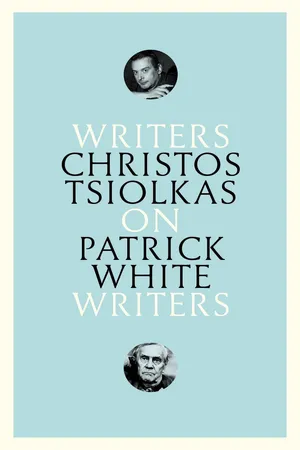
'Patrick White, the un-Australian writer who did more than any other writer in the twentieth century to create an imaginative language that we can call Australian, who unshackled us from the demand that we write as the English do, who recognised, through his own alienation and also through his profound love for his partner, that we were a migrant and mongrel nation forging our own culture and our own language.' Christos Tsiolkas spent a year of 'discovery and rediscovery' reading Patrick White. In this passionate and original book, he shows how the Nobel Prize winner's work still speaks to us.In the Writers on Writers series, leading writers reflect on another Australian writer who has inspired and fascinated them. Provocative and crisp, these books start a fresh conversation between past and present, shed new light on the craft of writing, and introduce some intriguing and talented authors and their work. Also in the Writers on Writers series Alice Pung on John Marsden
Erik Jensen on Kate Jennings
Ceridwen Dovey on J. M. Coetzee (forthcoming)
Nam Le on David Malouf (forthcoming)
Michelle de Kretser on Shirley Hazzard (forthcoming)
- 112 pages
- English
- ePUB (mobile friendly)
- Available on iOS & Android
eBook - ePub
About this book
Information
SMYRNA
When I read David Marr’s commanding biography, Patrick White: A Life, the storyteller in me was delighted to find that the young Patrick had been shipped to Cheltenham College in England as a youth, and that there he had experienced an exile from home and family that marked his character and his writing throughout his life. Marr eloquently describes the alienation the young boy felt upon being wrenched from his privileged and cocooned upbringing in rural New South Wales and bourgeois Sydney, to find himself suddenly a colonial misfit in one of the elite centres of English life.
I found myself in Cheltenham over seventy years later, and while there said to a friend, My God, this is one of the whitest places I’ve ever been. Something of the strangeness I felt in Cheltenham, the sense of being an outsider, made sense to me when I read Marr’s account of White’s experience as a schoolboy. This is precisely where the storyteller in me gets excited.
Of course, life isn’t fiction and it would be reckless to presume that the confusions and emotions the young Patrick White experienced as a transplanted colonial in Cheltenham eighty or more years ago were identical to the discombobulating anxiety I experienced as an Australian writer visiting the UK in the early twenty-first century. For one, White came from a line of wealthy Australian landholders and was born into a family that proudly asserted its British origins. I was born to peasant Greek immigrants whose migration to Australia made our family very much part of the working class. Nevertheless, despite these differences of time, history and cultural roots, there is something in White’s attraction to, and resentment of, his colonial status that links him to me.
White railed against the parochialism and mean-spiritedness of Australian culture all his life and this antagonism is a constant presence in his writing. It lends his wonderful autobiography, Flaws in the Glass, some of its most vivid imagery. And a fractious desire – fractious because never fulfilled, never finally consummated – to leave Australia and make Europe his permanent home is part of the life that Marr surveyed and also a recurrent desire of the characters in White’s novels. In fiction he could satisfy that longing: in both the early work, The Aunt’s Story, and in the late masterpiece, The Twyborn Affair, main characters can make that great divorce.
But White himself remained in Australia till the end of his life. That in itself is an important biographical element that I think informs how we understand his work. The flight of mid-twentieth-century writers from Australia in order to consolidate their identities and their careers was so commonplace as to be unremarkable – so much so that we had a name for the sense of inferiority involved: “cultural cringe”. Randolph Stow and Christina Stead, two other writers of comparable ability, had to leave their home country to continue writing. And a later generation that includes Robert Hughes, Germaine Greer and Clive James also had to make that particular migration. I think one thing that marks White’s writing and makes it different from the work of these other writers is that the Australia that emerges across his work is not static. This country, in all its beauty and ugliness, in all its meanness and potential, is a perpetual character in his novels. It changes and grows, it keeps repeating the same mistakes, and yet it can surprise us. This is one of the things I adore about the man’s work. There isn’t a whiff of nostalgia for Australia in his writing.
David Marr’s biography and Flaws in the Glass are such definitive works on Patrick White’s life and imagination that we might believe there to be no further call for biographical excavation, that they provide all the illumination we need. But I want to offer another work as also pivotal to our understanding of White. This is a lesser-known book by the critic and academic Vrasidas Karalis, his Recollections of Mr Manoly Lascaris. Published in 2008 and based on a series of interviews Karalis conducted with Lascaris, Patrick White’s long-term partner, the book is of interest not only for the insights it provides into White and his relationship with Lascaris, but also as an honest reflection by Karalis on the existential impermanence of the migrant experience.
The Lascaris who emerges from these conversations scuttles the romantic and clichéd sense of him as immigrant and refugee that I had been carrying around in my head for years. Of course, there is political and historical tragedy in his biography, specifically the almost complete purge of the Greek, Armenian and Jewish communities in Anatolia after the creation of the modern Turkish state in the early 1920s. Lascaris’s family, who lived in the Ottoman city of Smyrna (now Izmir), had to flee the city and were scattered, as were hundreds of thousands of other refugees, across Europe, Egypt, Canada and the USA. But Lascaris is clear in wishing to distinguish his own family’s experience from that of peasant and working-class Anatolian refugees.
As they converse, the older man admonishes the younger for “proletarian” and “vulgar” expressions. The use of that specifically Marxist term “proletarian” is telling, as if Lascaris wishes to place himself outside the familiar sociopolitical understanding of migration. His isn’t the confession of a “wog”, he seems to be implying, and in so doing he marks a gulf between his own experience and that of the overwhelming majority of Greek immigrants. Lascaris is proud of his family’s connection to the royal court of ancient Byzantium; he is, whatever the realities of his bank account, always an aristocrat.
Hearing Lascaris’s voice in his interviews with Karalis, I am granted insight into a very different perception to that of the Greek emigrants I grew up among, where the dominant narratives spoke of grinding rural poverty and limited education, experiences that owed nothing to and had no relationship with cosmopolitan, urban centres. I think it is in understanding that difference that I gleaned how much White and Lascaris shared in their comprehension of exile. One Australian and the other Anatolian, they were both upper-class men who owed allegiance to an idea of Empire. In fact, that’s how they met – both fighting in a world war wearing British uniforms. But that allegiance was also challenged, and therefore in part resented, because the very notion of Empire was collapsing, and the Britain they belonged to either condescended to them or no longer wanted them. This alienation from Empire they also shared.
The one thread that connects Lascaris to the Greece I know from my family history, and one of the great gifts Manoly bestowed on his lover, is the religion of Greek Orthodoxy. From his interviews, it becomes clear that Lascaris’s devout faith cannot be divorced from his pride in the history of the religion. Faith is both belief and blood. For the Greeks living in Anatolia and the Middle East, it was their religion, even more than their language, that set them apart from their neighbours. But if that was all religion meant to Lascaris, it would not have had the impact it did on White as a writer.
Greek Orthodoxy’s history, separated by schism and Empire from Western Europe, surviving for half a millennium in a largely Muslim world, is characterised by mysteries that exhort the unknowability of God. Cleaved from earthly power with the conquest of Constantinople by the Ottomans, Orthodoxy is marked by a fatalism that separates it from both Catholicism and Protestantism. Orthodoxy’s lore reifies the seer, the hermit and the seeker, those who abandon earthly pleasures to find God’s immanence in the natural world. Orthodoxy eschews the intellectual quest for God.
It’s not faith that Patrick White takes from Orthodoxy, but a sensibility, one that allowed him to return to Australia and see the landscape in a way he could not before his relationship with Manoly. The seer, the hermit and the seeker will become central to his work, and the spirituality in his novels will not arise from characters pondering the existence or non-existence of a deity, but from encountering the Godhead in the violences and ecstasies of the natural world. It’s this sensibility that connects White’s writing, for me, to the great Russian writers. It is this supreme gift that I think Lascaris gave him.
I suspect an intervention is necessary here, that I may need to defend myself against the accusation that it is my own Greek heritage that steers me towards Lascaris and his influence on White. This is true, undoubtedly. But I ask you to trust that what I am trying to get at is a transformation in White’s writing that is linked to his falling in love with Manoly Lascaris – that by falling in love and pledging a commitment to a life together, White took on an understanding of exile and of spirituality that was bestowed on him by his lover.
Of course, White’s feelin...
Table of contents
- Cover Page
- Title Page
- Copyright
- Dedication
- Contents
- A Question
- Smyrna
- Sarsaparilla
- Sydney
- Returning Home
- Works by Patrick White
- Back Cover
Trusted by 375,005 students
Access to over 1.5 million titles for a fair monthly price.
Study more efficiently using our study tools.
Frequently asked questions
Yes, you can cancel anytime from the Subscription tab in your account settings on the Perlego website. Your subscription will stay active until the end of your current billing period. Learn how to cancel your subscription
No, books cannot be downloaded as external files, such as PDFs, for use outside of Perlego. However, you can download books within the Perlego app for offline reading on mobile or tablet. Learn how to download books offline
Perlego offers two plans: Essential and Complete
- Essential is ideal for learners and professionals who enjoy exploring a wide range of subjects. Access the Essential Library with 800,000+ trusted titles and best-sellers across business, personal growth, and the humanities. Includes unlimited reading time and Standard Read Aloud voice.
- Complete: Perfect for advanced learners and researchers needing full, unrestricted access. Unlock 1.5M+ books across hundreds of subjects, including academic and specialized titles. The Complete Plan also includes advanced features like Premium Read Aloud and Research Assistant.
We are an online textbook subscription service, where you can get access to an entire online library for less than the price of a single book per month. With over 1.5 million books across 990+ topics, we’ve got you covered! Learn about our mission
Look out for the read-aloud symbol on your next book to see if you can listen to it. The read-aloud tool reads text aloud for you, highlighting the text as it is being read. You can pause it, speed it up and slow it down. Learn more about Read Aloud
Yes! You can use the Perlego app on both iOS and Android devices to read anytime, anywhere — even offline. Perfect for commutes or when you’re on the go.
Please note we cannot support devices running on iOS 13 and Android 7 or earlier. Learn more about using the app
Please note we cannot support devices running on iOS 13 and Android 7 or earlier. Learn more about using the app
Yes, you can access On Patrick White by Christos Tsiolkas in PDF and/or ePUB format, as well as other popular books in Literature & Literary Biographies. We have over 1.5 million books available in our catalogue for you to explore.