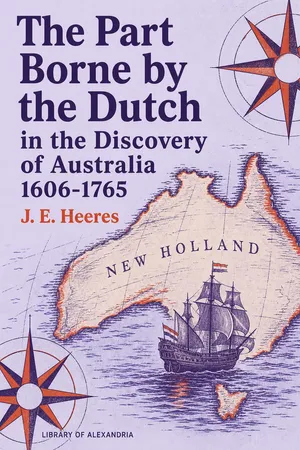
Before Cook, Dutch mariners were charting Australia's coasts-and changing Europe's understanding of the southern world.
In The Part Borne by the Dutch in the Discovery of Australia 1606-1765, historian J. E. Heeres examines the voyages that brought stretches of the Australian continent into European geographical knowledge. Drawing on archival records, ships' logs, maps, and correspondence, he traces the contributions of navigators whose journeys combined commercial ambitions with the hazards of unfamiliar waters.
The Dutch East India Company's trading network forms the background to this history of exploration. Voyages associated with Dirk Hartog and Abel Tasman belong to a larger story of coastal encounters, uncertain geography, and knowledge accumulated across generations. Heeres places these journeys within their historical setting, showing how trade routes and maritime experience helped shape the European mapping of Australia. His subject is European exploration of a continent already inhabited by Indigenous peoples, not the beginning of its human history.
What readers find inside:
- Early voyages - Dutch expeditions reveal the long history of European coastal exploration before British colonization.
- Navigation and risk - Unfamiliar coastlines and dangerous seas test the ambitions of mariners and their sponsors.
- Commerce and exploration - The Dutch East India Company's interests connect oceanic travel with the search for geographical knowledge.
- Changing maps - Reports from successive journeys gradually alter European ideas about the Australian continent.
- Historical evidence - Written records and cartographic sources underpin Heeres's account of Dutch contributions.
This work will appeal to readers of Australian history, maritime exploration, and the history of maps. It offers a focused way to look beyond familiar British-centered narratives and consider the voyages that preceded them.
Follow the Dutch navigators into the uncertain waters of Australia's early European maritime history.