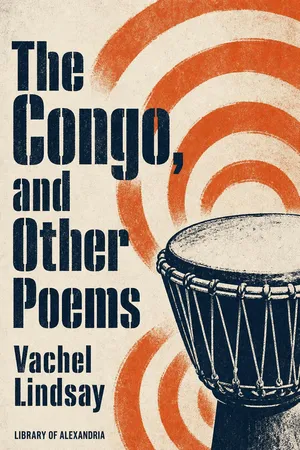
Poetry that asks to be heard, not merely read. Vachel Lindsay brings the pulse of chant, song, and public performance to the printed page.
In The Congo, and Other Poems, musical cadences and theatrical voices carry visions of American life, religion, and culture. Lindsay treats verse as a public art: something that can move an audience through sound as well as meaning. His experiments make reading aloud a way of discovering how repetition, pace, and changes of tone shape a poem's force.
The collection's famous title poem joins rhythmic invention to racial imagery that demands critical attention. Its stereotypes and imagined Africa reveal the prejudices within Lindsay's cultural vision, even as its sound shows his ambition for performed verse. Elsewhere, The Santa Fe Trail brings automobiles and Americana into poetry, while General William Booth Enters Into Heaven transforms the Salvation Army founder into the center of an exuberant religious vision. Together, these works offer an encounter with both the creative possibilities and the troubling assumptions of early twentieth-century American culture.
What readers find inside:
- Verse for the voice - Chant, repetition, and musical phrasing turn sound into an essential part of meaning.
- A controversial centerpiece - The title poem invites scrutiny of the relationship between formal innovation and racial stereotyping.
- Modern Americana - The Santa Fe Trail brings the movement and noise of automobiles into a changing national landscape.
- Religious imagination - General William Booth Enters Into Heaven combines spiritual fervor with a dramatic sense of procession.
- Public poetry - Satire and social commentary connect the poet's theatrical methods to questions of shared cultural life.
This collection will interest readers of American poetry, lovers of verse read aloud, and students exploring the tensions between literary experiment and historical prejudice.
Begin reading and discover what happens when a poem becomes a performance.