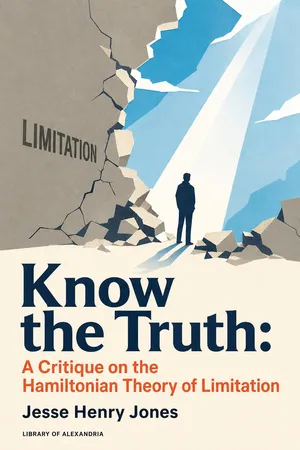
Is the infinite beyond human understanding-or have philosophers drawn the boundaries of knowledge too narrowly?
In Know the Truth: A Critique on the Hamiltonian Theory of Limitation, Jesse Henry Jones disputes Sir William Hamilton's influential account of the limits of human thought. Hamilton held that knowledge is confined to the conditioned and finite. Jones challenges that restriction, defending the mind's capacity to pursue knowledge beyond the boundaries Hamilton assigns it.
This nineteenth-century work brings metaphysics and epistemology into direct conversation with questions of religious faith. If reason cannot know the unconditioned, what follows for our understanding of ultimate reality? Through definitions, examples, and sustained argument, Jones examines the assumptions behind philosophical limitation rather than accepting them as settled. Its lasting interest lies in a question that remains urgent: how can we distinguish a genuine limit of understanding from a limit imposed by a theory?
What readers find inside:
- A direct philosophical challenge - Jones confronts Hamilton's claim that human knowledge is restricted to the finite and conditioned.
- The problem of the infinite - The argument considers whether what exceeds finite experience must also exceed the reach of thought.
- A defense of reason - Jones resists accounts that place fixed restrictions on the intellect's pursuit of ultimate reality.
- Faith and knowledge - The work explores philosophical questions with consequences for the relationship between rational inquiry and religious belief.
- Careful conceptual analysis - Definitions and logical distinctions shape the critique of what it means to know and understand.
For readers of metaphysics, students of the history of philosophy, and anyone interested in the meeting of reason and faith, this work offers an encounter with a searching nineteenth-century debate.
Begin with Jones's challenge and reconsider where the boundaries of human understanding belong.