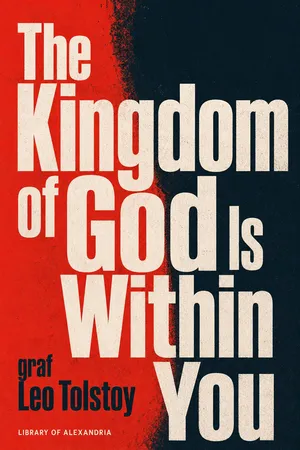
What happens when the demands of conscience collide with the commands of church and state? Tolstoy argues that a life grounded in love cannot accept violence as its foundation.
In The Kingdom of God Is Within You, Leo Tolstoy turns to the teachings of Jesus, especially the Sermon on the Mount, to make a searching case for nonresistance to evil by force. He challenges the assumption that war, punishment, and coercion can be reconciled with Christian love, and questions religious institutions that lend moral authority to state violence.
This landmark work of Christian anarchism places personal responsibility at the center of spiritual life. Rather than allowing institutions or social custom to settle moral questions, Tolstoy asks each person to examine the gap between professed beliefs and daily conduct. His argument helped shape Gandhi's thinking about nonviolence and continues to speak to debates about obedience, military service, and the limits of political power. Its force lies in a difficult question: can peace begin while individuals continue to justify violence?
What readers find inside:
- Christian nonviolence - Jesus' teachings become the basis for a rejection of violence, even when sanctioned by authority.
- Conscience and obedience - Tolstoy examines the individual's responsibility when public duties conflict with moral conviction.
- Church and state - His critique exposes the tension between religious professions of love and institutional support for coercion.
- War and military service - The argument challenges the moral assumptions that sustain armies and organized killing.
- Belief put into practice - Spiritual commitment is measured through conduct rather than doctrine or outward observance alone.
For readers of Christian ethics, students of nonviolent resistance, and anyone wrestling with the claims of conscience, this is a challenging encounter with an uncompromising moral vision.
Begin reading and consider what it would mean to make love, rather than force, the rule of daily life.