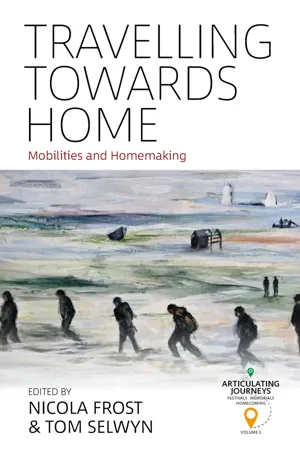
As we grapple with a growing refugee crisis, a hardening of anti-immigration sentiment, and deepening communal segregation in many parts of the developed world, questions of the nature of home and homemaking are increasingly critical. This collection brings ethnographic insight into the practices of homemaking, exploring a diverse range of contexts ranging from economic migrants to new Chinese industrial cities, Jewish returnees from Israel to Ukraine, and young gay South Asians in London. While negotiating widely varying social-political contexts, these studies suggest an unavoidably multiple understanding of home, while provoking new understandings of the material and symbolic process of making oneself "at home."
Trusted by 375,005 students
Access to over 1.5 million titles for a fair monthly price.
During our fieldwork at a support group for young Asian gay men in London, a meeting took place on the topic of ‘coming out: the parent’s perspective’. Given that young gay men’s parents could often seem to embody a ‘traditional’ culture that was unable or unwilling to articulate same-sex desire and confronts expressions of gay identity with plain incomprehension, we were intrigued to see what would happen at the session. When Amir, the group leader, announced his idea for the session, it sparked off worried discussions among the young men. Would anyone bring their parents? What would the atmosphere be like? And given that the meetings were held in a building in Soho, how would they get their parents there without parading them through the heart of ‘gay London’ – Old Compton Street? Amir reassured the others that ‘we’re not going to take them through “Batty Boy” street, I don’t want my relationship with my mother to go back ten years’. He and another group member worked out a route to get the parents from the underground station to the support group venue without passing any porn shops or rowdy gay bars.
In the event, only Amir and one of the service users, Rohit, were able to bring their mothers along to the meeting. Amir’s mum arrived dressed in traditional Pakistani salwar kameez, head covered in a dupatta scarf, while Rohit’s mum presented herself with a middle-class British accent and a tightly tailored and fashionable Punjabi suit. As the group members piled into the room, the mood, normally raucous and convivial, turned formal and serious. Some of the young men stood in a quiet and deferential gaggle around Amir’s mother, whilst others maintained polite conversation with Rohit’s mother. There was also a white English woman hovering awkwardly outside the two circles; she was representing another organization that provided support to the parents of gay children.
As the group got ready to start, the young men sat in a circle on cushions. The two mothers sat on chairs at the back. Once the group settled down, Rahul, the facilitator, struck a Buddhist singing bowl to indicate that the session was about to start. He said how important it was to understand parents’ perspectives on coming out and thanked the two mothers profusely for coming. He suggested an ice-breaking game: each person was asked to introduce themselves and give the name of the first album or single they had ever bought. There were laughs at the tackiness of the first albums, with the exception of Amir’s mother’s first buy, which was the Pakistani national anthem.
The representative for the parents’ support organization introduced herself. She started by acknowledging the difficulties of having gay children. Both of her children were gay; she said she knew this when they were in their early teens and encouraged them to be open with her about their sexuality. She told the group that she understood the difficulty of having to tell other members of the family – the most common response she heard was ‘what – both of them?’. At this she laughed slightly, but there is no response from the rest of the group. The next exercise was to break off into pairs and discuss the topic of ‘what coming out means to family’. Chand was paired with a service user, Narinder, and they weren’t able to talk about the topic; Narinder was feeling too emotional. They talked about his experiences of other gay support groups, which he said were helpful but didn’t really understand him and his culture, particularly around issues of marriage. After the second topic was announced, ‘how we can help our parents’, Narinder looked more and more distressed, and quietly got up and left the room. Finally, it was time for Amir’s mother to address the group:
When I found out I was very depressed – my religion . . . back home . . . but what can I do? He is my son; I want him to be happy. I cried, I cried, I feel guilty. It was like an atom bomb; dad still loves him but doesn’t want to talk to him about this gay thing . . . [voice breaks] I did something wrong in bringing him up . . . Looking around it’s OK – you are all gorgeous boys, but inside you are hurting.
Aseem, a service member who had benefited hugely from Amir’s emotional support over his two years attending the group, said to her in a deferential voice: ‘aunty, you have done nothing wrong because Amir is so good, he has changed my life’. This comment was translated into Hindi by Rahul, but when Amir’s mum responded, Rahul fell silent. Later, Rahul explained to Chand that he had been unable to continue the translation because the sense of disappointment she conveyed about her son’s sexual orientation had brought tears to his eyes. Then it was Rohit’s mother’s turn. ‘Well, I always knew he had a feminine side ’cause he was looking at bangles more than I did’, she laughed:
After he finished school he left home and he sent an email to us saying that this is who I am and I pray to God that you can accept me. I was so hurt that he was sad – he’s my son. I didn’t have a problem with it at all, Rohit is Rohit and I will always love him. My problem though was with telling the family, I didn’t know how to say it. You know parents have to come out as well, it’s painful . . . it’s painful for us too.
After each meeting, the members would usually go to a coffee shop across the road to socialize and often onwards for a light meal and a group trip to one of the many gay clubs in Soho. It was at these times when Amir would come into his stride, buzzing around the tables checking on people, joking and making exaggerated South Asian-style head nods. This time, however, after making sure that people had had time to say a respectful goodbye to his mother, he escorted her out of the door and slipped away. Rohit and his mother hung around outside the building before the remainder of the group went on to the coffee shop.
It was a deeply affecting meeting and, by the end, many were moved to tears. Narinder told Chand that he had to leave the room for half an hour because it was too overwhelming and he just needed some time alone. Weeks later, Narinder spoke to Kaveri about how Rohit’s mother reminded him of his own. He could imagine his mum trying to engage with his ‘gayness’ in a similarly ‘cool’ and understanding way, but deeply hurting inside, and against Amir’s hopes for the session, this experience made Narinder all the more certain that he would not tell his parents and inevitably upset and disappoint them.
This meeting struck a chord with us as it illustrated with particular salience the painful emotions provoked for the young men by the question of broaching their sexual preference with their parents. At the same time, the very organizing of the session illustrated the young men’s desire to make their lives intelligible to their parents, secure their approval and to wrought into being a coherent sense of self that was free of the painful disjunctures between the constructions of same-sex desire and their families and contexts of origin.
This chapter explores ethnography and life histories with this group of gay-identified male Asian twentysomethings in London: we have retained the men’s use of the category of ‘Asian’, which in the British context refers to people of South Asian heritage. Speaking about their childhood homes, the young men talked about homes that were somehow unhomely, in which the workings of heteronormativity and respectability alienated them from their families of origin and ‘Asian culture’, which they felt was less accepting of homosexuality than mainstream British society. Their attempts to negotiate a space where they could feel ‘at home’ raise questions about our theorizings of home and homeland.
By way of introduction, we will briefly outline how seminal work in gay and lesbian studies has approached questions of home and homeland, before turning to our ethnographic material and returning to these debates in the discussion.
Home and Homeland
Alan’s Sinfield’s (1996) engagement with diaspora theory is highly suggestive for this collection. Sinfield suggests that queer experience can be thought of as a kind of reverse diaspora. Whilst the archetypical Jewish and Black diasporas invoke the idea of an originary home, exile and forced migration, the identity of queer people is constituted almost in reverse. The diasporic sense of exile experienced by queer people may in fact attach itself to aspects of the heterosexual culture of their childhood homes:
Most of us are born and/or socialized into (presumably) heterosexual families. We have to move away from them, at least to some degree; and into, if we are lucky, the culture of a minority community. ‘Home is the place you get to, not the place where you come from’ . . . Instead of dispersing, we assemble. (Sinfield 1996: 280)
In this model of dispersal-as-assembling, the estrangement from home is conceived in terms of moving into a gay or lesbian subculture that is invested with the qualities of a diasporic return. These subcultures are a ‘cultural homeland’ (Sinfield 1996: 285) for gay and lesbian people. The gay bar, Sinfield suggests, is ‘a place where he [as a gay man] is in the majority, where some of his values and assumptions run’; ‘a place of reassurance and sharing’ (1996: 287). Importantly, and illuminatingly for us here, this is a complicated journey without a fixed point of arrival. For Sinfield, home is indeterminate and perennially deferred, as queer people are ‘stuck at the moment of emergence . . . we never quite arrive’ (1996: 280).
Sinfield’s musings have been seminal in inspiring work on queer diaspora. Yet later work has been critical not only of his celebration of dispersal-as-assembling, but also, more searchingly, of the conceptualization of home that he assumes. In Anne-Marie Fortier’s (2003) subtle exploration of gay and lesbian autobiographies and memoirs, she demonstrates that the movements effected by gays and lesbians are more complicated. She breaks away from a linear concept of migration and shows that, rather than simply leaving the childhood home behind, gays and lesbians are drawn to, remain attached to and may actually return to their childhood homes, attempting to find a different way of living there. For example, in Bob Cant’s (1997) Invented Identities? Lesbians and Gays Talk about Migration, he reminisces about his childhood in a farming community in the east of Scotland:
Eventually I was able to look at the culture of normality which affirmed that ‘everyone’ lived in families and ‘everyone’ subscribed to the values of the Church of Scotland. It was a culture which made me feel like an outsider; it was only after I left that area that I realized I was not the only outsider. (Cant 1997: 7)
Similarly, in Mary Cappello’s (1998) Night Bloom, the author returns to her Italian-American upbringing and sees it as the source of her queerness, queer unshackled here from sexuality and expanding to all non-normative difference:
What I could never fail to notice about the men and women in my Italian/American family . . . was [how] the men failed miserably and with varying degrees of unhappiness in conforming to the mask of white, middle class masculinity, and the women wielded word, story, their own bodies, in ways that could never pass for demure. By Anglo-American standards, to put it crudely, the male members of my family were soft and the females were hard. Mightn’t the fraternal demolition parties that Hollywood cinema has invented for Italian/American subjectivity [as epitomized by The Godfather sequels] be indicative of precisely the fear that those dark, curly-haired, music-loving, flower-tending Italian/Americans are queer? (Cappello 1998: 96)
Fortier is drawn to explore these returns and re-memberings of childhood homes. This complicates considerably a model of queer diaspora in terms of dispersal-as-assembling. But even more provocatively, Fortier offers a critique of the conceptualization of home as emblematic of comfort, care and belonging, and opens it up to queer belongings. For inspiration she draws from Avtar Brah (1996), who writes of ‘homing desires’ in the context of migration and diaspora. Brah suggests that home is not necessarily defined by feelings of being ‘at home’, but by the longing that results from the loss of leaving home. Fortier pushes this even further and asks whether it is possible to conceive of homing desires that are already ‘engendered and lived at home’ (1996: 124).
Fortier is equally critical of Sinfield’s exposition of gay and lesbian ‘cultural homelands’ as a space of comfort, care and belonging. The concept of home is fetishized in this movement away from the familial home towards an imagined other space to be called home: ‘while the fantasy of “home” and belonging is projected onto these “imaginary homelands”, the material conditions that determine their existence are concealed’ (Fortier 2003: 119).
Whilst the autobiographies and memoirs Fortier analyses consider returns to ethnicity, in the sense of Cappello’s re-inhabitance of her Italianness, she does not explore Italy itself, as the homeland of Cappello’s immigrant parents. Gayatri Gopinath’s (2003; 2005) thoughts on nation and diaspora are useful here. Gopinath argues that the nation is inherently heternormative, depending on familial metaphors of belonging and on the family as the reproductive unit through which the stability of gender roles and hierarchies is preserved. She states that this makes the queer subject ‘impossible’, making a play here between the ‘impossibility’ of a queer subject in the sense of cultural constructions of the nation and the sense of irreconcilability felt by nonheterosexual Indians about their sexuality and national identity. She goes on to show that these formations persist in the cultural politics of the Indian diaspora. However, she also sees diaspora as generative of resistive, critical locations and positions. Examining the alternative queer sensibility that allows for the depiction of a marriage without a groom in Indian American Shyam Selvadurai’s 1994 book Funny Boy, or two sisters-in-law in bed together in Deepa Mehta’s 1996 film Fire, she writes that:
A queer diasporic logic displaces heteronormativity from the realm of natural law and instead launches its critique of hegemonic constructions of both nation and diaspora from the vantage point of an ‘impossible’ subject. (Gopinath 2003: 152)
Gopinath’s work underlines the necessity, for a queer diasporic subject, of returning to the concept of nation. The ethnographic material discussed in this chapter brings together these three bodies of work; Sinfield’s ‘reverse diaspora’ from childhood homes to the cultural homelands of queer subcultures, Fortier’s problematizing of home as a space of comfort, care and belonging, and Gopinath’s queering of national homelands. The chapter proceeds through four ethnographic sections exploring young men’s reflections on their childhood homes; queer cultural homelands; India, the homeland of their Indian immigrant parents; and finishing with a description of a queer yajna ritual aimed at bringing together a gay identity with the traditional religious domestic sphere. Finally, we will return to the theorization of home and homeland and will suggest how our ethnographic material speaks to these debates.
Childhood Homes
We start with Jaz, whose conversations with Chand offered windows onto his profound feelings of discomfort with his family and ‘community’, feelings that were echoed by other young men in the group. Jaz was twenty-four years old and studying for a Master’s degree in London. He had grown up in a working-class Asian area of Birmingham, which he referred to as a ‘ghetto’. He painted a very negative portrait that seemed to speak to many pathologized or stereotyped accounts of South Asian families, describing his parents as ‘married off by seventeen’ and stressing his parents’ lack of choice and fulfilment in their marriage. Their unhappiness with each other, he said, gave them a vicarious desire for their children to study hard, go to university and make a more satisfying future for themselves. This game plan was laid out very clearly before Jaz, yet he knew from an early stage that he would not fit his parents’ ideal. He recalled himself at the age of eight going through the free magazines at home and trying to amuse himself with the pictures of women advertising bras, but finding himself more aroused by the men’s underwear instead. He tried to suppress these early feelings, but as he explained:
From the age of eleven till about thirteen I remember going to bed every night and playing this sort of movie in my head about how it would be when I marry a woman, how the honeymoon would be, what I would do to her in bed, how I would be sexually, you know active with her. And I would, kind of try and wipe . . . to brainwash myself, kind of wipe the memories away, of my homosexuality. But then when I was thirteen I realized that you know, I can’t live a lie.
Jaz was a good-looking guy, turning up to the support group meetings with a trim indie look, a monkey hat and army coat with shoulder lapels. He was clean-shaven, with fashionably messy hair, but he had begun life with the orthodox Sikh look of long uncut hair and a patka (topknot). He played the tabla at the local gurdwara (temple) on the weekends until he left home. The incommensurability of his homosexuality with Indian culture and the Sikh religion struck him from an early age, he said. He recalled how his own reflection in the mirror, as a turbaned Sikh youth, used to unsettle him and make him consider himself an anomaly:
I had long hair until I was fifteen, that’s a constant daily reminder of my religion and who I was. Every day I was reminded when I looked in the mirror, when I touched my head, whatever whatever – who am I, this very conservative Sikh Indian boy. I didn’t know any Sikh gay guys I didn’t even heard of what was gay or men who like men, you know that doesn’t exist . . . After I found out I was gay I rejected all of that.
Growing up, Jaz felt that Indianness was incommensurable with gayness, which was substantially to do with the heterosexual life course expected of him – that after completing his education, he would get married, bring a daughter-in-law back to the family home and then have babies. He constructed a life history of progressively distancing himself from the Indian aspects of his upbringing. He said that he’d been trying to ‘run away’ from his Indian and Sikh background, ‘trying to run away from it and try to find myself’. He reflected that his Asianness felt like a kind of ‘baggage’; ‘it affected my homosexuality and my homosexuality took precedence’. He cut out his Asian friends as much as he could: ‘Completely shut off, didn’t meet them, didn’t want to meet them, didn’t come across them.’
In Jaz’s narratives we glimpse how the ‘impossibility’ of a queer Indian subject, as suggested by Gopinath (2005), is produced through the family as well as through a racialized visual field. For a queer Indian subject, there is a slippage between the family and wider co-ethnic circles, as we can see in Jaz’s developed aversion to the Indian aspects of himself, his Asian friends and, by extension, the Punjabi Sikh community in which he grew up. In her work on gay and lesbian Italians in Montreal, Fortier (1999) has explored this tendency to separate out the ethnic and gay aspects of the self and maintain these two subject positions in disju...
Table of contents
Cover
Title Page
Copyright Page
Dedication
Contents
List of Illustrations
Introduction. Home and Homemaking in a Time of Crisis
Chapter 1. Homing Desires: Queer Young Asian Men in London
Chapter 2. Homeawayness and Life-Project Building: Homemaking among Rural-Urban Migrants in China
Chapter 3. Between a Home and a Homeland: Experiences of Jewish Return Migrants in Ukraine
Chapter 4. Who Makes ‘Old England’ Home? Tourism and Migration in the English Countryside
Chapter 5. Modalities of Space, Time and Voice in Palestinian Hip-Hop Narratives
Chapter 6. My Maluku Manise: Managing Desire and Despair in the Diaspora
Chapter 7. Anecdotes of Movement and Belonging: Intertwining Strands of the Professional and the Personal
Afterword
Index
Frequently asked questions
Yes, you can cancel anytime from the Subscription tab in your account settings on the Perlego website. Your subscription will stay active until the end of your current billing period. Learn how to cancel your subscription
No, books cannot be downloaded as external files, such as PDFs, for use outside of Perlego. However, you can download books within the Perlego app for offline reading on mobile or tablet. Learn how to download books offline
Perlego offers two plans: Essential and Complete
Essential is ideal for learners and professionals who enjoy exploring a wide range of subjects. Access the Essential Library with 800,000+ trusted titles and best-sellers across business, personal growth, and the humanities. Includes unlimited reading time and Standard Read Aloud voice.
Complete: Perfect for advanced learners and researchers needing full, unrestricted access. Unlock 1.5M+ books across hundreds of subjects, including academic and specialized titles. The Complete Plan also includes advanced features like Premium Read Aloud and Research Assistant.
Both plans are available with monthly, semester, or annual billing cycles.
We are an online textbook subscription service, where you can get access to an entire online library for less than the price of a single book per month. With over 1.5 million books across 990+ topics, we’ve got you covered! Learn about our mission
Look out for the read-aloud symbol on your next book to see if you can listen to it. The read-aloud tool reads text aloud for you, highlighting the text as it is being read. You can pause it, speed it up and slow it down. Learn more about Read Aloud
Yes! You can use the Perlego app on both iOS and Android devices to read anytime, anywhere — even offline. Perfect for commutes or when you’re on the go. Please note we cannot support devices running on iOS 13 and Android 7 or earlier. Learn more about using the app
Yes, you can access Travelling towards Home by Nicola Frost, Tom Selwyn, Nicola Frost,Tom Selwyn in PDF and/or ePUB format, as well as other popular books in Social Sciences & Cultural & Social Anthropology. We have over 1.5 million books available in our catalogue for you to explore.