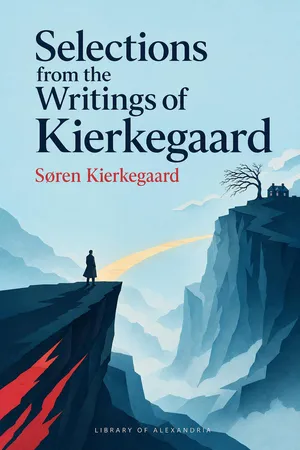
What does it cost to live by your convictions? For Søren Kierkegaard, faith and selfhood begin where comfortable certainties end.
Selections from the Writings of Kierkegaard brings together philosophical and religious writing by the Danish thinker whose searching account of individual existence helped shape existential philosophy. Drawing from works including Fear and Trembling, In Vino Veritas, Preparation for a Christian Life, and The Present Moment, the collection explores the tensions between thought and action, outward respectability and inward commitment, religious convention and lived belief.
Kierkegaard treats the individual not as an abstract idea but as a person who must choose, suffer uncertainty, and take responsibility. His reflections on subjectivity, anxiety, despair, and Christian faith resist the reassurance of belonging to the crowd. These writings have lasted because their questions remain personal: Can belief be reduced to an argument? What separates knowing how to live from actually living? And how can a person become a self rather than simply accept a role assigned by society?
What readers find inside:
- Faith and Paradox - Religious commitment tests the limits of detached reasoning and demands personal engagement.
- The Individual and the Crowd - Kierkegaard challenges conformity and the temptation to let public opinion replace conscience.
- Anxiety and Choice - The possibilities of existence bring uncertainty as well as responsibility.
- Despair and Selfhood - Reflections on inward life ask what it means to become, or fail to become, oneself.
- Christianity as Practice - The distinction between professing belief and living it gives these writings their spiritual urgency.
This collection will appeal to readers exploring existential philosophy, those interested in Christian thought, and anyone drawn to searching questions about identity and conviction. Its varied reflections offer many points of entry into a demanding and deeply personal body of thought.
Begin with a question that matters to you, and let Kierkegaard challenge the answer.