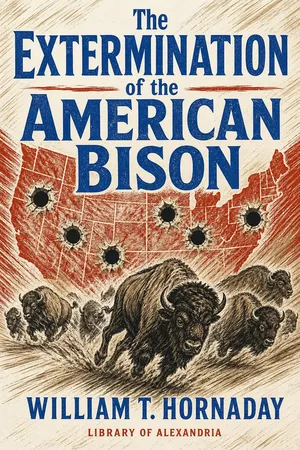
How does an animal numbering in the millions come close to disappearing? This early conservation landmark documents a catastrophe driven by human choices-and argues against accepting it as inevitable.
Published in 1889, William T. Hornaday's The Extermination of the American Bison examines the destruction of the vast herds that once ranged across North America. Drawing on scientific observation, population estimates, historical accounts, and his own field investigations, Hornaday follows the transformation of an abundant species into one facing extinction. Commercial hunting and the wasteful killing of wildlife stand at the center of his account.
The book brings together natural history, a record of nineteenth-century exploitation, and an urgent appeal for preservation. It considers the animal's place in the life of the plains and its importance to Indigenous communities, while documenting the scale and speed of its decline. Written from a nineteenth-century perspective, it remains revealing both as evidence of environmental destruction and as a forceful expression of the emerging conservation movement.
What readers find inside:
- Natural history - Observations of the species establish what was at stake beyond the loss of individual animals.
- Commercial slaughter - Accounts of hunting and destruction show how immense herds were reduced within decades.
- Evidence from the field - Population estimates and firsthand investigation give the catastrophe a concrete historical scale.
- Life on the plains - The animal's ecological and cultural importance connects wildlife loss with broader human consequences.
- A case for preservation - Hornaday challenges indifference and presses for action before the surviving animals disappear.
This book will interest readers of environmental history, students of North American wildlife, and anyone exploring the origins of conservation. Its combination of evidence and moral urgency gives present-day debates about species protection a sobering historical foundation.
Begin this account of a near-loss that still asks what people owe to the living world.