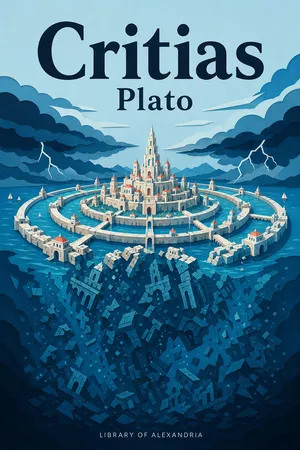
What happens when a powerful civilization loses the virtues that made it great? In Plato's account of Atlantis, extraordinary wealth and ambition meet the threat of divine judgment.
A continuation of Timaeus, Critias contrasts an idealized ancient Athens with the mighty island empire of Atlantis. Through the speaker Critias, Plato describes a land associated with Poseidon, a royal lineage, elaborate waterways, rich resources, and laws intended to preserve order. The detail gives this imagined society a striking physical presence, from its concentric rings of land and water to its temples and royal buildings.
Yet the dialogue's concern reaches beyond the shape of a legendary island. As the Atlanteans' divine inheritance weakens, their appetite for wealth and power grows, turning a portrait of prosperity into a warning about moral decline. The surviving text breaks off as Zeus prepares to address the gods, leaving the anticipated judgment unspoken. This unfinished ending has helped sustain the work's fascination, while its questions about virtue, excess, and political responsibility remain sharply relevant.
What readers find inside:
- Atlantis imagined - A richly described island empire gives lasting form to one of antiquity's most influential legends.
- Two societies - Ancient Athens and Atlantis offer contrasting pictures of civic discipline, resources, and power.
- Wealth and character - The Atlanteans' changing values expose the tension between material success and moral strength.
- Divine order - Poseidon's legacy and Zeus's impending judgment connect political life with a larger moral framework.
- An abrupt ending - The dialogue stops before Zeus's speech, leaving its final movement unresolved.
For readers of ancient Greek philosophy, lovers of the Atlantis legend, and anyone interested in the rise and decline of civilizations, Critias offers both an evocative imagined world and a searching political challenge.
Enter Atlantis and consider what a society risks when prosperity outgrows virtue.