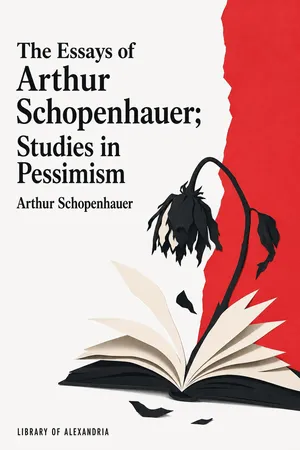
What if the pursuit of happiness keeps us dissatisfied? Schopenhauer asks readers to look beyond comforting promises and examine the desires that drive everyday life.
In Studies in Pessimism, Arthur Schopenhauer brings his unsparing intelligence to suffering, human nature, and the expectations we place on the world. These essays question the belief that pleasure, success, or progress can resolve the difficulties of existence. At their heart lies a troubling observation: desire continually renews itself, so that getting what we want seldom puts an end to wanting.
A major voice in nineteenth-century German philosophy, Schopenhauer combines argument with irony and a keen eye for self-deception. His pessimism challenges optimism not simply as a mood, but as an account of what life is like. His reflections remain provocative in a culture that urges us to achieve more, acquire more, and treat contentment as the next attainable goal. Reading him offers the chance to test those assumptions rather than accept them.
What readers find inside:
- Suffering and existence - Essays consider whether pain and disappointment are incidental troubles or fundamental conditions of human life.
- Restless desire - Schopenhauer explores the will and the dissatisfaction that accompanies continual striving.
- The limits of pleasure - His arguments question the promise that fulfilled wishes can secure lasting happiness.
- A challenge to optimism - Familiar assurances about life meet a skeptical examination of their foundations.
- Human self-deception - Biting observations expose the gap between what people hope to believe and what experience reveals.
This collection will appeal to readers of classic philosophy, those interested in the psychology of desire, and anyone drawn to searching reflections on suffering and meaning. Agreement is not required: the reward lies in encountering a thinker who makes familiar convictions harder to take for granted.
Begin these essays and put your own ideas about happiness, desire, and contentment to the test.