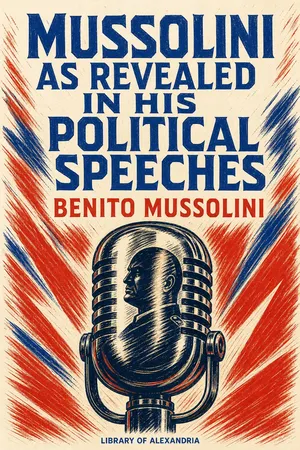
How does a movement turn anger into allegiance? These addresses expose the rhetoric through which Italian fascism claimed authority and demanded loyalty.
Mussolini as Revealed in His Political Speeches brings together public addresses by Benito Mussolini, offering direct evidence of his ideology and methods of persuasion. Against the upheavals of early twentieth-century Italy, his words connect national identity, political conflict, and the promise of renewal. They show how public speech can present coercion as resolve and make submission to a leader appear to serve a national purpose.
Read critically, the collection is a record of fascist self-presentation rather than a neutral account of events. Its interest lies both in what Mussolini argues and in how he frames those arguments: the enemies he identifies, the collective loyalties he invokes, and the authority he claims. The distance between political promises and the exercise of power makes these addresses valuable historical evidence. They remain relevant to readers asking how propaganda works and how authoritarian movements seek consent.
What readers find inside:
- Fascist ideology - Public addresses reveal the movement's claims about the nation, leadership, and political authority.
- Nationalist appeals - Mussolini invokes shared identity and national ambition to rally his listeners.
- Mass persuasion - The language draws on grievance, fear, and promises of renewal to mobilize support.
- Power and opposition - The speeches show how political conflict is framed to justify concentrated authority.
- A historical voice - Mussolini's own words provide material for examining the gap between a regime's rhetoric and its actions.
This collection will interest students of Italian history, readers studying fascism and authoritarianism, and anyone examining political rhetoric as a force in public life. It rewards a questioning approach to both its arguments and its silences.
Begin reading to examine the language of fascist power at its source.